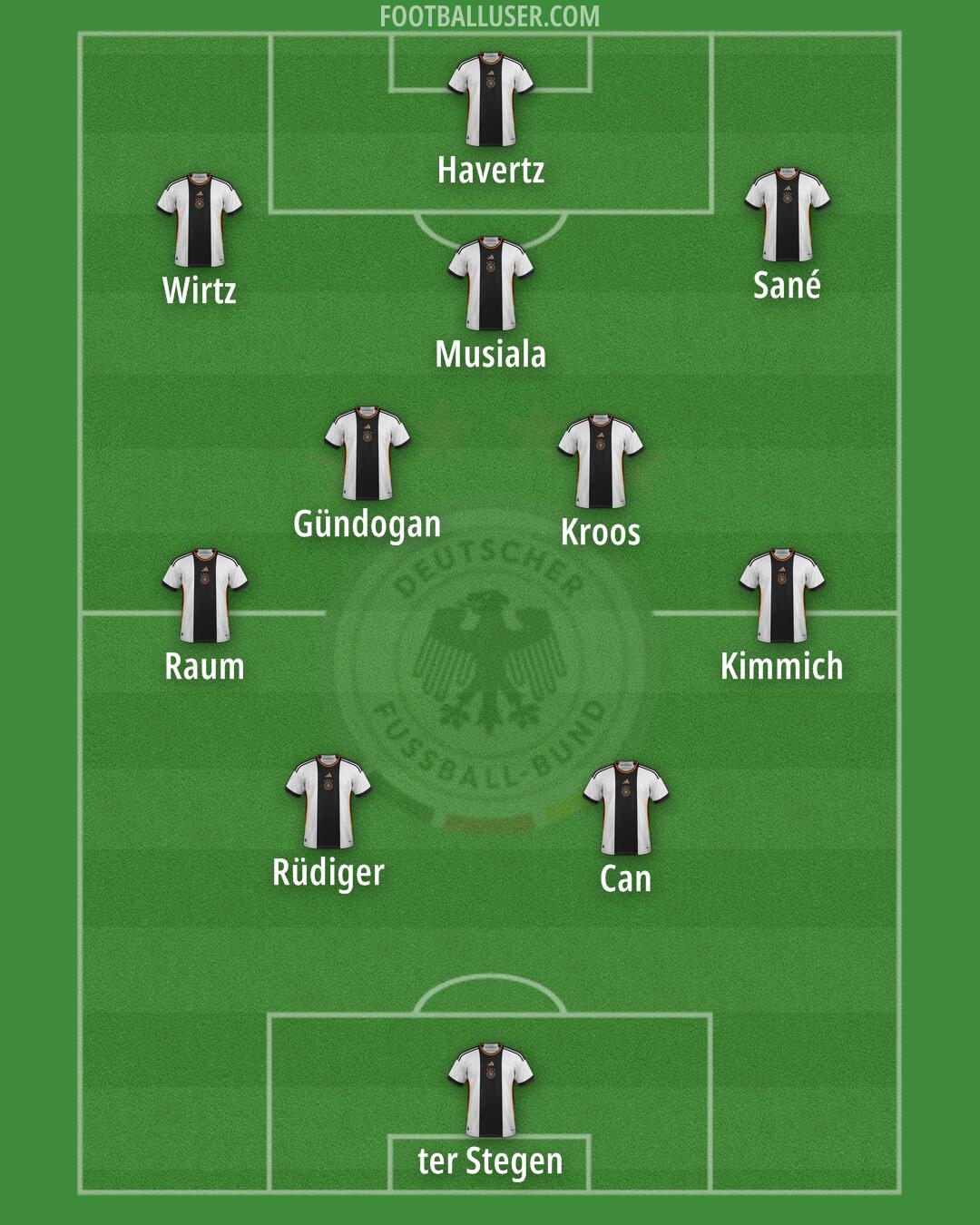

Germany National Football Team Formation
 June 15, 2024


Starting Lineup
Havertz · Raum · Kimmich · ter Stegen · Rüdiger · Can · Gündogan · Kroos · Sané · Musiala · WirtzGermany plays with a heavy attacking intent, seeking to overwhelm the opposition through constant pressure and rapid verticality in a 2-4-4. This lineup is built to dominate the pitch by pushing bodies into advanced areas to ensure the ball stays in the opponent's half. By committing so many players forward, the team aims to control the tempo and create constant chaos in the final third. This formation is designed to play a direct and aggressive style of football.
In goal, ter Stegen acts as a sweeper to cover the large amount of space left behind the defenders. The defensive unit relies on a two man back line consisting of Can and Rüdiger. Rüdiger uses his pace and physicality to defend in a high line, while Can works to intercept passes and maintain defensive stability. Since they operate without traditional full backs, these two central defenders must stay narrow and work together to defend zonally and manage the space behind them.
The midfield functions as a four man block to bridge the gap between the defense and the attack. Kroos operates as a deep lying playmaker, using his exceptional passing range to find teammates and switch play. Kimmich provides balance by driving forward and helping to recycle possession. Raum and Gündogan occupy the central areas to press aggressively and win the ball high up the pitch. This midfield group works to compress the midfield and deny the turn to opposition players.
The attack features four players positioned to stretch the defence and penetrate the box. Wirtz and Sané play wide, with Sané using his pace to hit in behind and Wirtz cutting inside to create chances. Musiala and Havertz work as a central partnership in the front line. Musiala uses his dribbling to beat men in tight spaces, while Havertz works to find the feet of the forwards and link up play between the lines. This formation encourages the wingers to pull wide and creates many chances for cutbacks from the byline.
This formation offers a huge advantage through numerical superiority in the attacking third. The team can press in coordinated waves to force a long ball from the opposition. Additionally, the technical quality of the midfield allows Germany to play through the lines and find the attackers with precision. The ability to transition quickly means the team can exploit gaps the moment the opponent loses possession.
The 2-4-4 formation is a bold choice meant for teams that want to dictate the game through pure attacking volume. It is most effective when facing a team that sits deep and needs to be broken down by constant pressure.