
Celta Football Formation
 June 15, 2024


Starting Lineup
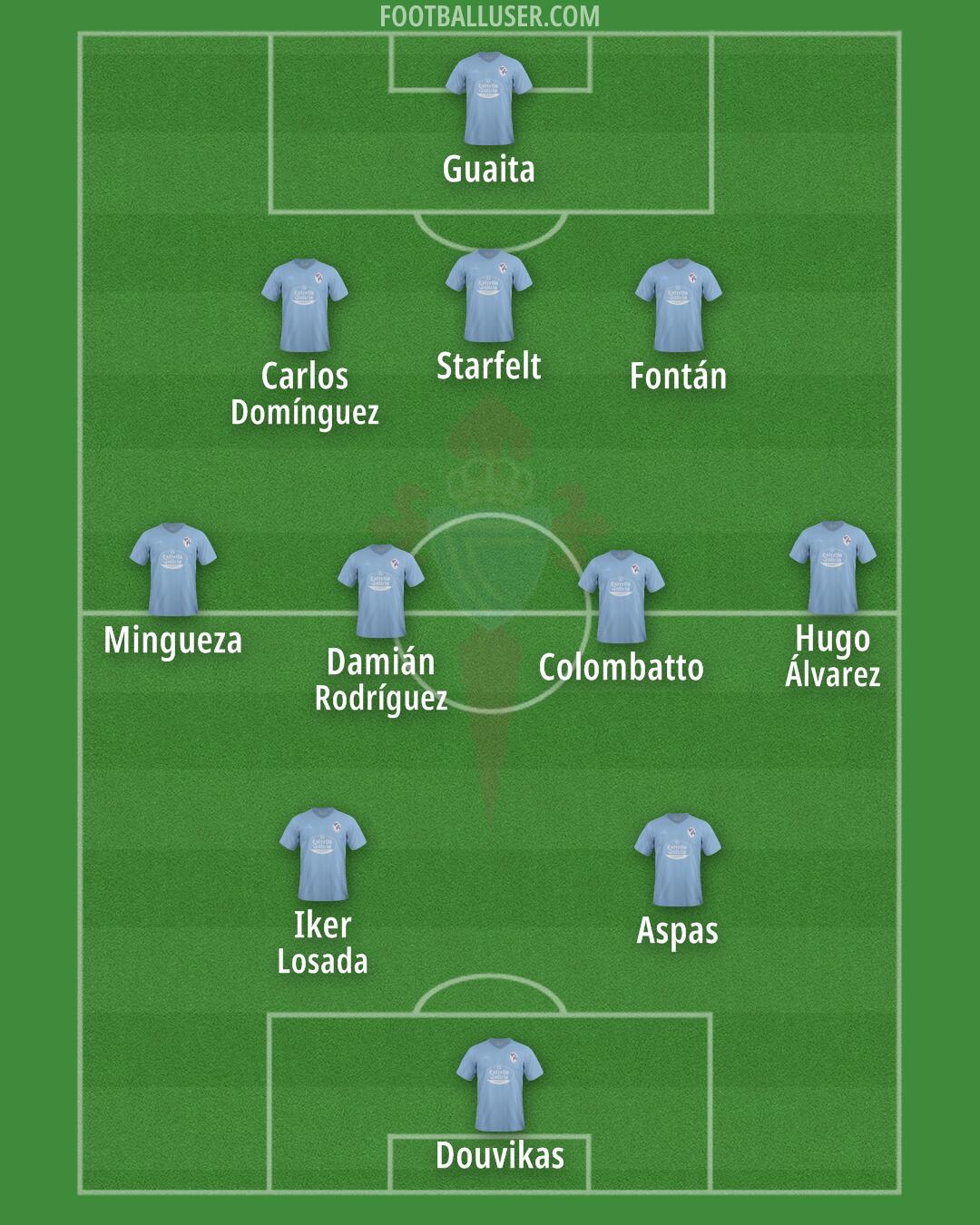
Guaita · Mingueza · Hugo (Álvarez) · Carlos (Domínguez) · Starfelt · Fontán · Damián (Rodríguez) · Colombatto · Douvikas · Aspas · Iker (Losada)Celta aims to play a vertical style of football that looks to hurt opponents quickly through direct movement and high intensity. This is achieved using a 3-4-3 formation that creates multiple passing lanes in the final third. The team relies on quick transitions to catch the opposition out of position and uses the wide areas to stretch the play.
Guaita operates between the posts to organize the defensive unit. The back line functions as a back three with Starfelt, Fontán, and Carlos providing a solid foundation. Fontán and Carlos act as wide centre-backs to cover the spaces left by the wing backs, while Starfelt acts as the central defender to win the second ball and clear the lines. The defensive unit stays compact to prevent through balls and forces the opposition to play wide.
The midfield is built around a central pairing of Damián and Colombatto who control the center of the pitch. Damián works to shield the defence and intercept passes, while Colombatto acts as a carrier to drive forward with the ball. Mingueza and Hugo occupy the wide areas as wing backs, providing the necessary width and helping to progress through the thirds. This midfield group connects the defence to the attack by recycling possession and finding the feet of the forwards.
In the attacking phase, Celta utilizes three attackers to pin the last defender. Douvikas acts as the lone striker to hold up the ball and battle with centre-backs. Aspas plays as an inverted winger on the left, looking to cut inside and create chances, while Iker stays wide on the right to provide crosses. The forwards press from the front to win the ball back high up the pitch and create chances through quick combinations in the final third.
A major advantage for Celta is the ability to create wide overloads when Mingueza and Hugo push high to support the wingers. The formation also provides numerical superiority in the central areas when the wing backs tuck in. This allows the team to maintain control and create space for Douvikas to work in isolation against single defenders.
This 3-4-3 formation is built for teams that want to dominate the wide areas and transition with speed. It is best suited for matches where the opponent plays a high line and can be punished with runs in behind.