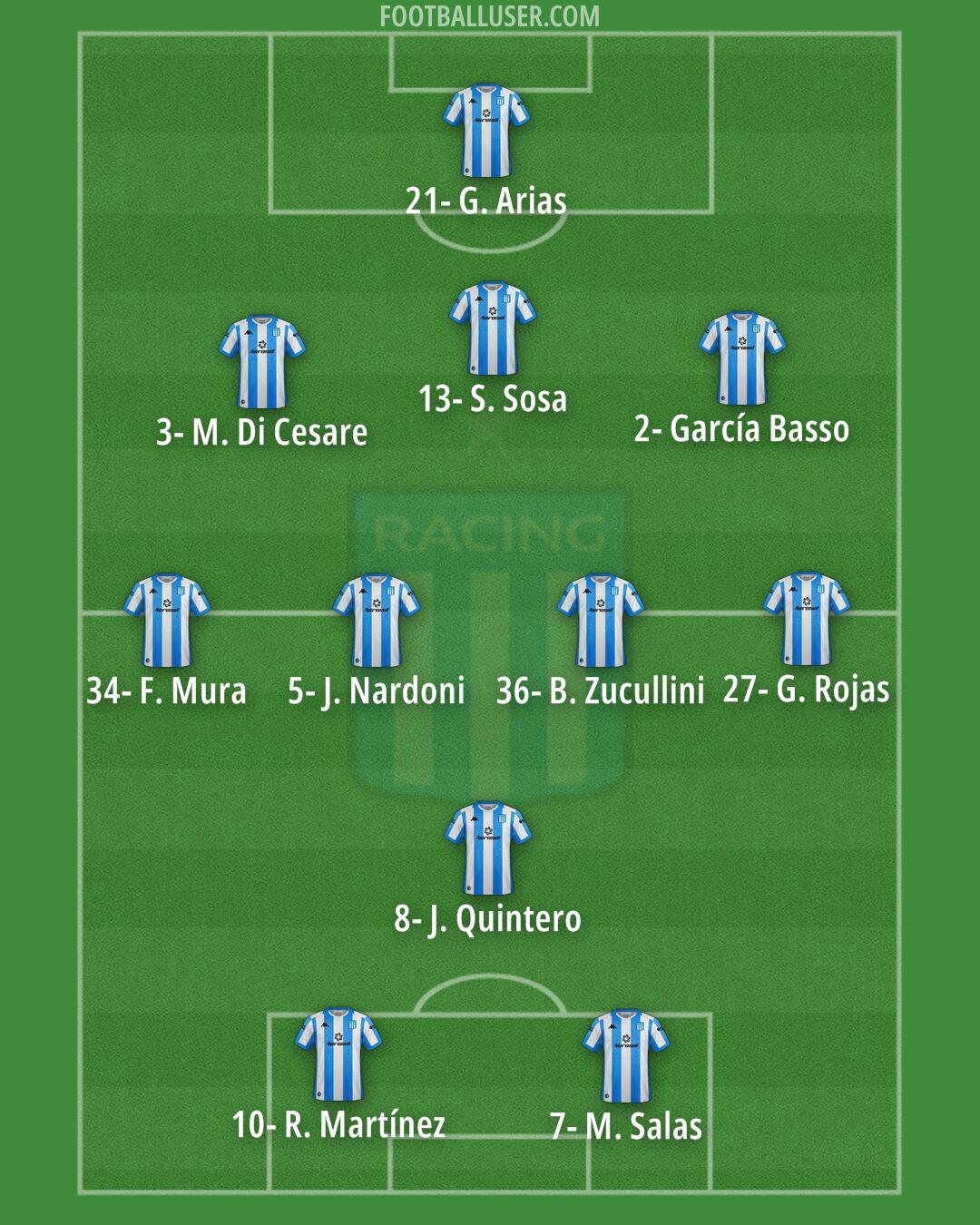

Racing Club Football Formation
 June 15, 2024


Starting Lineup
21- G. Arias2- García Basso
13- S. Sosa
3- M. Di Cesare
5- J. Nardoni
34- F. Mura
36- B. Zucullini
27- G. Rojas
8- J. Quintero
10- R. Martínez
7- M. Salas
Racing Club aims to dominate the center of the pitch through a heavy presence in the middle, utilizing a 3-5-2 formation. This lineup is built to control the tempo and use a high press to win the ball back quickly. By saturating the central areas, the team can recycle possession and look for ways to break the lines of the opposition.
G. Arias sits between the posts to organize the defensive unit. The back three consists of S. Sosa, García Basso, and M. Di Cesare. García Basso acts as the left center back with his ability to defend zonally, while M. Di Cesare covers the right side. S. Sosa holds the middle to ensure the team stays compact. These defenders stay close together to defend a mid-block and step up to squeeze the space when the team wins the ball.
The midfield functions as a powerhouse with a central core and wide players. J. Nardoni and B. Zucullini operate as a double pivot to shield the defense and win the second ball. J. Quintero plays as an attacking ten behind the strikers, looking to play through the lines and create chances. To provide width, F. Mura and G. Rojas act as wide midfielders who push forward to support the attack and track back to help the defense. This group connects the back three to the front two by moving the ball quickly from deep areas.
In the attacking third, Racing Club uses two forwards in a partnership. M. Salas and R. Martínez work together to pressure the opposition back line. R. Martínez is a known threat in the box with his movement, while M. Salas works to link up play between the lines. The team looks to create runs in behind the defenders and use the width provided by F. Mura and G. Rojas to stretch the defence. When the team transitions, they look to hit the opposition quickly with direct passes to the strikers.
A major advantage for Racing Club is the numerical superiority in midfield, which makes it hard for opponents to keep the ball. The wide players allow for overloads on the flanks, forcing the opposition to shift and leave gaps in the middle. The team also maintains high compactness when defending, making it very difficult to play through the center.
This 3-5-2 formation provides a robust platform for controlling central zones and pressing from the front. It is best suited for matches against teams that play with a single pivot or those that struggle to manage wide players in transition.