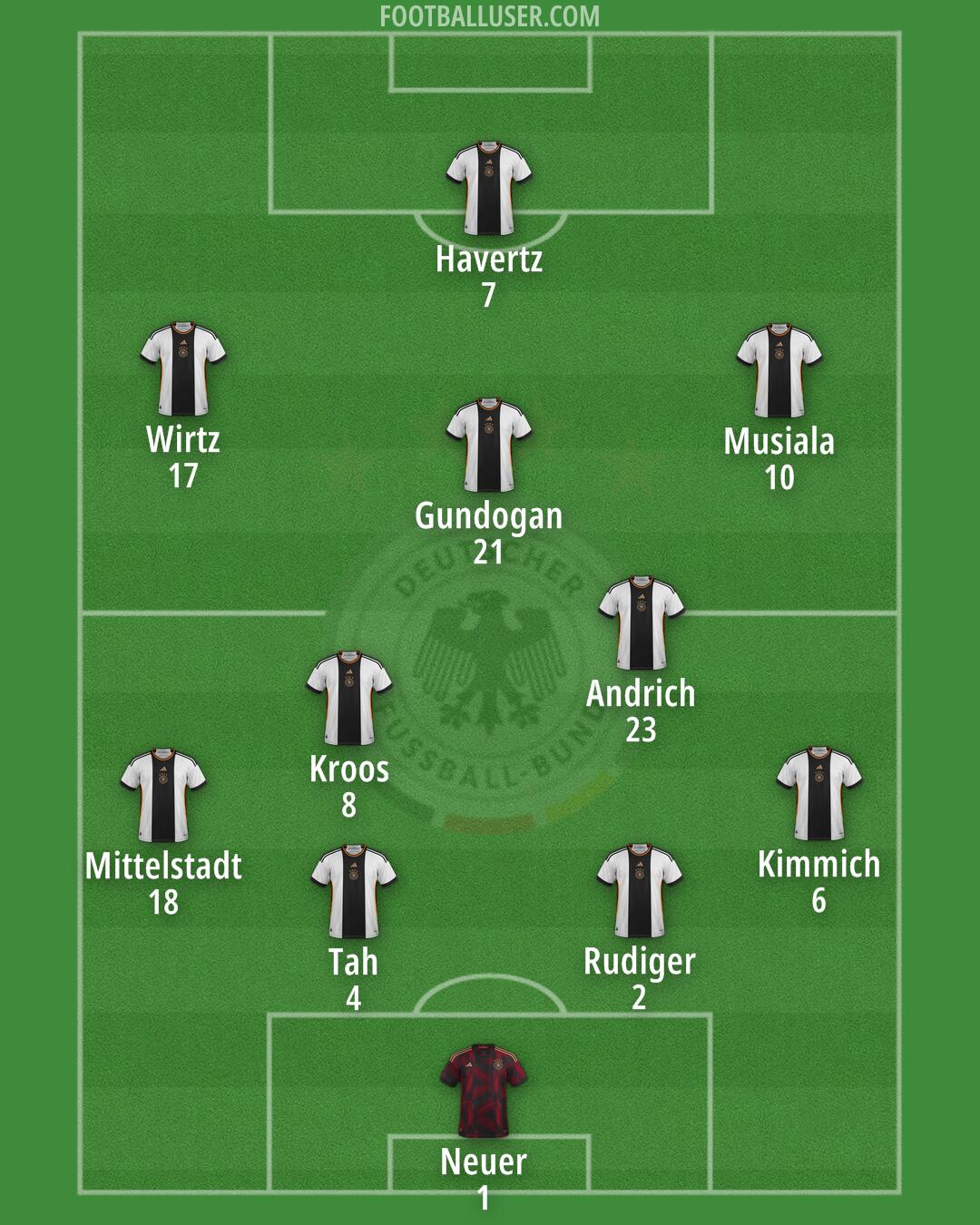

Germany National Football Team Formation
 June 19, 2024


Starting Lineup
Rudiger (2) · Tah (4) · Neuer (1) · Kimmich (6) · Mittelstadt (18) · Kroos (8) · Andrich (23) · Gundogan (21) · Musiala (10) · Wirtz (17) · Havertz (7)Germany looks to control matches through a high press and heavy possession with a 4-5-1 formation. This lineup relies on winning the ball high up the pitch to pin the opposition in their own half. The tactical identity focuses on controlling the tempo and using technical quality to progress through the thirds.
Manuel Neuer acts as a sweeping goalkeeper behind a back four that maintains a high line. Tah and Rudiger operate as the central defenders, with Rudiger providing aerial strength and Tah acting as a ball playing defender to help play out from the back. Kimmich plays as an attacking full back on the right to help spread wide, while Mittelstadt covers the left side to keep the defensive unit compact. The back line works to squeeze the space and catch opponents offside when they try to break.
The midfield functions as a five man unit with a double pivot providing a base. Kroos operates as a deep lying playmaker, using his passing range to find teammates and recycle possession, while Andrich stays closer to the defense to shield the back four. Gundogan plays in the center to connect the defensive and attacking lines, often arriving late into the box to support the play. Musiala and Wirtz operate in the half spaces, with Musiala using his dribbling style to carry the ball forward and Wirtz looking to play through the lines.
Germany utilizes a lone striker in Kai Havertz to lead the line. Havertz acts as a pressing centre forward to disrupt the opposition build up and hold up the ball for the arriving midfielders. The wide players, Musiala and Wirtz, do not hug the touchline but rather cut inside to create numerical superiority in the central areas. This creates runs in behind and allows the team to combine in tight spaces through quick short passes.
One major advantage is the ability to press high in coordinated waves using the front five to force a long ball from the opponent. Germany also gains numerical superiority in midfield when Gundogan, Kroos, and Andrich control the central zone. This allows the team to dominate the ball and limit the chances of the opposition finding any rhythm.
This 4-5-1 formation is built to dominate games through ball retention and intense pressing. It is best suited for matches where Germany needs to control the tempo against teams that sit deep.