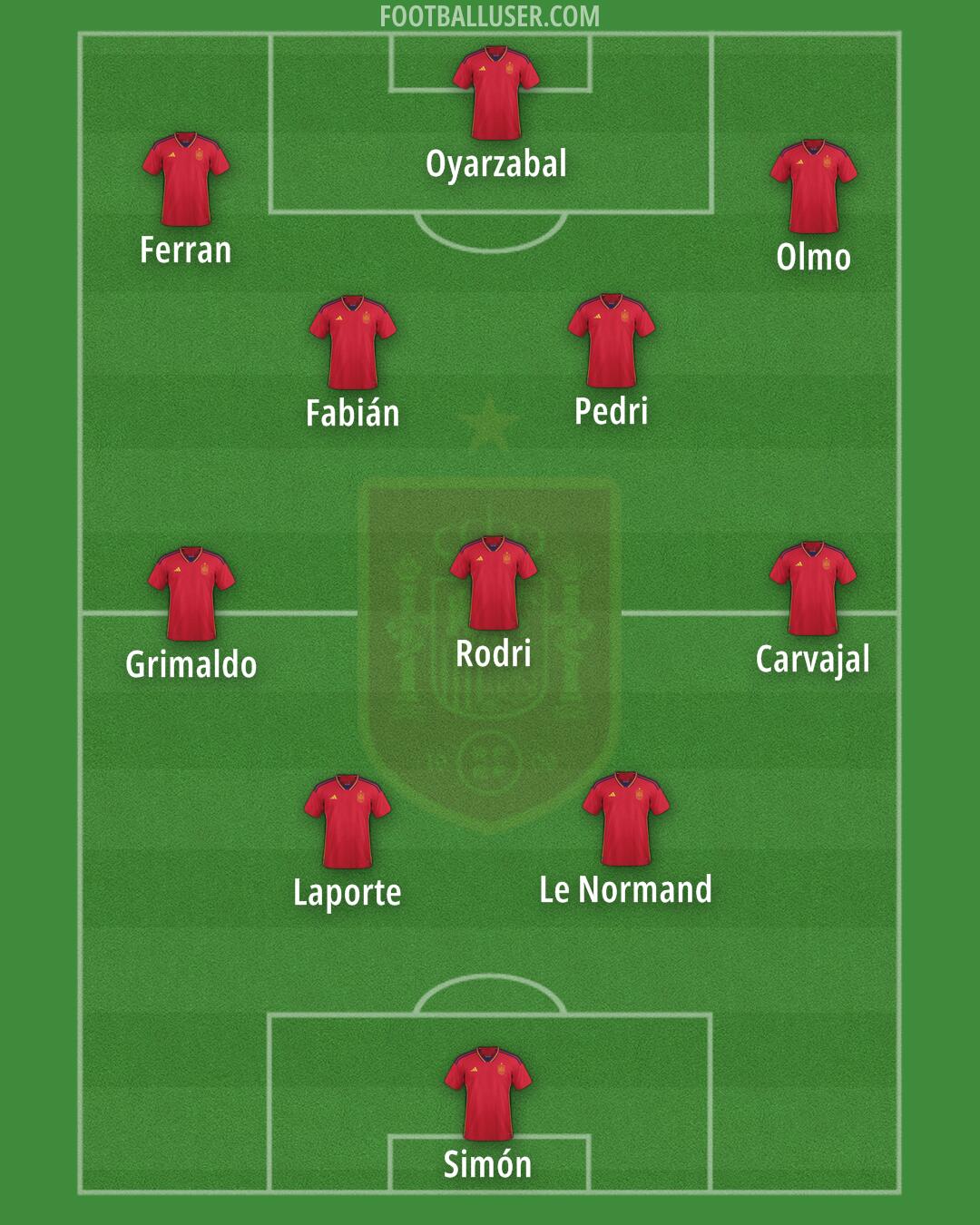

Spain National Football Team Formation
 June 21, 2024


Starting Lineup
Ferran · Grimaldo · Carvajal · Simón · Laporte · Le Normand · Rodri · Fabián · Pedri · Oyarzabal · OlmoSpain aims to play with high intensity and verticality using a 5-2-3. The lineup focuses on winning the ball high up the pitch and moving the ball quickly toward the goal. This formation is built to allow for heavy defensive cover while providing enough numbers to support the attack in transition.
Simón guards the goal as the last line of defense. The back five uses a staggered zonal line where Rodri acts as the central ball playing defender to help play out from the back, using his passing range and positional awareness to control the game. Laporte and Le Normand sit beside him as wide centre-backs to cover the channels and win the header in set piece situations. Grimaldo and Carvajal operate as attacking wing backs, pushing high up the flanks to provide width. When the team wins the ball, these defenders help to stretch the defence and spread wide.
The midfield functions as a double pivot. Fabián and Pedri operate in the center to control the game. Pedri, noted for his passing range and ability to receive on the half-turn, works to link the defensive and attacking lines. Fabián acts as a carrier to drive forward with the ball and connect the play. They must work to compress the midfield and win the second ball to keep the pressure on the opponent.
The attack features three players across the front. Oyarzabal plays as a pressing centre-forward to pin the last defender. Ferran and Olmo act as inverted wingers who cut inside to create space for the wing backs. Ferran often pulls wide to create room, while Olmo looks to play through the lines. The formation is designed to create overlaps from wide players and cutbacks from the byline through the movement of Grimaldo and Carvajal.
A major strength for Spain is the ability to press high in coordinated waves using the front three. The team also creates wide overloads because Grimaldo and Carvajal can overlap the wingers easily. This creates numerical superiority in the wide areas and allows for quick switches of play to find space. The defensive unit can also quickly shift to cover runners and maintain a compact block.
This 5-2-3 formation offers a balance between defensive stability and attacking threat. It is best suited for games against opponents that rely on heavy possession and leave space behind their midfield.