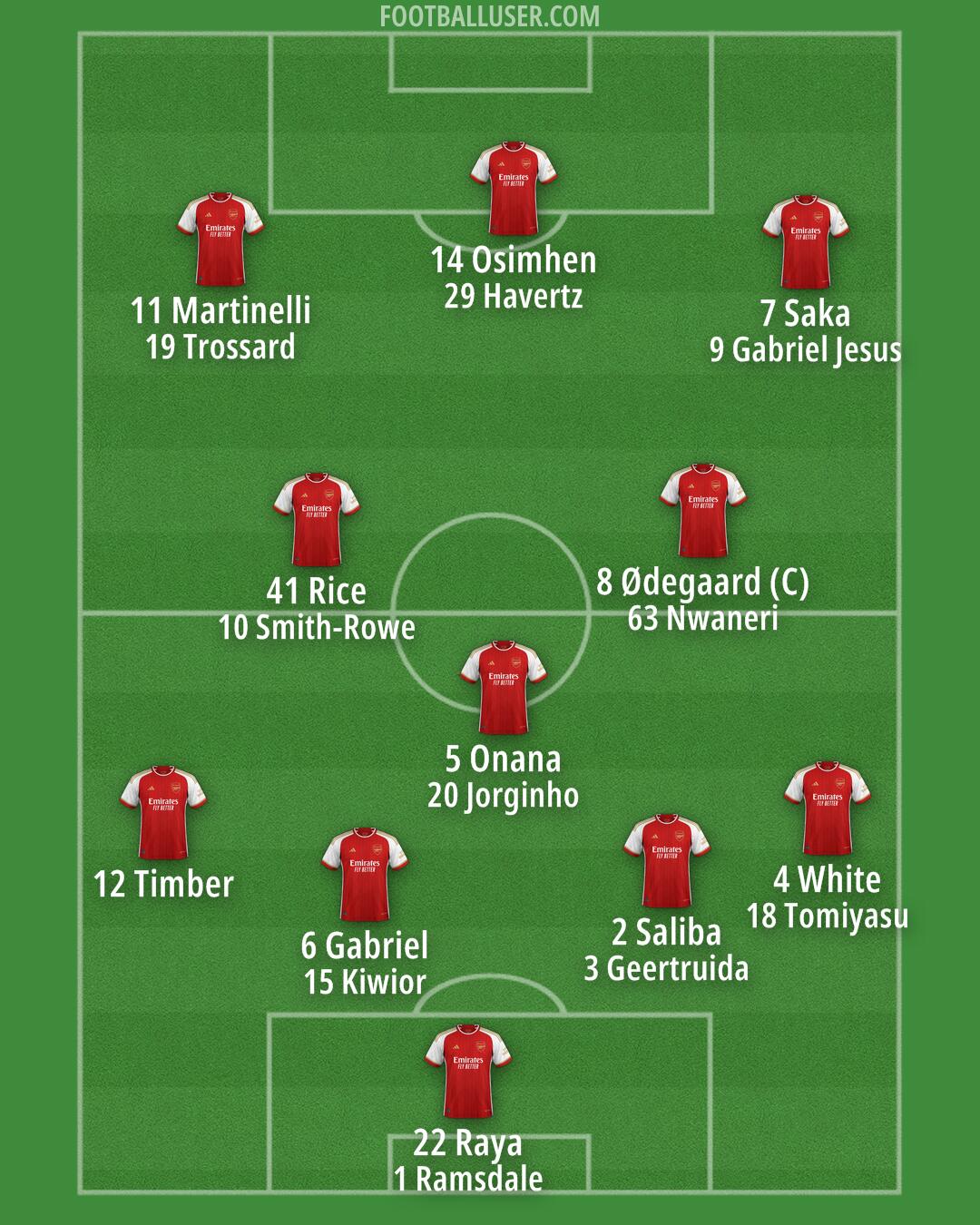
Arsenal Football Formation
 June 23, 2024


Starting Lineup
22 Raya (1 Ramsdale)4 White (18 Tomiyasu)
2 Saliba (3 Geertruida)
6 Gabriel (15 Kiwior)
12 Timber
5 Onana (20 Jorginho)
8 Ødegaard (C) (63 Nwaneri)
41 Rice (10 Smith-Rowe)
7 Saka (9 Gabriel Jesus)
11 Martinelli (19 Trossard)
14 Osimhen (29 Havertz)
Arsenal look to control games through a high press and quick transitions using a 5-2-3. This formation allows the team to stay compact while having the bodies ready to strike on the break. By using a back five, the side aims to dominate central areas and maintain stability when the opposition tries to play through the middle.
Raya sits between the posts to organize the defensive line. The back five consists of Onana, Saliba, and Gabriel, who act as a central block of three. Saliba and Gabriel are both strong in the air and use their recovery speed to cover space behind the line. Timber and White act as attacking wing backs on the flanks. Timber provides width on the left while White pushes forward on the right to support the attack. This defensive unit functions by sitting in a mid-block to deny space between the lines.
The midfield consists of a two man unit with Rice and Ødegaard. Rice acts as the primary shield for the defense, using his interception skills and physical presence to win the second ball. Ødegaard (C) operates as the creative engine, looking to receive the ball in half spaces and play through the lines. This duo connects the defense to the front three, with Rice often dropping deep to help build from the back while Ødegaard finds ways to drive the team forward.
In the final third, Arsenal use three attackers to pin the opposition back. Osimhen acts as a pressing centre forward, using his strength to hold up the ball and fight for long balls. Saka and Martinelli provide width as wide wingers, with Saka often cutting inside to create chances. These players look to isolate defenders in one on one situations. The movement of the front three is designed to create runs in behind and allow for quick combinations in the box.
One major advantage of this formation is the ability to press high in coordinated waves. The front three can trigger a press immediately, while the midfield and back three move up to squeeze the space. Another strength is the wide overloads created when Timber and White push high up the pitch. This forces the opposition to defend a large area and creates space for the central players to operate.
This formation provides Arsenal with a robust defensive base and the tools to attack with speed. It is a lineup best suited for matches against teams that try to play an expansive game.