
Vasco da Gama Football Formation
 June 26, 2024


Starting Lineup
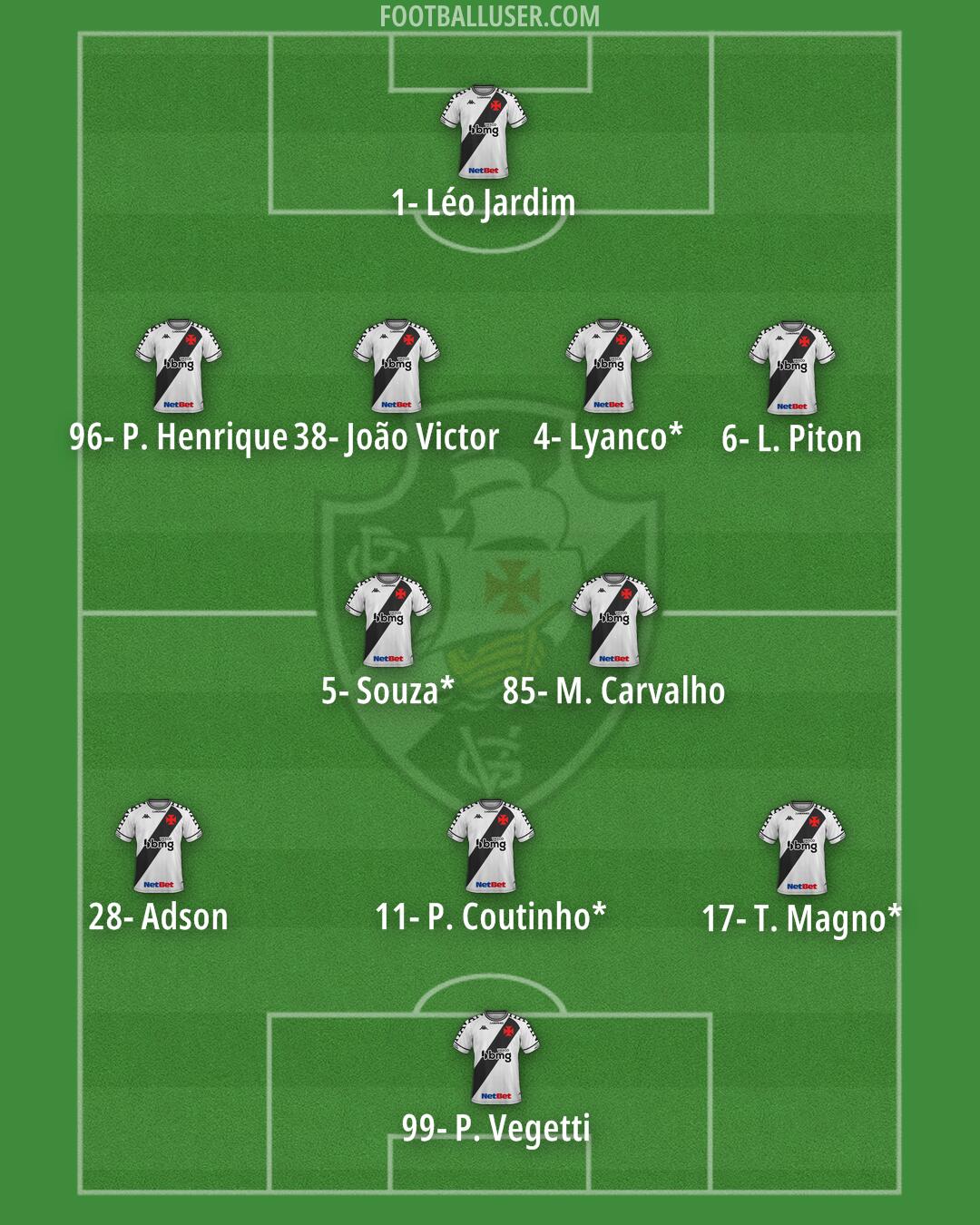
1- Léo Jardim96- P. Henrique
38- João Victor
4- Lyanco*
6- L. Piton
5- Souza*
85- M. Carvalho
11- P. Coutinho*
99- P. Vegetti
28- Adson
17- T. Magno*
Vasco da Gama looks to play a direct and aggressive brand of football using a 4-2-4 formation. This lineup is built to stretch the opposition and hit them hard in transition. By pushing as many players as possible into the final third, the team seeks to overwhelm the opponent through high intensity and rapid ball movement.
Léo Jardim guards the goal and oversees the defensive unit from deep. The back line consists of a flat back four where L. Piton and P. Henrique act as full backs to provide width. In the center, João Victor and Lyanco operate as the central defensive pair. João Victor provides aerial strength, while Lyanco works to cover space behind the line. These defenders aim to keep a high line to compress the pitch, forcing the opposition to play long balls rather than through the middle.
The midfield relies on a double pivot to provide a platform for the attack. Souza and M. Carvalho sit in the middle to shield the defense and win the second ball. Souza acts as the engine to press aggressively and win the ball high up the pitch, while M. Carvalho works to recycle possession and connect the back four to the front four. This two-man midfield must be disciplined to prevent being bypassed by opponents playing between the lines.
The attack is very potent with four players pushed high. Adson and T. Magno occupy the wide positions as wingers, with Adson looking to cut inside and T. Magno providing service from the left. Up front, the team uses a partnership of two center forwards. P. Coutinho, who serves as the captain, plays in a more advanced role to link play, while P. Vegetti acts as a target man to win headers and hold up the ball. This front four presses the opposition back line to force mistakes.
Vasco da Gama gains a massive advantage through their ability to create wide overloads when the full backs push up to support the wingers. The numerical superiority in the attacking third allows the team to pin the last defender and create chances in the box. Additionally, the speed of transition from the double pivot to the four forwards allows the club to catch opponents out of position very quickly.
This 4-2-4 formation is a high risk, high reward system that relies on verticality. It is best suited for matches where the team needs to chase a goal or play against an opponent that struggles to defend in wide areas.