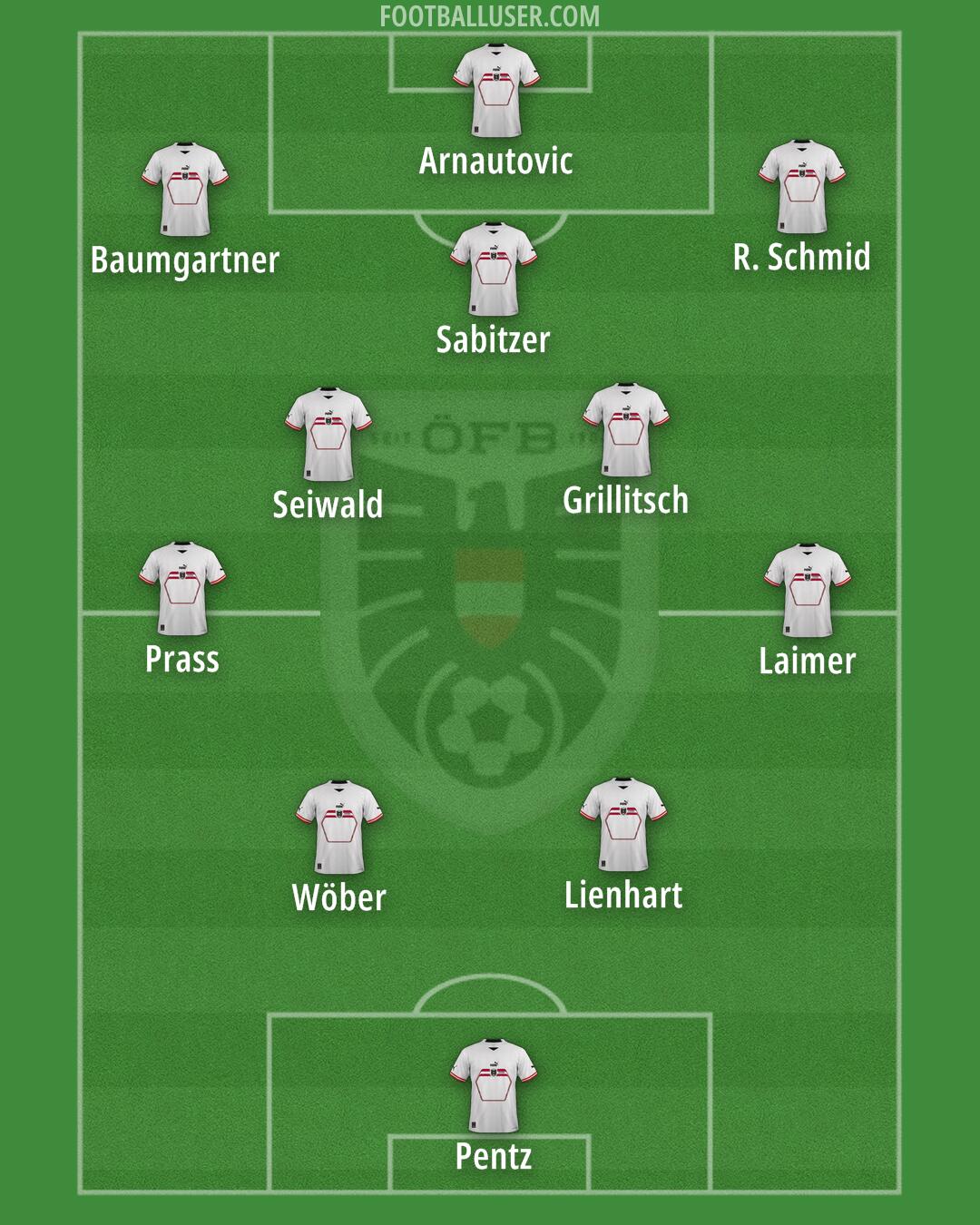

Austria National Football Team Formation
 June 26, 2024


Starting Lineup
Seiwald · Laimer · Arnautovic · Sabitzer · Baumgartner · R. Schmid · Wöber · Lienhart · Prass · Grillitsch · PentzAustria focuses on a compact defensive block and quick transitions using a 5-4-1. This formation is built to sit deep and absorb pressure before hitting the opposition on the break. The identity of the team relies on staying compact and limiting space between the lines to frustrate opponents who rely on possession.
Arnautovic stays between the posts to command his area. The defense operates as a back five with Sabitzer, Grillitsch, and Seiwald forming a central trio. Sabitzer provides aerial strength while Grillitsch and Seiwald work to cover space and track back if the ball is lost. R. Schmid acts as an attacking wing back on the left to provide width and overlap the midfield, while Baumgartner performs a similar role on the right. The defensive unit functions as a whole to hold the line and squeeze the space when the ball moves into wide areas.
The midfield four works to protect the center and connect the lines. Prass and Laimer form a double pivot to shield the defense. Laimer uses his high pressing intensity to win the ball and disrupt play. Prass stays more central to sit deep and recycle possession. Wöber and Lienhart play as the wide midfielders within the midfield four. Wöber and Lienhart connect the defensive and attacking lines by finding passes through the lines and making runs into the half spaces. They must be ready to drop back and help the pivot when the team sits deep.
Pentz leads the line as a lone striker. He must work to hold up the ball and find the feet of the midfielders when the team moves forward. Pentz is tasked to press from the front to force a long ball from the opposition. The attack is built through quick transitions where Wöber or Lienhart can carry the ball forward to find Pentz. The movement of R. Schmid and Baumgartner is designed to create width and allow for cutbacks from the byline once they get past the wingers.
This 5-4-1 offers Austria great compactness when defending. The narrow block makes it very hard for opponents to play through the middle. Another advantage is the ability to win the second ball in midfield due to the proximity of the players. The team also uses the width of the wing backs to create wide overloads.
This formation is best for a team that wants to play on the counter. It is ideal for situations where Austria faces an opponent with high possession and needs to sit deep.