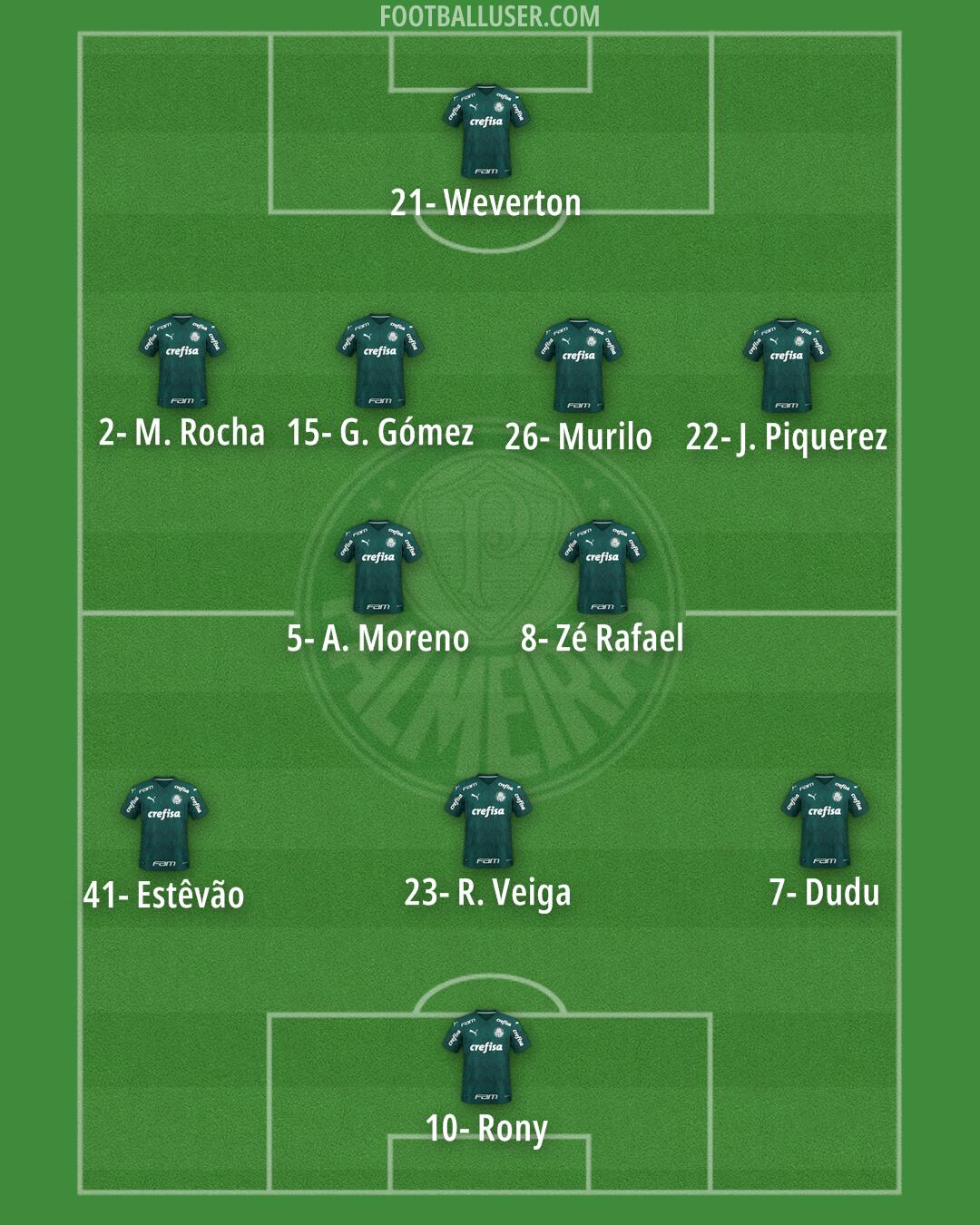

Palmeiras Football Formation
 June 30, 2024


Starting Lineup
21- Weverton2- M. Rocha
15- G. Gómez
26- Murilo
22- J. Piquerez
5- A. Moreno
8- Zé Rafael
23- R. Veiga
10- Rony
41- Estêvão
7- Dudu
Palmeiras seeks to overwhelm opponents with a high press and direct verticality using a 4-2-4. This formation is built to attack with high intensity, using many players to pin the opposition back and win the ball high up the pitch. The goal is to stretch the defence and create many chances through rapid transitions and aggressive positioning.
Weverton guards the goal as the last line of defence for Palmeiras. The back line consists of a flat back four featuring M. Rocha and J. Piquerez as the full backs. M. Rocha works to defend the wide areas while J. Piquerez provides support on the left. In the middle, G. Gómez and Murilo act as the central defenders, where G. Gómez uses his aerial strength to win headers and Murilo covers the space behind. They work together to hold the line and defend zonally against incoming runs.
The midfield utilizes a double pivot to provide a layer of protection in front of the back four. A. Moreno and Zé Rafael occupy the central roles to connect the defensive and attacking lines. Zé Rafael drives forward with the ball to link play, while A. Moreno helps to shield the defence and recycle possession when the team needs to slow the tempo. This pairing must be disciplined to prevent being bypassed in the middle of the pitch.
A heavy attacking presence is maintained with four players in the front line. Dudu and Estêvão operate as wide attackers, where Dudu looks to cut inside and Estêvão uses his dribbling style to beat his man on the flank. Rony and R. Veiga operate as the central duo. Rony works as a pressing centre-forward to harass the opposition back line, while R. Veiga moves between the lines to find pockets of space. They combine in tight spaces to create runs in behind or deliver crosses into the box.
This lineup offers the advantage of massive pressure in the final third, often forcing errors from the opponent. The use of four attackers creates wide overloads and makes it difficult for the opposition to defend the full width of the pitch. When the ball is won high, the team can break quickly to exploit the space left by a retreating defence.
The 4-2-4 formation focuses on high intensity and rapid attacking movements. It is best suited for matches where the team needs to break down a deep block or punish an opponent through speed of transition.