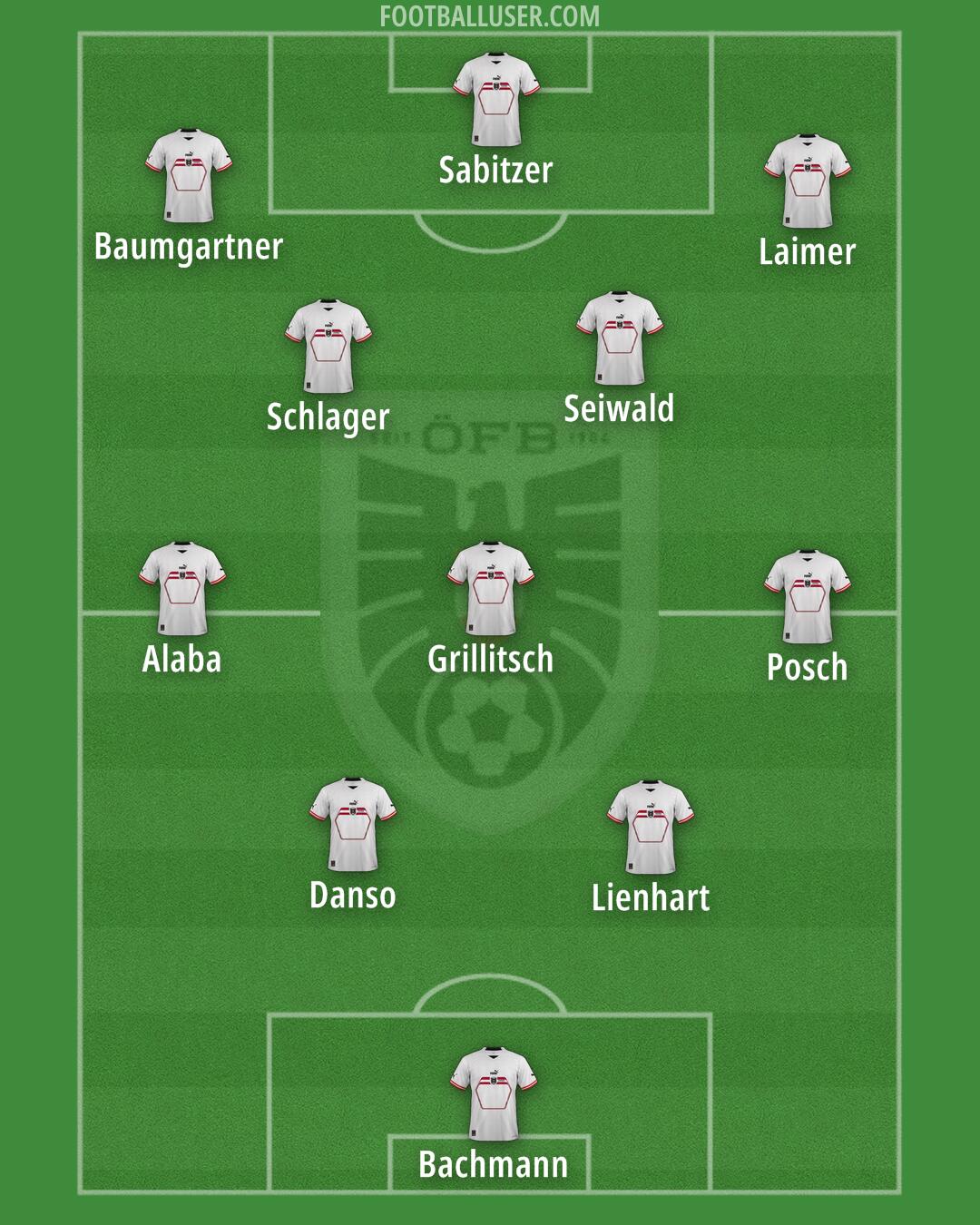

Austria National Football Team Formation
 July 2, 2024


Starting Lineup
Alaba · Posch · Danso · Lienhart · Bachmann · Grillitsch · Schlager · Seiwald · Baumgartner · Sabitzer · LaimerHigh pressing and rapid transitions define the identity of Austria, who employ a 5-2-3 formation. This lineup is built to squeeze the space in the opponent's half and use the width of the pitch to stretch the defence. The team aims to win it back high up the pitch and move the ball forward with speed to catch the opposition out of position.
Bachmann stays between the posts to command the area and direct the line. The defensive unit operates as a back five where Grillitsch acts as the central defender to sweep behind the line. Lienhart and Danso play as the wide centre-backs to provide cover and win the second ball. Posch plays as an attacking wing back on the right to provide width and overlap the winger. Alaba operates as an attacking wing back on the left, using his passing range to start attacks from deep. This unit is capable of holding a compact line or stepping up to set the offside trap.
A double pivot controls the center of the pitch. Seiwald and Schlager work together to protect the back five and trigger a press in a mid-block. Seiwald holds his position to shield the defence while Schlager looks to carry the ball forward and connect the lines. They move the ball through the thirds to bridge the gap between the defenders and the attackers. The duo must work to intercept passes and deny the pivot of the opposition to ensure control.
The attack is led by three players working in tandem. Sabitzer acts as the pressing centre-forward to lead the hunt and use his high work rate to find the feet of his teammates. Laimer operates as a wide winger on the right who likes to cut inside, using his pressing intensity to disrupt the opposition back line. Baumgartner stays wide on the left to spread the play and allow for overlaps. The team looks to hit in behind on the transition and use the movement of the forwards to create chances in tight spaces.
This formation offers several clear advantages. Austria can create wide overloads when Posch pushes up to support the attack. The ability to press high in coordinated waves allows the team to win the ball in dangerous areas. Additionally, the formation provides great compactness when the team must sit deep to defend a lead.
This 5-2-3 formation relies on high energy and quick vertical movement. It is best suited for facing opponents who struggle to play short from the back under intense pressure.