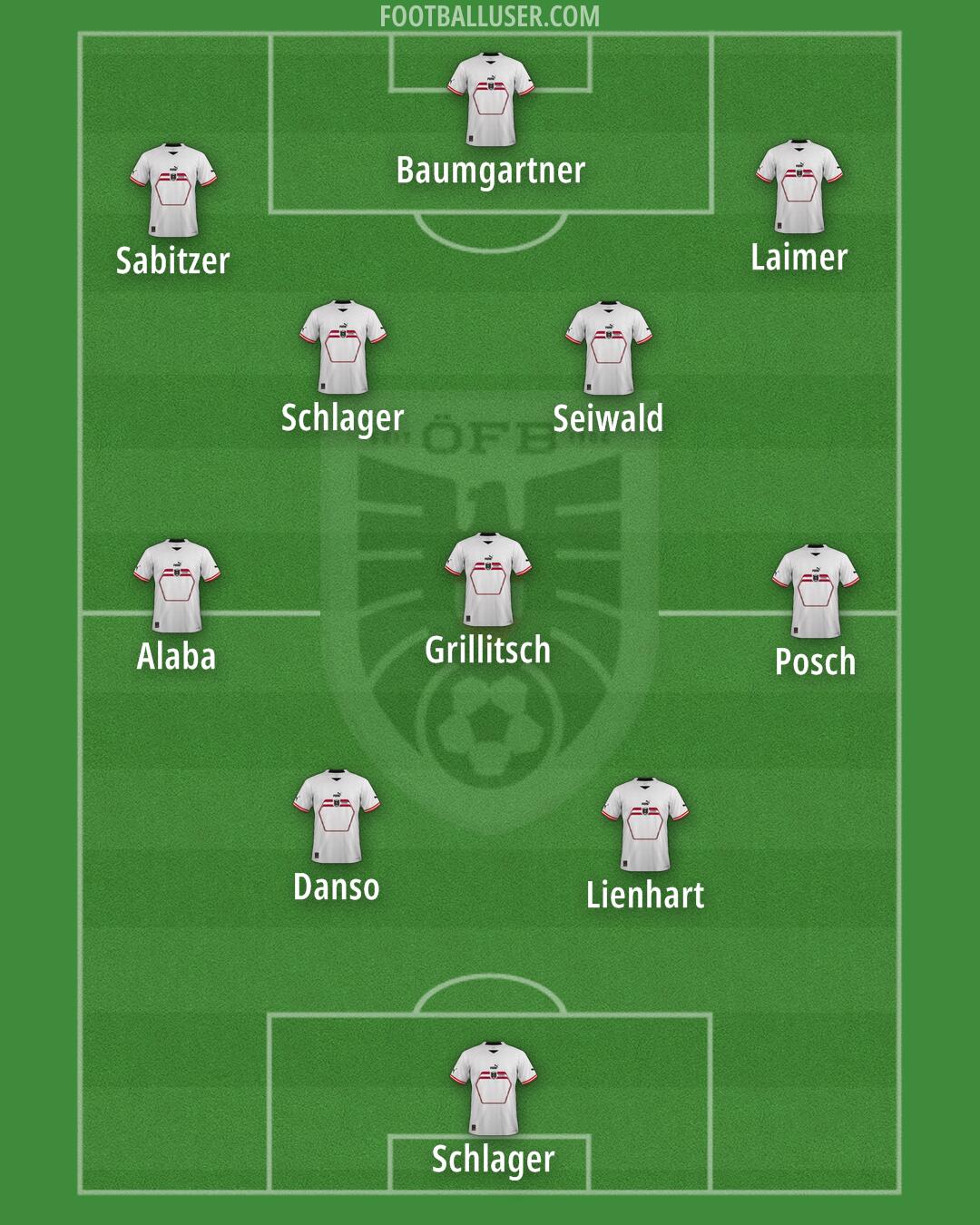

Austria National Football Team Formation
 July 3, 2024


Starting Lineup
Alaba · Posch · Schlager · Danso · Lienhart · Grillitsch · Baumgartner · Sabitzer · Laimer · Schlager · SeiwaldAustria plays with a heavy high press to win the ball back high up the pitch. They utilize a 5-2-3 formation to squeeze the opposition and play with verticality. This lineup is built to transition from defense to attack with great speed.
Schlager operates in goal to guard the net. The defense uses a back five. Grillitsch holds the center of the three, while Lienhart plays as the right centre-back and Danso covers the left centre-back role. Posch acts as an attacking wing back on the right to provide width, and Alaba functions as a left wing back to push high into the attacking third. The defensive unit defends zonally to maintain a compact block and covers the space behind the midfield.
The midfield uses a double pivot to control the center of the pitch. Seiwald and Schlager occupy the two central roles. Seiwald works to carry the ball forward and drive through the lines, while Schlager focuses on shielding the defense and intercepting passes. This pair connects the defensive line to the attacking unit by recycling possession and searching for the forwards.
Three attackers form the front line to stretch the opposition defense. Baumgartner plays as a pressing centre-forward to trigger the press from the front. Sabitzer and Laimer act as wide attackers who look to cut inside and create chances. Sabitzer often cuts inside to find space in the channels, while Laimer looks to hit in behind on the transition. The wing backs, Posch and Alaba, overlap the wingers to deliver crosses and create wide overloads. These movements are intended to isolate defenders in one on one situations and create runs in behind.
A major tactical advantage for Austria is the ability to press in coordinated waves. This forces the opposition into mistakes in their own half. The formation also provides speed of transition, allowing the team to break quickly once the ball is won. By using the wing backs to stretch the defense, the team creates space for the central attackers to operate in tight spaces.
This 5-2-3 formation relies on high intensity and rapid ball recovery. It is best suited for matches against teams that struggle to play short from the back.