
São Paulo Football Formation
 July 8, 2024


Starting Lineup
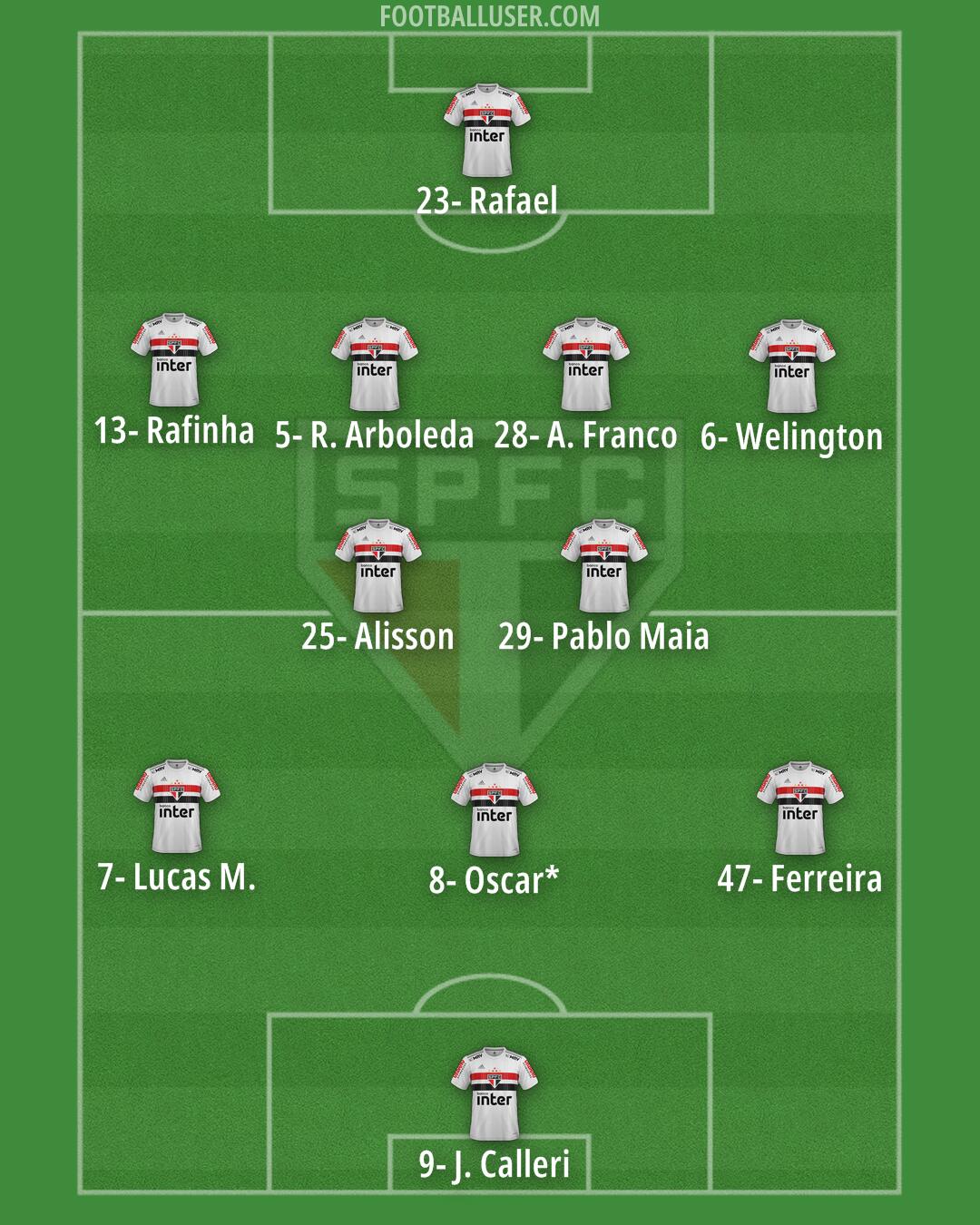
23- Rafael13- Rafinha
5- R. Arboleda
28- A. Franco
6- Welington
25- Alisson
29- Pablo Maia
8- Oscar*
7- Lucas M.
47- Ferreira
9- J. Calleri
São Paulo focuses on a compact, hard to break down identity using a 4-5-1 formation. This lineup is built to play a mid-block and win the ball back quickly to transition into attack. The team relies on staying close together to deny space between the lines and frustrate opponents through heavy numbers in the middle of the pitch.
Rafael sits between the posts to command the area. The back four functions as a zonal line with Rafinha and Welington providing width. Rafinha acts as an attacking full back to push up the flank, while Welington covers the left side. In the middle, R. Arboleda is dominant in the air and handles the physical battles, with A. Franco acting as the covering defender to sweep behind the line. The unit stays tight to prevent through balls.
The midfield is a dense five man block designed to control the center. Pablo Maia works as the single pivot to shield the defense and win second balls. Next to him, Alisson provides cover and helps recycle possession. Lucas M. and Ferreira operate in the half spaces to link the defense to the attack, while Oscar drives forward to connect the lines. This group is tasked to press in a mid-block and squeeze the space when the ball enters their zone.
J. Calleri operates as a lone striker and serves as the focal point for the attack. He works to hold up the ball and lay it off to the oncoming midfielders. When the team wins the ball, the wide midfielders look to spread wide and provide service into the box. The forwards press the opposition back line to force a long ball. The aim is to create chances through combinations and quick vertical passes once the ball is recovered.
One major advantage for São Paulo is the numerical superiority in midfield which makes it very difficult for opponents to play through the center. The team also benefits from the ability to press in coordinated waves to win the ball high up the pitch. This makes the lineup very hard to break down when they sit in a compact block.
This formation is a defensive tool meant to frustrate teams that want to control the ball. It is best suited for matches against heavy favorites where the goal is to sit deep and strike on the transition.