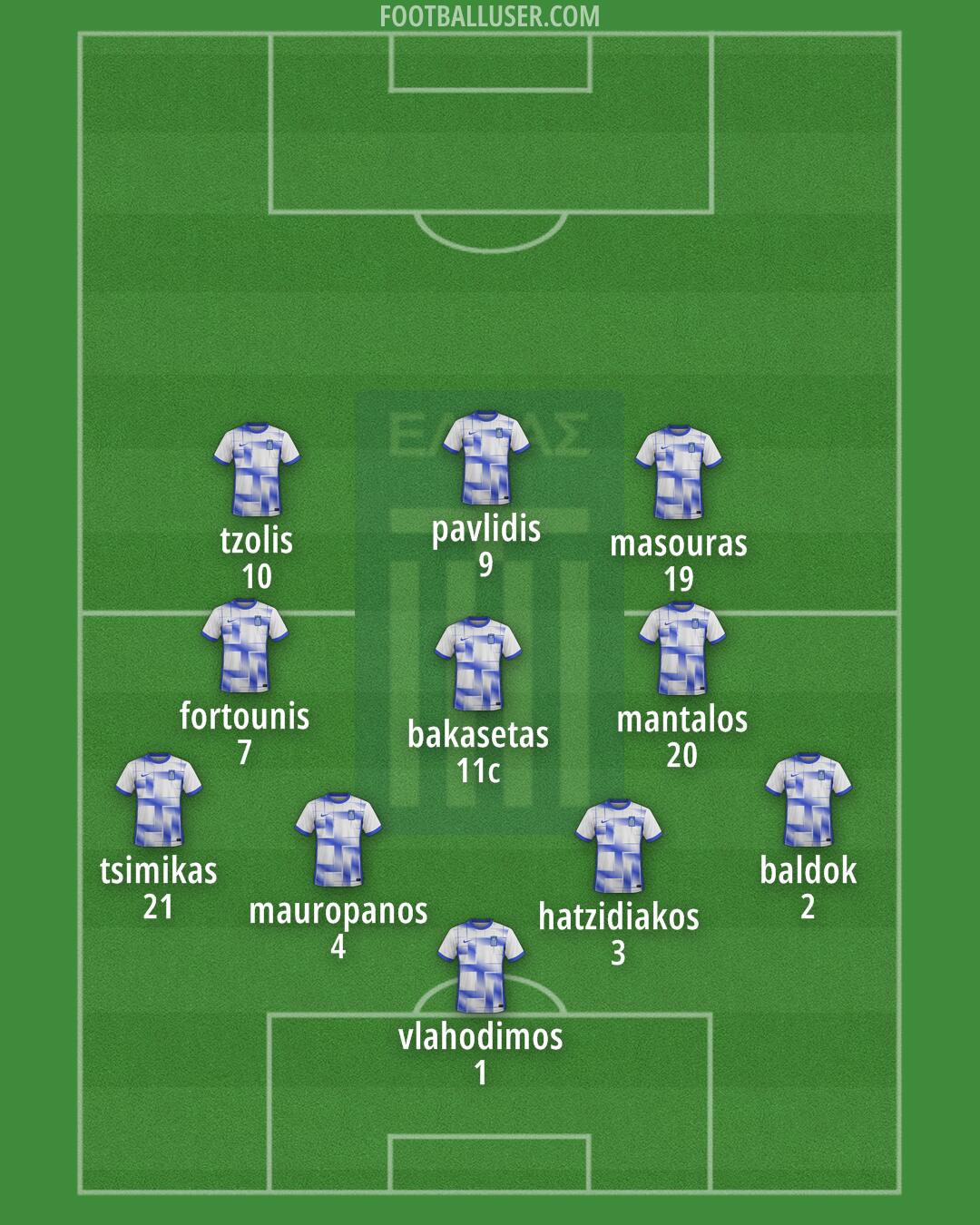

Greece National Football Team Formation
 July 8, 2024


Starting Lineup
vlahodimos (1) · mauropanos (4) · hatzidiakos (3) · baldok (2) · tsimikas (21) · bakasetas (11c) · fortounis (7) · mantalos (20) · pavlidis (9) · masouras (19) · tzolis (10)Greece prefers a high press and quick transition play to catch opponents off guard. This team relies on a 4-3-3 formation to dominate the middle of the pitch and win the ball back high up the pitch. The intent is to play vertically and move the ball forward quickly once possession is regained.
In goal, vlahodimos provides a reliable presence to sweep behind the defensive line. The back four functions as a zonal line with baldok at right back and tsimikas at left back. baldok often acts as an attacking full back to provide width, while tsimikas looks to overlap the winger. In the center, hatzidiakos and mauropanos defend as a pair. hatzidiakos is a ball playing defender who can step into midfield, while mauropanos is dominant in the air to win the header.
The midfield features a three-man midfield with a carrier to link the lines. mantalos plays in the right central role to carry the ball forward and connect the defense to the attack. bakasetas sits in the middle to recycle possession and shield the defense. fortounis plays in the left central role to create from deep and find the feet of the striker. This trio works to press in a mid-block to squeeze the space and deny the turn.
The attacking unit uses three attackers across the front to stretch the defense. pavlidis acts as a pressing centre-forward who can hold up the ball and lead the line. masouras plays on the right as an inverted winger who will cut inside to create central threats. tzolis operates on the left to get to the byline and whip it in toward the center. The movement is designed to create runs in behind and allow the players to combine in tight spaces.
One major strength of this Greece lineup is the ability to press in coordinated waves to win it back high up the pitch. Another advantage is the creation of wide overloads when the full backs push up to support the wingers. This creates space for the midfielders to arrive late into the box and exploit the second ball.
This 4-3-3 is a high intensity formation built for teams that want to dominate through pressing and speed. It is best suited for games against opponents who struggle to play out from the back under pressure.