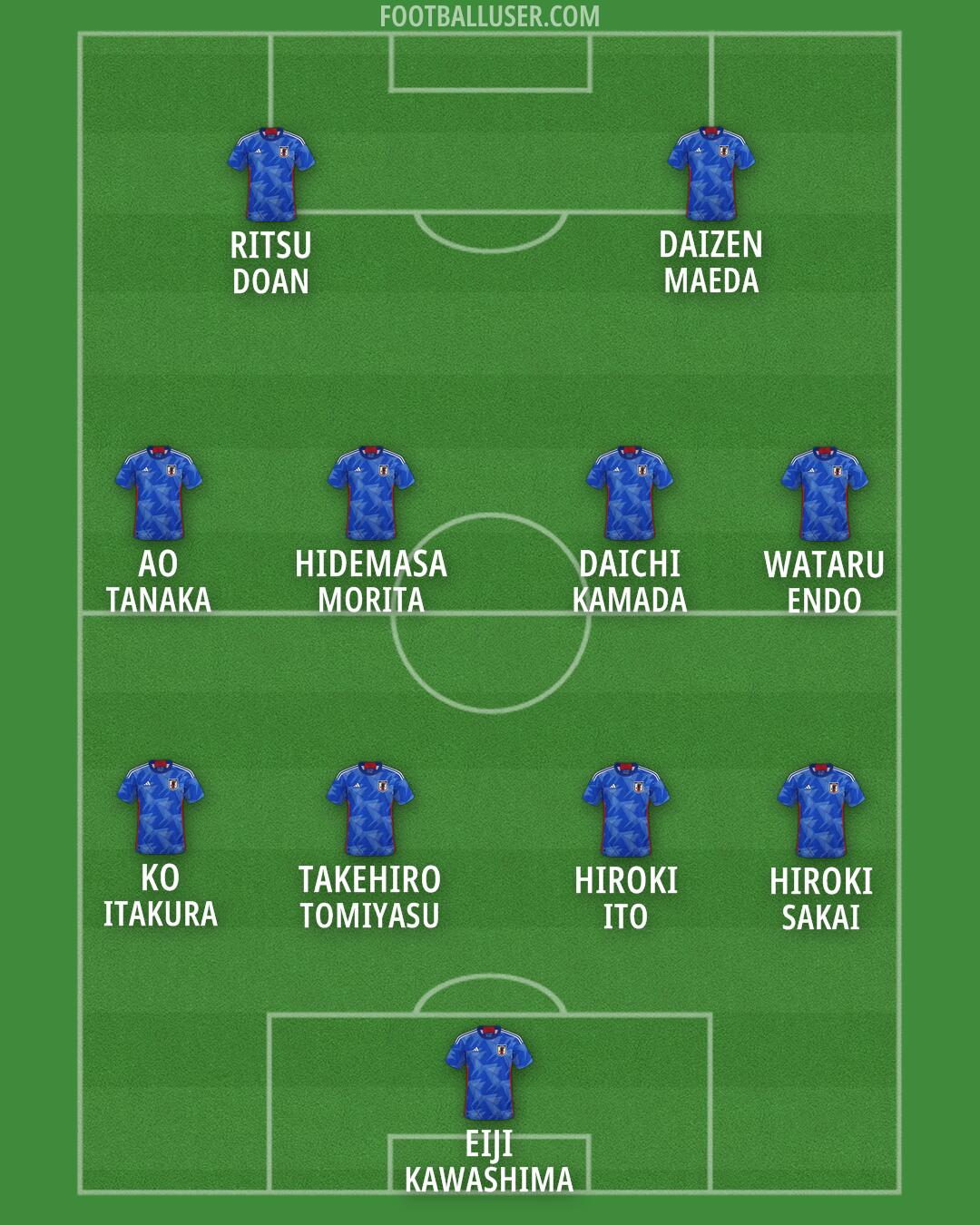

Japan National Football Team Formation
 July 14, 2024


Starting Lineup
EIJI (KAWASHIMA) · HIROKI (SAKAI) · HIROKI (ITO) · TAKEHIRO (TOMIYASU) · KO (ITAKURA) · WATARU (ENDO) · DAICHI (KAMADA) · HIDEMASA (MORITA) · AO (TANAKA) · DAIZEN (MAEDA) · RITSU (DOAN)Japan relies on a direct and high pressing identity within a 4-4-2 formation. This lineup is built to win the ball high up the pitch and strike quickly through coordinated movements. The team looks to use verticality to catch opponents off guard before they can settle into a defensive block.
EIJI starts between the posts to organize the back line. A flat back four provides the foundation, with HIROKI on the right side and KO on the left to provide width. In the center, HIROKI and TAKEHIRO operate as the two central defenders. HIROKI is known for his aerial strength and ability to win headers, while TAKEHIRO focuses on covering space behind the line. The defensive unit aims to maintain a high line to squeeze the space and keep the distances between the lines short.
The midfield works in two banks of four to control the center of the pitch. DAICHI and HIDEMASA operate as a central pairing, where DAICHI looks to carry the ball forward while HIDEMASA works to shield the defense and win the second ball. WATARU occupies the right side to provide width and track back when needed, while AO works on the left. This midfield group focuses on pressing in pairs to force turnovers and then quickly finding the forwards to break the lines.
The attack features two forwards, RITSU and DAIZEN, who play as a partnership to stretch the defense. RITSU acts as a pressing centre-forward, using his intensity to harass the opposition back line. DAIZEN works alongside him, often making runs in behind to exploit gaps. They do not stay static, instead pulling wide or dropping into the channels to create space for the midfielders to arrive late into the box. The goal is to combine in tight spaces or use quick transitions to catch the opposition.
Japan utilizes several tactical advantages with this lineup. The two central midfielders, DAICHI and HIDEMASA, provide a strong presence to win the second ball and prevent opponents from playing through the middle. The formation also allows for effective wide overloads when HIROKI or KO overlap the wingers. This creates high pressing waves that can overwhelm a single defender in one on one situations.
This 4-4-2 formation provides a balanced platform for high intensity pressing and rapid transitions. It is best suited for games where Japan can exploit a disorganized defense through quick, vertical play.