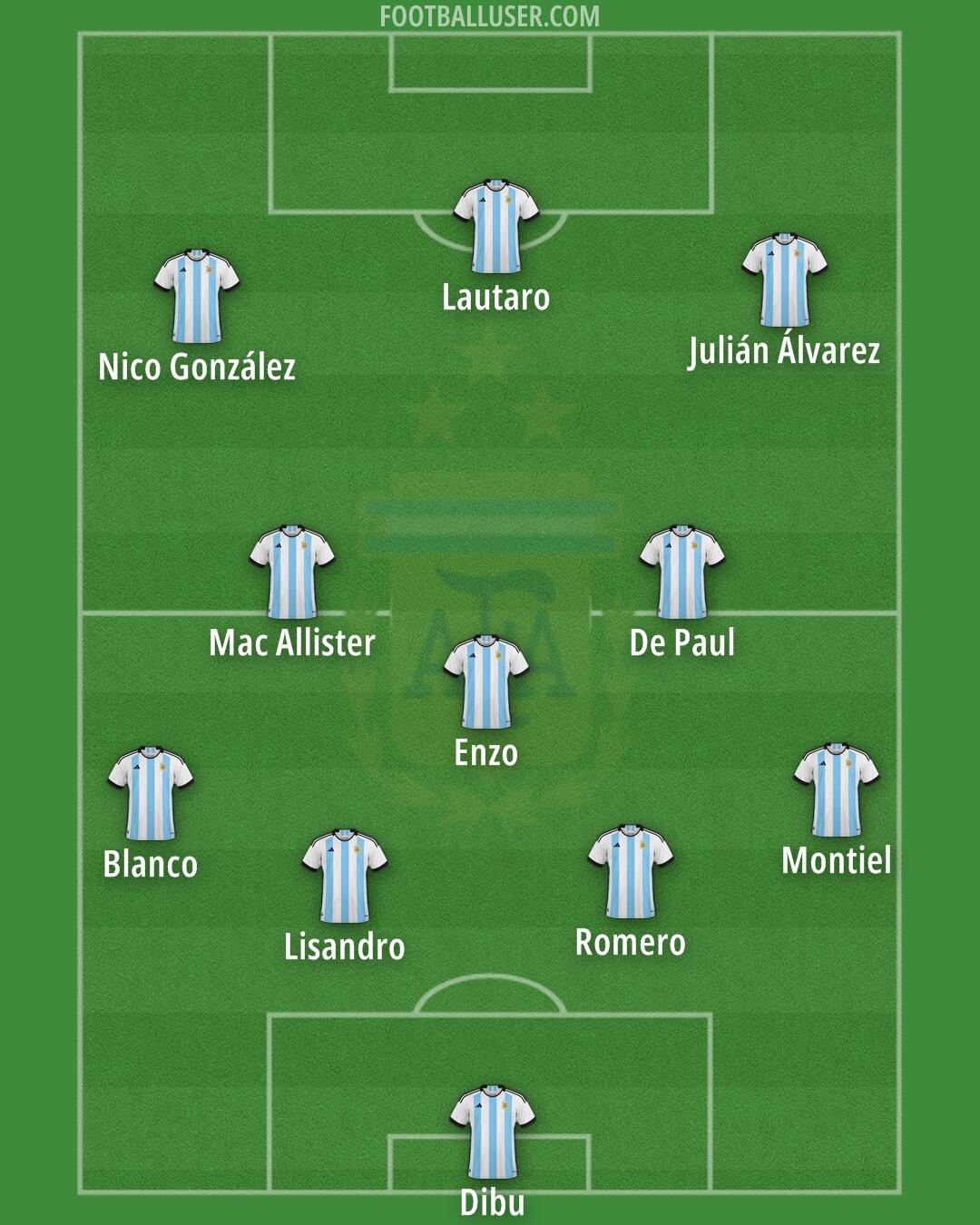

Argentina National Football Team Formation
 July 15, 2024


Starting Lineup
Dibu · Lisandro · Romero · Montiel · Blanco · Enzo · De Paul · Mac Allister · Lautaro · Julián Álvarez · Nico GonzálezArgentina aims to win the ball back high up the pitch and attack with speed through a 5-2-3 formation. This lineup is built to control the game through intense pressing and quick transitions that catch opponents out of position. The team looks to use the width of the pitch while keeping a compact defensive block to stay solid.
Dibu starts in goal to command the area and organize the back line. A back five provides heavy coverage with Enzo and Romero acting as the central defenders to win the second ball and stay dominant in the air. Lisandro plays as the left centre back to cover space when the wing backs push up. Montiel and Blanco operate as attacking wing backs who provide width and support the flanks. The defensive unit works to stay tight and shift together to deny the turn to opposition attackers.
The midfield relies on a two man central unit to control the center of the pitch. De Paul and Mac Allister form a double pivot that connects the defence and attack. De Paul acts as a carrier to drive forward with the ball while Mac Allister looks to create from deep and recycle possession. They must work together to press aggressively and prevent the opposition from playing through the lines. This pair is vital for maintaining balance when the wing backs move high.
Up front, the team uses three attackers to stretch the defence. Lautaro acts as a pressing centre forward to harass the back line and find the feet of the striker. Nico González and Julián Álvarez play as wide attackers who cut inside to create central presence. They look to combine in tight spaces and make runs in behind to exploit gaps. This front line is designed to trigger a press from the front and create chances through quick one twos and cutbacks.
One major advantage for Argentina is the ability to create wide overloads when Montiel and Blanco join the attack. The team also benefits from numerical superiority in the middle when the wingers pull wide to create space for the central players. The speed of transition allows them to hit in behind on the transition before the opposition can reset.
This formation is built for a high intensity game where winning the ball high up the pitch is the priority. It is best suited for matches against teams that try to build slowly from the back.