
Roma Football Formation
 July 16, 2024


Starting Lineup
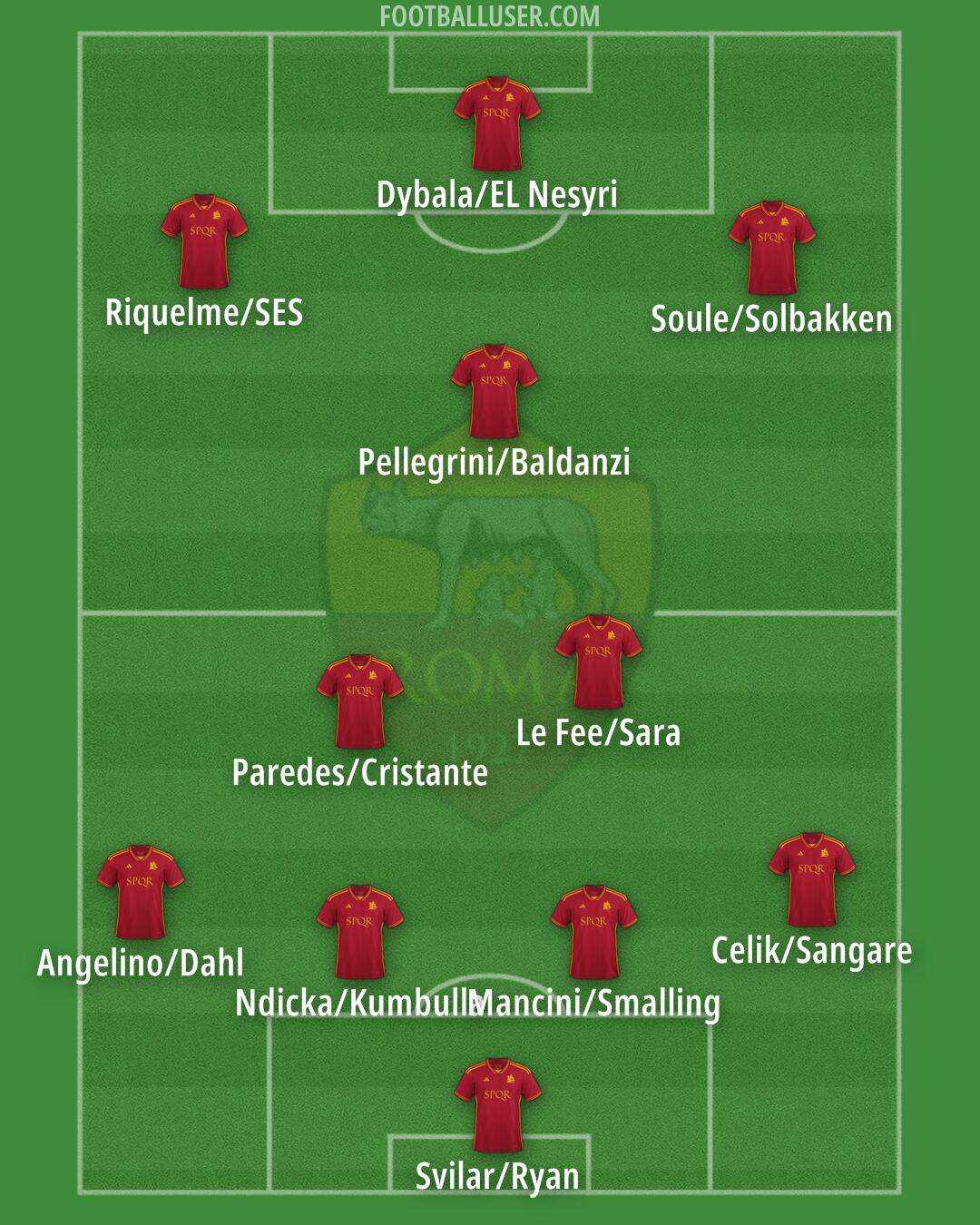
Dybala/EL Nesyri · Soule/Solbakken · Riquelme/SES · Pellegrini/Baldanzi · Paredes/Cristante · Le Fee/Sara · Angelino/Dahl · Ndicka/Kumbulla · Mancini/Smalling · Celik/Sangare · Svilar/RyanRoma aims to dominate through a high press and rapid transitions using a 4-3-3 formation. This lineup is built to control the tempo and win the ball high up the pitch to create immediate scoring chances. The team seeks to stretch the defence by using wide players to create space for central runners.
Svilar operates as the goalkeeper to sweep behind the back line. The defensive unit functions with a flat back four where Angelino acts as an attacking full back to provide width on the left. Celik plays as a more conservative right back to help the defensive block. Mancini and Ndicka form the central pairing, with Mancini providing aerial strength and Ndicka acting as a ball playing defender to start attacks.
The midfield relies on a three-man midfield with a carrier to link the lines. Paredes sits deeper to shield the defence and recycle possession, while Le Fee works to carry the ball forward and progress through the thirds. Cristante offers physicality to win the second ball in the center. Pellegrini operates as the attacking ten behind the striker, looking to find pockets of space and arrive late into the box to support the attack.
Roma utilizes three attackers across the front to pin the opposition back. Riquelme acts as an inverted winger on the left to cut inside and create, while Soule occupies the right wing to stretch the play. Dybala plays as a mobile striker who often drops into midfield to link up play with the advancing midfielders. The front line is tasked to press from the front, forcing the opposition into mistakes so the team can break quickly.
This formation offers significant tactical advantages, particularly the ability to press high in coordinated waves. The presence of Pellegrini and Dybala creates numerical superiority in the half-spaces, making it difficult for opponents to mark everyone. Additionally, the movement of Angelino allows Roma to create wide overloads on the left flank.
The 4-3-3 formation provides Roma with a way to control games through high intensity and technical quality. This lineup is best suited for matches against teams that struggle to play out from the back under pressure.