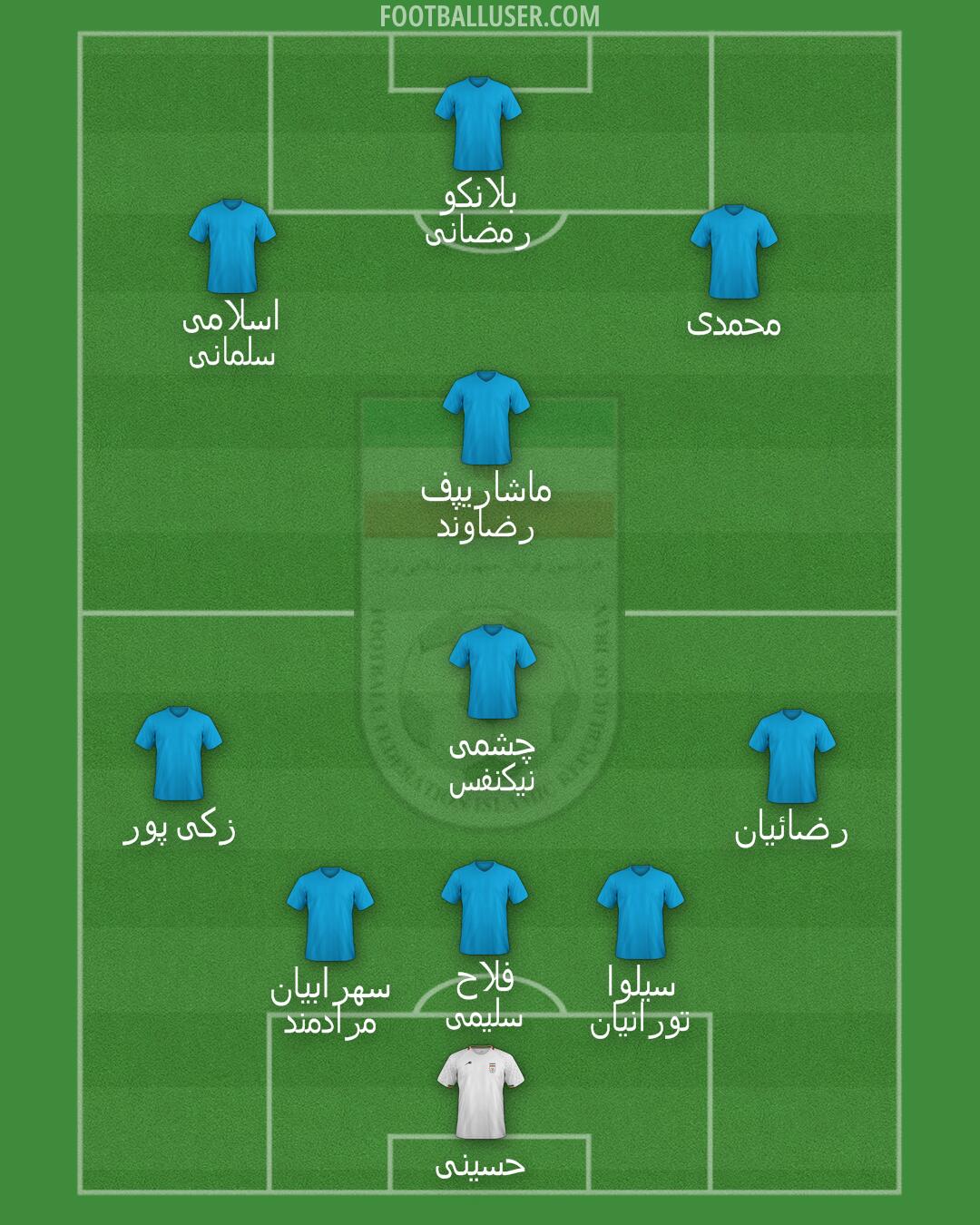

Iran National Football Team Formation
 July 17, 2024


Starting Lineup
حسینی · سیلوا (تورانیان) · فلاح (سلیمی) · سهرابیان (مرادمند) · رضائیان · زکی پور · چشمی (نیکنفس) · ماشاریپف (رضاوند) · بلانکو (رمضانی) · محمدی · اسلامی (سلمانی)Focusing on a high press and quick transitions, Iran utilizes a 3-4-3 formation to stretch the opposition. This lineup relies on verticality to move the ball from the defensive third to the attacking line as fast as possible. By using a heavy front three, the team aims to pin the last defender and create space for late arrivals from the midfield.
In goal, Hosseini acts as the first point of distribution. The defensive unit works as a back three, with Fallah acting as the central defender to win the header and clear the lines. Silva occupies the right side of this unit to cover space, while Sohrabian plays as the left centre back to provide balance. This back line stays compact to defend zonally and prevent runners from finding space between the defenders.
The midfield functions with a central presence designed to control the tempo. Cheshmi sits deep to shield the defence and recycle possession when under pressure. Zaki Pour operates alongside him to connect the defensive and attacking lines, while Rezaian provides energy to drive forward with the ball. Masharipov plays as an attacking ten behind the striker, looking to find the feet of the forwards or play through the lines with clever passing.
Attacking the opposition requires the front three to stay wide and high. Blanco acts as a pressing centre forward to force a long ball from the opposition back line. On the flanks, Mohammadi plays as a wide winger to stretch the defence, while Eslami acts as an inverted winger who looks to cut inside and create chances. These attackers work to trigger a press high up the pitch to win the ball back in dangerous areas.
One major advantage for Iran is the ability to create numerical superiority in the attacking third through the movement of Masharipov. The formation also allows for quick transitions where the wide players can immediately exploit space behind the opposition full backs. This setup forces the opponent to stay narrow to prevent through balls, which in turn leaves more room for the wingers to work in one on one situations.
This 3-4-3 formation is built to dominate games through aggressive pressing and rapid forward movement. It is best suited for facing teams that play a high line and can be caught on the transition.