
Real Madrid Football Formation
 July 21, 2024


Starting Lineup
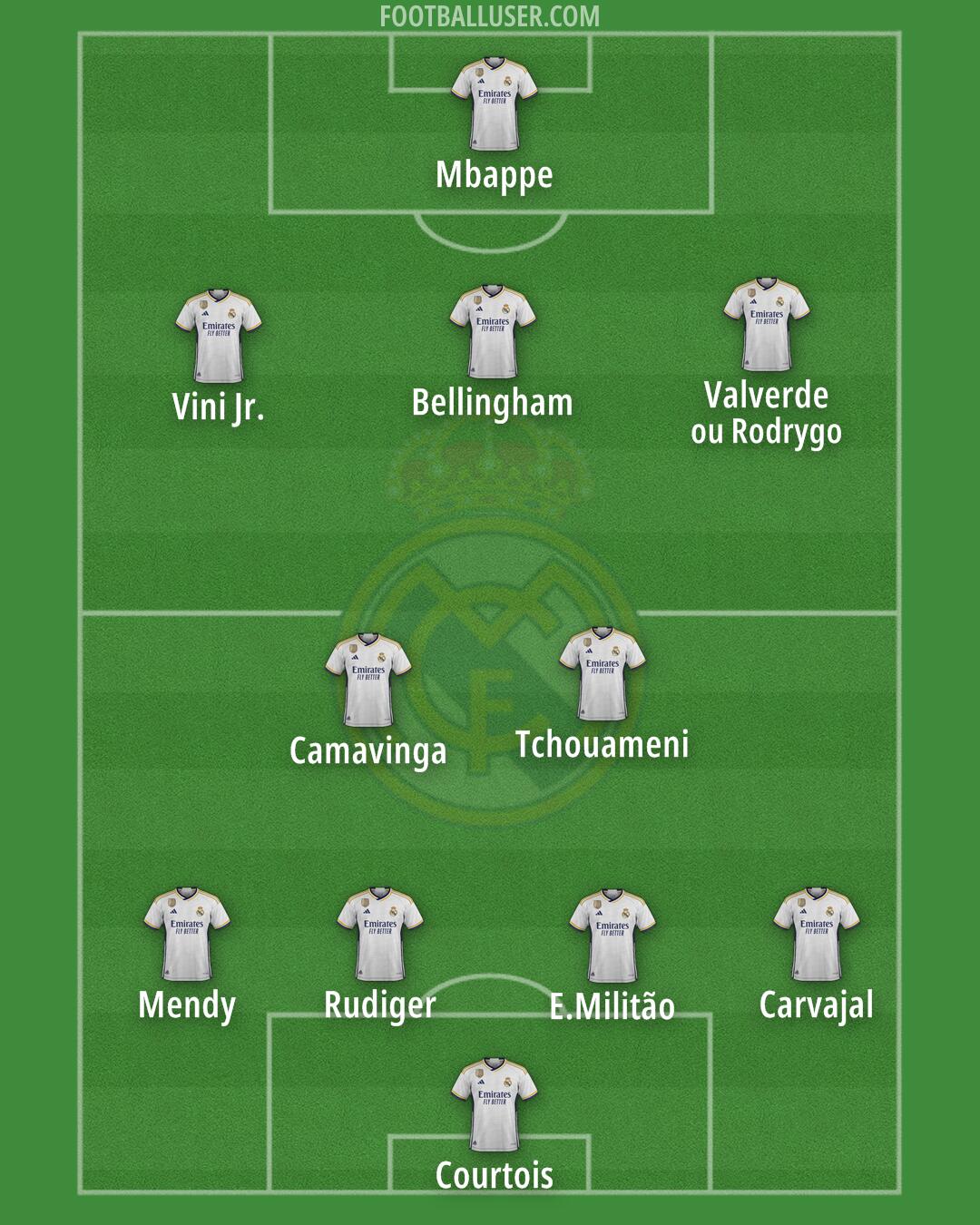
Courtois · Carvajal · Mendy · Rudiger · E.Militão · Tchouameni · Camavinga · Bellingham · Valverde (ou Rodrygo) · Vini Jr. · MbappeReal Madrid looks to overwhelm the opposition with a heavy high press using a 4-2-4 formation. The tactical identity is centered on verticality and lightning quick transitions to punish teams in open space. This lineup is built to push the opposition back and maintain constant pressure in their own half.
In goal, Courtois uses his massive reach to command the area and collect crosses. The back line functions as a flat back four with Mendy at left back and Carvajal at right back. Rudiger and E. Militão act as the two central defenders. Rudiger brings significant aggression and strength to the defensive unit, while E. Militão works to cover the space behind and intercept through balls. Mendy and Carvajal stay relatively narrow to ensure the team remains compact when the opposition tries to switch play.
The midfield relies on a double pivot consisting of Camavinga and Tchouameni. Tchouameni sits deep to shield the defence and win the second ball. Camavinga acts as the carrier, driving forward with the ball to connect the defensive unit to the attack. This duo must work to squeeze the space in the middle and deny the pivot of the opposition. By controlling the center, they allow the front four to stay higher up the pitch.
The attacking unit is extremely aggressive with four players leading the way. Vini Jr operates on the left wing, using his dribbling and pace to cut inside and threaten the goal. Valverde provides width on the right, often looking to deliver early crosses or overlap. In the center, Mbappe and Bellingham act as the two forwards. Mbappe uses his explosive pace to hit in behind the defence, while Bellingham makes late runs into the box to arrive as a shadow striker. This combination creates many chances through quick one-two movements.
One major advantage of this Real Madrid lineup is the ability to press high in coordinated waves. The four attackers can trigger a press from the front to force a long ball from the opponent. Additionally, the team creates significant wide overloads when the wingers and full backs combine to stretch the defence. The sheer speed of transition ensures that they can break quickly once the ball is won back.
This 4-2-4 formation is designed to dominate matches through high intensity and overwhelming numbers in the final third. It is best suited for situations where the team needs to break down a low block or exploit a disorganized defence in transition.