Man Utd Football Formation
 July 21, 2024


Starting Lineup
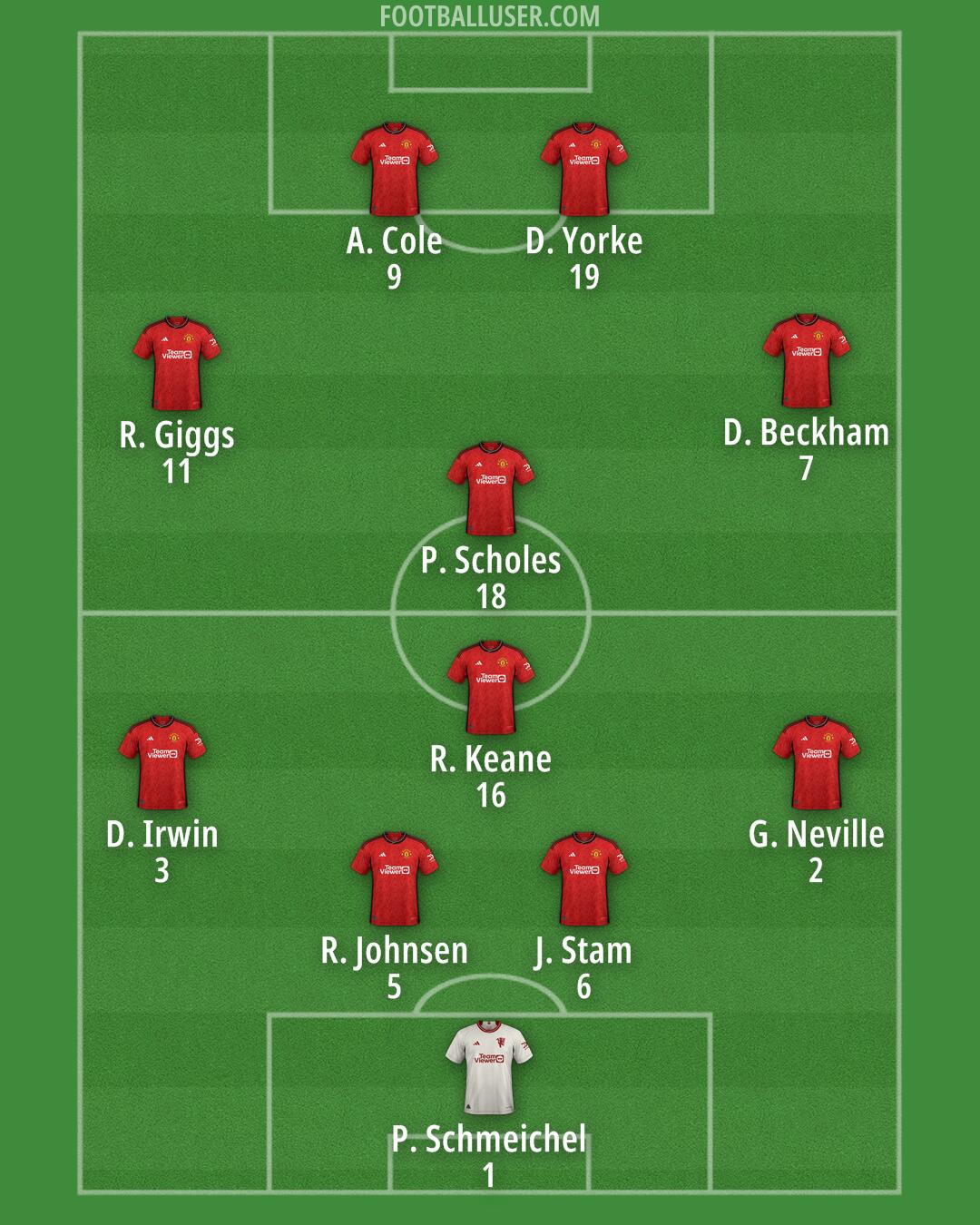
P. Schmeichel (1) · G. Neville (2) · J. Stam (6) · R. Johnsen (5) · D. Irwin (3) · R. Keane (16) · P. Scholes (18) · D. Beckham (7) · R. Giggs (11) · D. Yorke (19) · A. Cole (9)Manchester United seeks to control games through a strong central presence and quick transitions in a 5-3-2 formation. This lineup relies on stability in the middle and the ability to launch attacks through the wide areas. The team is built to sit in a mid-block, squeeze the space, and use the pace of their forwards to punish teams on the break.
P. Schmeichel stays between the posts to organize the back line. The defensive unit functions as a back three consisting of R. Keane, J. Stam, and R. Johnsen. R. Keane acts as the central leader to sweep behind the line and win the second ball. J. Stam uses his aerial strength to defend crosses, while R. Johnsen covers the left side. The wing backs, G. Neville and D. Irwin, provide the width by pushing high to overlap the midfielders or tracking back to form a narrow defensive block when out of possession.
The midfield operates as a three-man midfield with a carrier and a deep playmaker. P. Scholes sits as the single pivot to shield the defence and recycle possession. He is known for his passing range and ability to break the line with long balls. R. Giggs operates on the left to carry the ball forward and connect the lines, while D. Beckham occupies the right side to deliver early crosses and switch play. This trio works to control the tempo and ensure the team can move from a defensive stance into an attacking one quickly.
In the final third, Manchester United utilizes two forwards in a partnership. A. Cole and D. Yorke work together to stretch the defence. A. Cole often looks to make runs in behind the opposition back line, while D. Yorke acts to hold up the ball and link up play between the lines. The team attacks in combinations, using the width provided by G. Neville and D. Irwin to create cutbacks from the byline. When the forwards press from the front, they aim to force a long ball and win it back high up the pitch.
This formation offers several tactical advantages. The back three provides compactness when defending against teams that play with two strikers. The team can also create wide overloads by having the wing backs push up alongside the midfielders. Furthermore, the presence of P. Scholes and D. Beckham allows the team to bypass the midfield with direct passing when they need to counter at pace.
Manchester United employs a solid defensive base that transforms into a dangerous attacking unit. This formation is best suited for facing teams that play with high lines or those that struggle to deal with crosses and quick transitions.