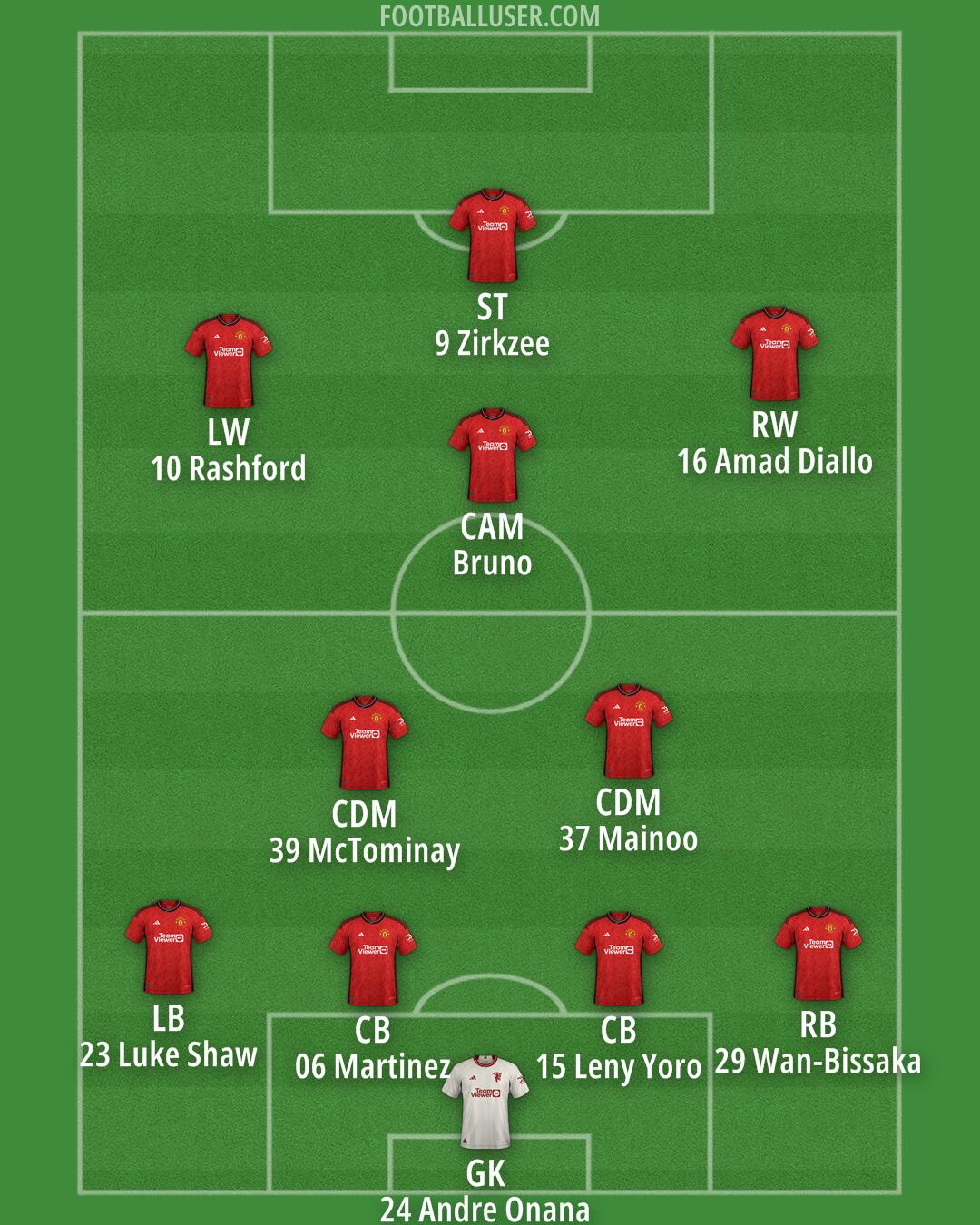
Man Utd Football Formation
 July 23, 2024


Starting Lineup
GK (24 Andre Onana) · LB (23 Luke Shaw) · RB (29 Wan-Bissaka) · CB (06 Martinez) · CB (15 Leny Yoro) · CDM (37 Mainoo) · CDM (39 McTominay) · CAM (Bruno) · RW (16 Amad Diallo) · LW (10 Rashford) · ST (9 Zirkzee)Man Utd aims to control the game through a high press and quick transitions using a 4-3-3 formation. This lineup is built to dominate the ball in the final third and win it back high up the pitch. By keeping the players close together, Manchester United can play through the lines and stretch the defence once they win possession.
The goalkeeper sits behind a flat back four that maintains a high line to squeeze the space. The two central defenders must be ready to cover space behind them and win the header whenever the opposition goes direct. On the flanks, the left back and right back act as attacking wing backs to provide width, while the central defenders focus on clearing the lines and marking the opponent strikers.
A three-man midfield provides the engine for this system, using a double pivot to shield the defence. The two central defensive midfielders work to intercept passes and recycle possession to keep the tempo high. Ahead of them, the attacking midfielder acts as a connector, looking to receive on the half-turn and play through the lines to the forwards. This trio must work to compress the midfield and prevent the opposition from playing out from the back.
In the attacking third, the team uses three attackers to pin the last defender. The left winger and right winger operate as inverted wingers who cut inside to create goalscoring chances, while the striker acts as a focal point to hold up the ball. These front three often press from the front to force a long ball from the opposition. The wide players will also look to get to the byline and cut it back for the midfielders who arrive late into the box.
One major strength of this 4-3-3 is the ability to press high in coordinated waves, making it difficult for opponents to build play. The formation also allows for wide overloads when the full backs overlap the winger to create two on one situations. This creates constant pressure and forces the opposition to defend in tight spaces.
This formation relies on high energy to win the ball back quickly and strike on the transition. It is best suited for matches against teams that try to play out from the back and leave space behind their midfield.