
Legia Football Formation
 July 25, 2024


Starting Lineup
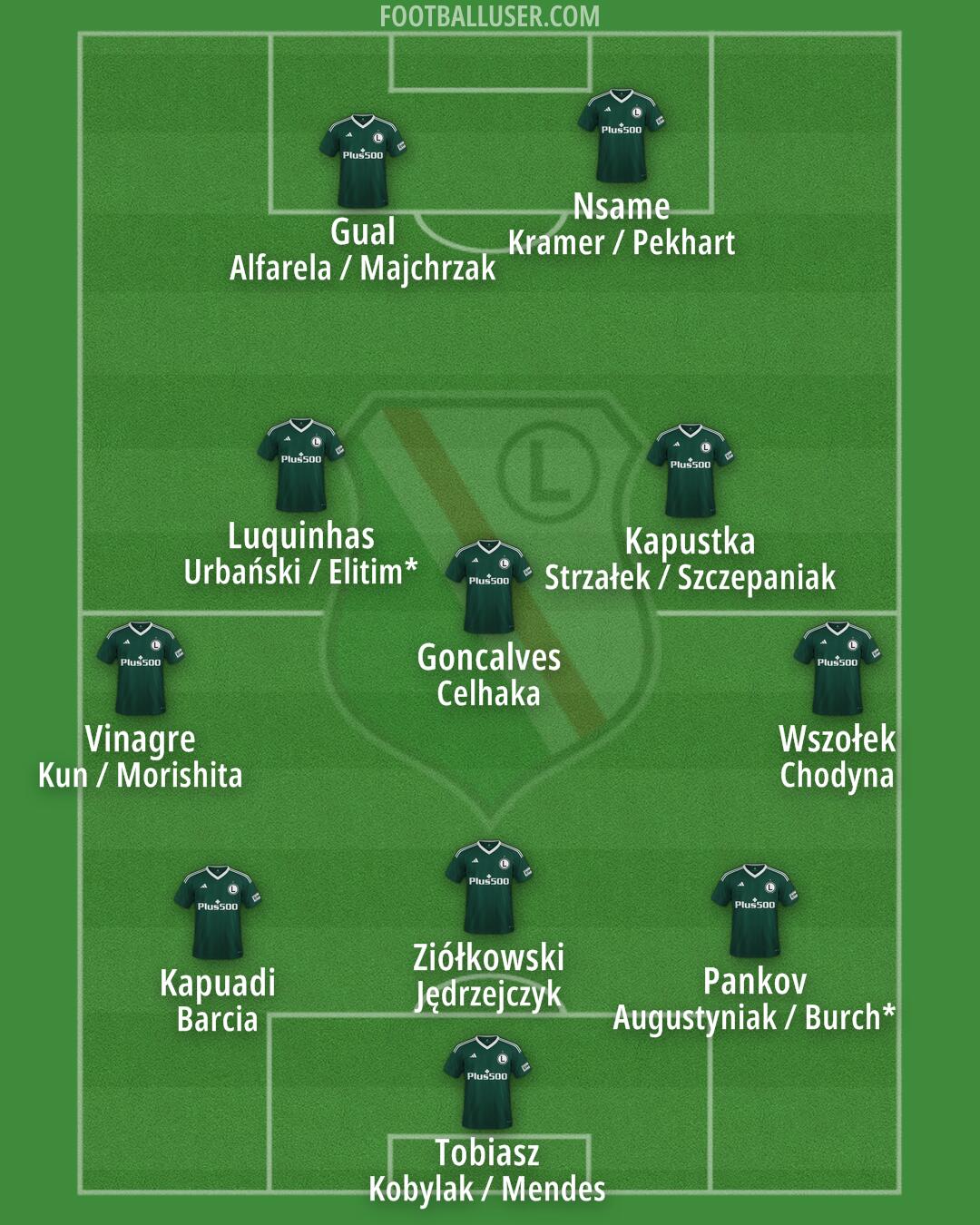
Nsame (Kramer / Pekhart) · Gual (Alfarela / Majchrzak) · Kapustka (Strzałek / Szczepaniak) · Goncalves (Celhaka) · Luquinhas (Urbański / Elitim*) · Vinagre (Kun / Morishita) · Wszołek (Chodyna) · Kapuadi (Barcia) · Ziółkowski (Jędrzejczyk) · Pankov (Augustyniak / Burch*) · Tobiasz (Kobylak / Mendes)Legia operates with an identity centered on high pressing and verticality. The team utilizes a 3-3-4 formation to overwhelm opponents in their own half. This lineup is built to attack relentlessly and win the ball back high up the pitch to keep the pressure constant and force mistakes from the opposition.
Nsame stays between the posts to guard the goal. The defensive unit uses a high line consisting of Kapustka, Luquinhas, and Gual. Kapustka and Gual focus on winning headers and covering space, while Luquinhas operates as a wide centre-back to track runners and manage the flank. This back three works together to squeeze the space, defend zonally, and set the offside trap to prevent runs in behind.
In the middle of the pitch, the midfield functions with a single pivot. Goncalves sits in front of the defenders to shield the back three and protect the center. Vinagre and Wszołek operate as the two central midfielders to connect the defense to the attack. To maintain control, Vinagre looks to recycle possession and play short from the back, while Wszołek attempts to carry the ball forward and play through the lines to break the opposition block.
The attacking lineup features four players across the front line. Pankov and Kapuadi act as wide players to stretch the defense and create width. While Pankov often cuts inside to occupy half-spaces, Kapuadi tries to get to the byline to whip it in. Ziółkowski and Tobiasz operate as a central partnership. These two strikers press from the front to force a long ball and use their physical presence to win the second ball in the final third.
A major tactical advantage for Legia is the ability to press high in coordinated waves. The proximity of the four attackers and the three midfielders allows them to trigger a press quickly and win it back high up the pitch. Furthermore, the formation provides significant numerical superiority in the final third. This allows the team to combine in tight spaces and hit in behind on the transition to catch the defense off guard.
This 3-3-4 formation defines an aggressive and vertical identity for the club. It is most effective against teams that sit deep and struggle to deal with constant pressure and high numbers in the box.