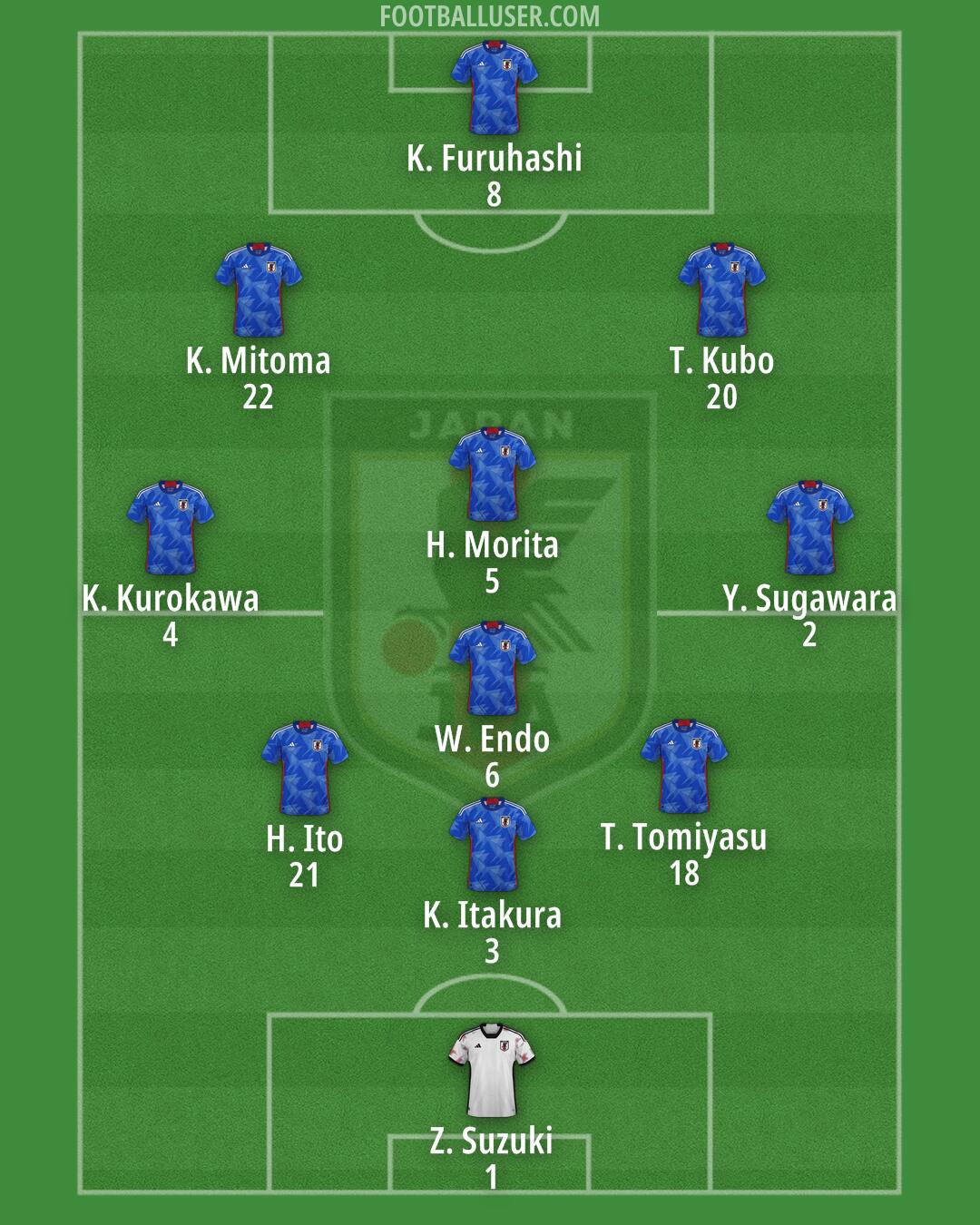

Japan National Football Team Formation
 July 27, 2024


Starting Lineup
Z. Suzuki (1) · Y. Sugawara (2) · T. Tomiyasu (18) · K. Kurokawa (4) · K. Itakura (3) · H. Ito (21) · H. Morita (5) · W. Endo (6) · T. Kubo (20) · K. Mitoma (22) · K. Furuhashi (8)Japan looks to win the ball high up the pitch and transition quickly through a 4-5-1 formation. This lineup focuses on a high press to force turnovers in the opponent half. The team aims to use the speed of their wide players to stretch the defence once they win possession.
Z. Suzuki guards the goal as the unit maintains a high line to squeeze the space. In front of him, a back four consists of T. Tomiyasu at right back and H. Ito at left back. They act as wide defenders who can push forward to support the attack. K. Itakura and W. Endo form the central pairing, with Itakura providing aerial strength and Endo acting as a covering defender. This unit works together to maintain a high line and set the offside trap to keep the opposition from playing through the lines.
The midfield relies on a three-man midfield with a carrier and two attacking midfielders. H. Morita sits centrally to shield the defence and connect the lines. Beside him, Y. Sugawara and K. Kurokawa work to press in a mid-block and win the second ball. T. Kubo and K. Mitoma occupy the half-spaces as attacking midfielders. Kubo uses his dribbling style to pull wide and create space, while Mitoma uses his dribbling to cut inside from the left. This midfield group works to win it back high up the pitch to feed the front line.
Japan employs a lone striker in K. Furuhashi who acts as a pressing centre-forward. He works to pin the last defender and create room for the midfielders. The attack is built through the wide players, K. Mitoma and T. Kubo, who look to receive the ball on the half-turn. They often look to hit in behind on the transition or deliver early crosses. K. Furuhashi often tries to find the feet of the striker or run into the channels to create one on one situations for the wingers.
This formation offers Japan the ability to press high in coordinated waves. By using five midfielders, they can create numerical superiority in the middle of the pitch to recycle possession. The speed of transition is a major advantage, as the team can move from a defensive block to an attacking move in seconds.
Japan uses this 4-5-1 formation to dominate territory through intense pressing. It is best suited for matches against teams that struggle to play out from the back.