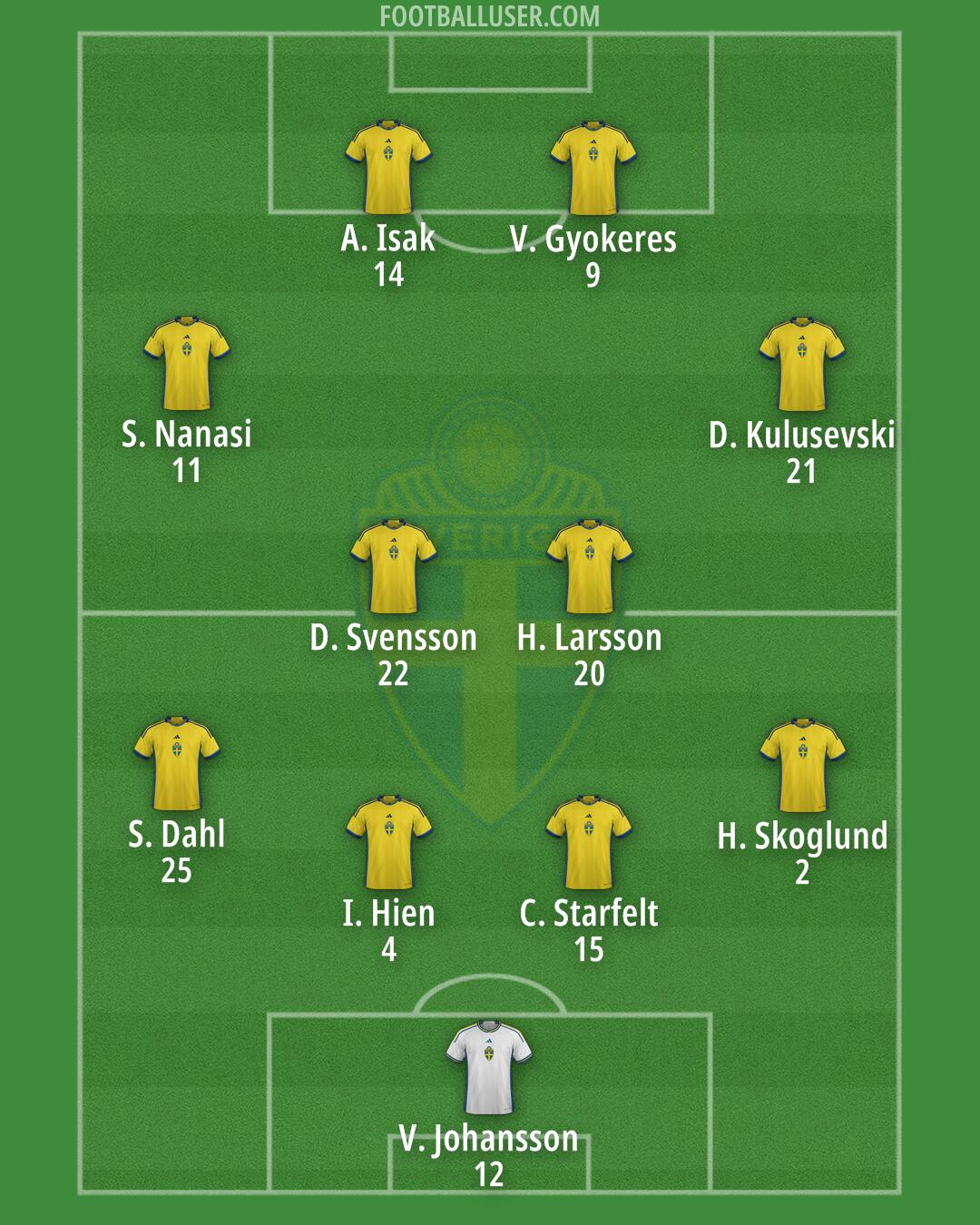

Sweden National Football Team Formation
 July 31, 2024


Starting Lineup
V. Johansson (12) · H. Skoglund (2) · I. Hien (4) · C. Starfelt (15) · S. Dahl (25) · H. Larsson (20) · D. Svensson (22) · D. Kulusevski (21) · S. Nanasi (11) · A. Isak (14) · V. Gyokeres (9)Sweden focuses on a high press and rapid transitions through a 4-2-4 formation. This lineup is built to stretch the opposition and create constant pressure in the final third. By using four attackers, Sweden aims to overwhelm the defensive line and win the ball high up the pitch to attack quickly.
V. Johansson guards the goal while the defensive unit operates behind a high line. C. Starfelt and I. Hien form the central pairing, acting as the main pillars to win headers and cover ground. H. Skoglund and S. Dahl operate as full backs to provide width, though they must track back quickly to defend against counters. The back four works to squeeze the space and keep the team compact when the opposition tries to play out from the back.
The midfield operates as a double pivot to provide balance to the aggressive front line. D. Svensson and H. Larsson occupy the central areas to shield the defence and link the play. D. Svensson works to recover the ball and recycle possession, while H. Larsson carries the ball forward to drive into the half spaces. This pair must be disciplined to prevent the opposition from bypassing the midfield during transition moments.
In the attacking phase, Sweden employs two forwards in a partnership alongside two wide attackers. V. Gyokeres and A. Isak act as the central strike force, using their physical presence to pin the last defender and make runs in behind. S. Nanasi and D. Kulusevski operate as inverted wingers who cut inside to create overloads in the middle. D. Kulusevski uses his dribbling style to beat his marker, while S. Nanasi looks to play through the lines to find the strikers.
This formation offers significant tactical advantages through its ability to press in coordinated waves. The heavy presence in the final third allows for immediate pressure once the ball is lost, often forcing a long ball from the opponent. Sweden also benefits from the speed of transition, as the four attackers are always positioned to exploit gaps in a retreating defensive line.
Sweden relies on a high tempo to disrupt the opponent and create goal scoring chances. This formation is best suited for games where the team needs to overwhelm a deep defensive block or exploit a high line through speed.