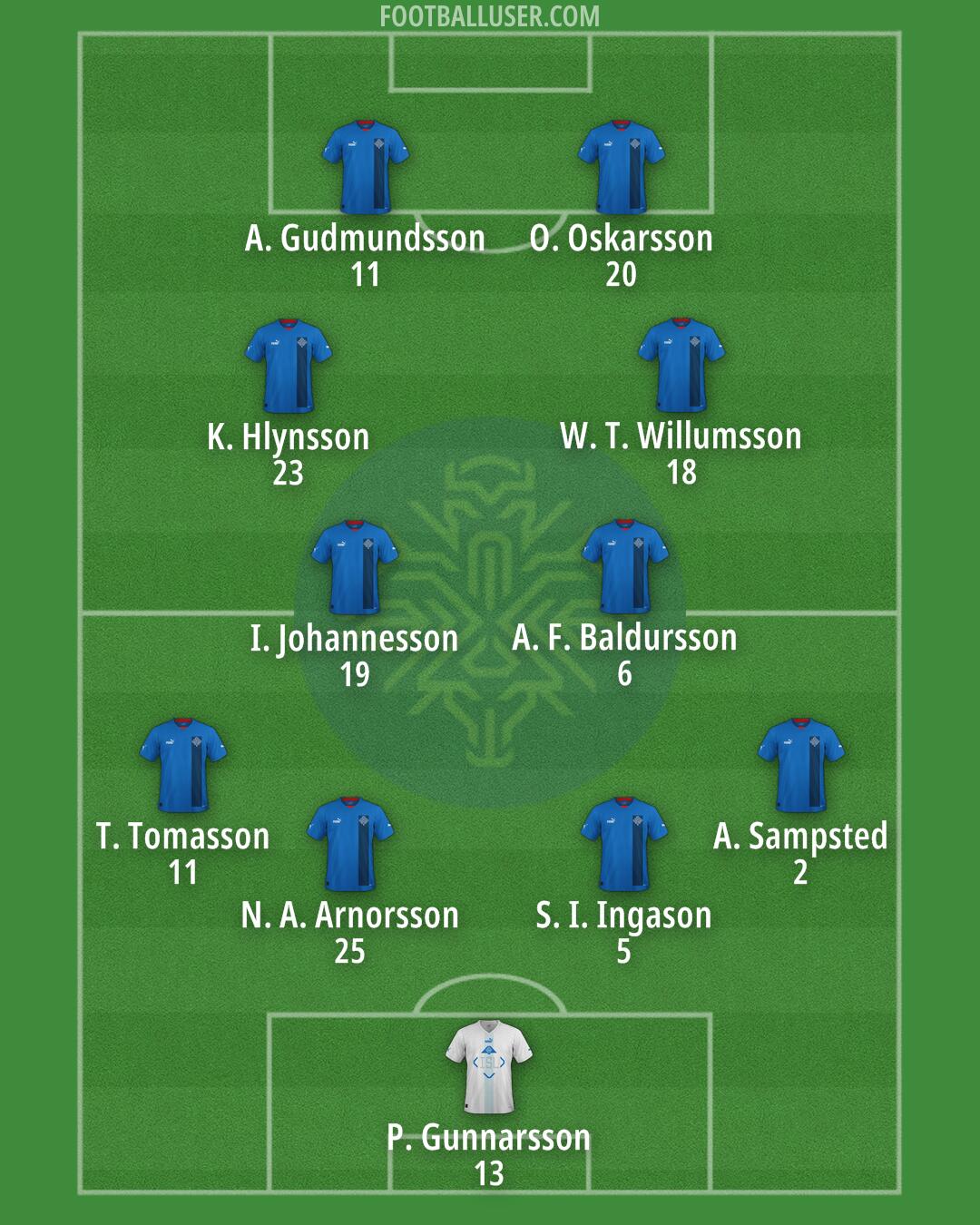

Iceland National Football Team Formation
 August 2, 2024


Starting Lineup
P. Gunnarsson (13) · A. Sampsted (2) · T. Tomasson (11) · S. I. Ingason (5) · N. A. Arnorsson (25) · K. Hlynsson (23) · I. Johannesson (19) · A. F. Baldursson (6) · W. T. Willumsson (18) · A. Gudmundsson (11) · O. Oskarsson (20)Iceland looks to play a direct and vertical game with a 4-2-4 formation. This lineup focuses on getting the ball forward quickly to exploit spaces behind the opposition defense. By spreading the players across the pitch, the team aims to score through rapid transitions and high pressure.
P. Gunnarsson stays between the posts to organize the defensive line. The back four functions as a flat defensive block to prevent easy entries into the box. T. Tomasson and A. Sampsted operate as full backs to cover the wide areas, while S. I. Ingason and N. A. Arnorsson act as the central defenders. Ingason uses his aerial strength to win headers during defensive set pieces, and Arnorsson covers the space behind the advancing full backs. The unit works together to squeeze the space and protect the penalty area.
The midfield operates as a double pivot to provide a screen for the defense. A. F. Baldursson and I. Johannesson occupy the central zones to control the tempo. Johannesson acts as a carrier to drive the ball forward, while Baldursson stays deeper to shield the back four and recycle possession. This pairing is responsible for connecting the defensive unit to the attacking front line, ensuring that the team can transition from defense to attack without losing control in the middle of the pitch.
The attacking line is composed of four players designed to stretch the opposition. K. Hlynsson and W. T. Willumsson act as wide wingers who look to cut inside and create scoring chances. In the center, O. Oskarsson and A. Gudmundsson lead the line as two forwards in a partnership. This duo works to find space between the defenders, using their movement to pull center backs out of position. The forwards press from the front to force a long ball and win the second ball in the final third.
Iceland gains a tactical advantage through the speed of transition when moving from a mid-block to an attacking phase. The 4-2-4 allows for wide overloads when the wingers and full backs combine to create crosses. Additionally, the heavy presence of four attackers can pin the last defender and create chaos in the opposition box.
This formation relies on high intensity to overwhelm opponents in the final third. It is best suited for games where the team needs to hit in behind a high defensive line on the transition.