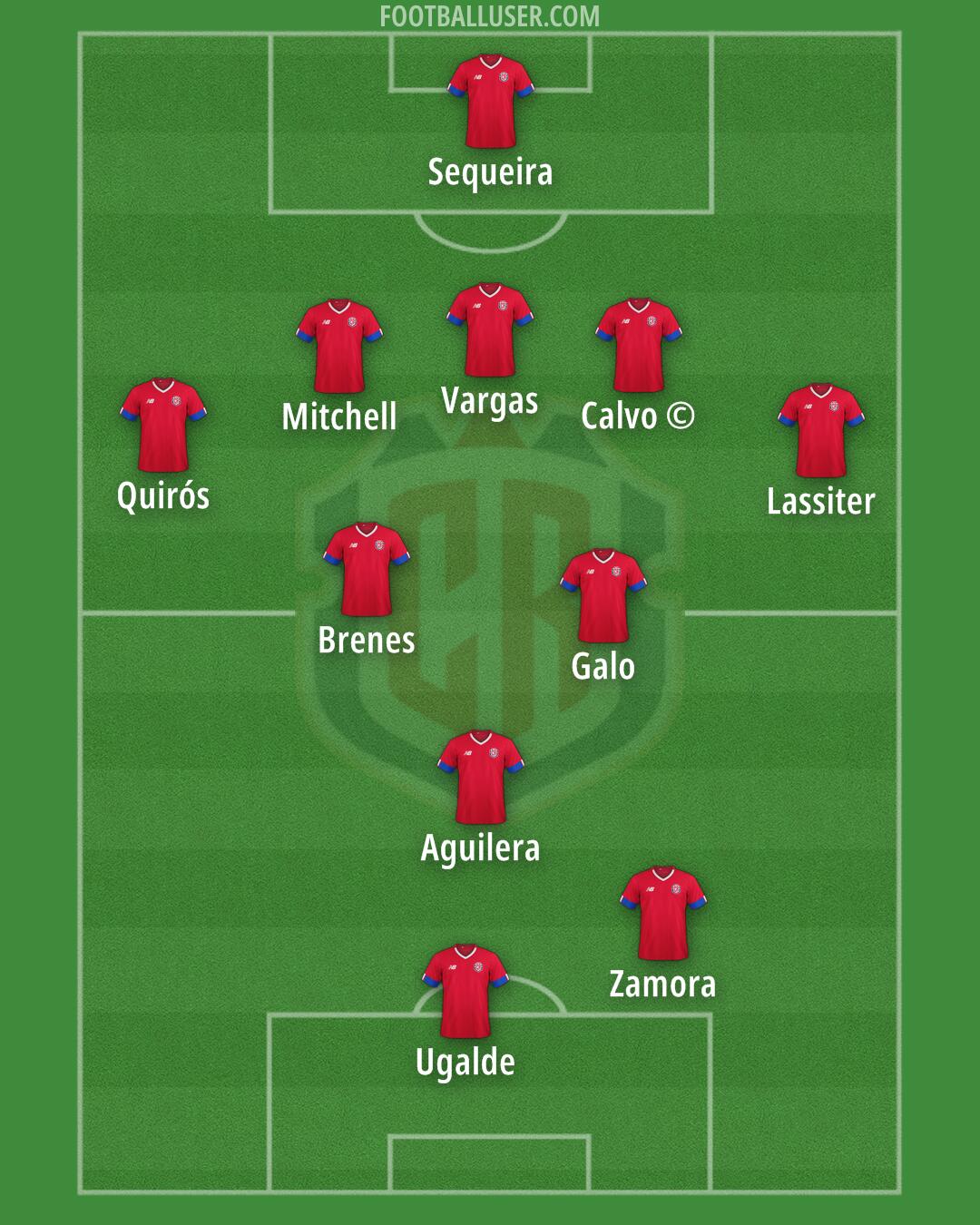

Costa Rica National Football Team Formation
 August 4, 2024


Starting Lineup
Calvo © · Sequeira · Mitchell · Vargas · Quirós · Lassiter · Brenes · Galo · Aguilera · Zamora · UgaldeCosta Rica looks to play with a direct and defensively solid identity using a 5-3-2 formation. This lineup is built to absorb pressure and hit opponents on the transition with speed. The goal is to remain hard to beat while waiting for the right moment to exploit spaces behind the opposition back line.
Sequeira guards the goal as the last line of defense. The defensive unit works as a back five with a narrow defensive block. Mitchell and Vargas provide central stability, while Calvo © acts as a ball playing defender who can step up to intercept play. The wing backs, Quirós and Lassiter, are tasked with providing width, often pushing high to support the attack but needing to track back quickly to defend the flanks. The central defenders must win the header and stay compact to deny runners in the channels.
The midfield operates as a three man midfield with a carrier and an attacking ten. Galo and Brenes work to win the second ball and protect the central area, acting as a shield for the defenders. Aguilera plays as the advanced midfielder in the hole, tasked to find the feet of the striker and play through the lines. This midfield group connects the defensive line to the forwards by recycling possession and driving the ball forward into the half spaces.
The attack utilizes two forwards in a partnership to stretch the defense. Zamora and Ugalde work in close combination to hold up the ball and bring others into play. They do not sit deep but instead look to make runs in behind the defense to receive long balls. The team builds the attack through the wide areas where Quirós and Lassiter can deliver early crosses or cut it back to the arriving runners. This creates a central presence that forces the opposition to defend in tight spaces.
Costa Rica offers several tactical advantages with this 5-3-2. The formation creates a very compact shape when defending, making it difficult for opponents to find gaps. The team can also create wide overloads when the wing backs push up to join the attackers. This allows the side to shift between a low block and a quick counter at pace effectively.
This formation is designed to be defensively resilient and lethal on the break. It is best suited for games against possession based teams that leave space behind their high line.