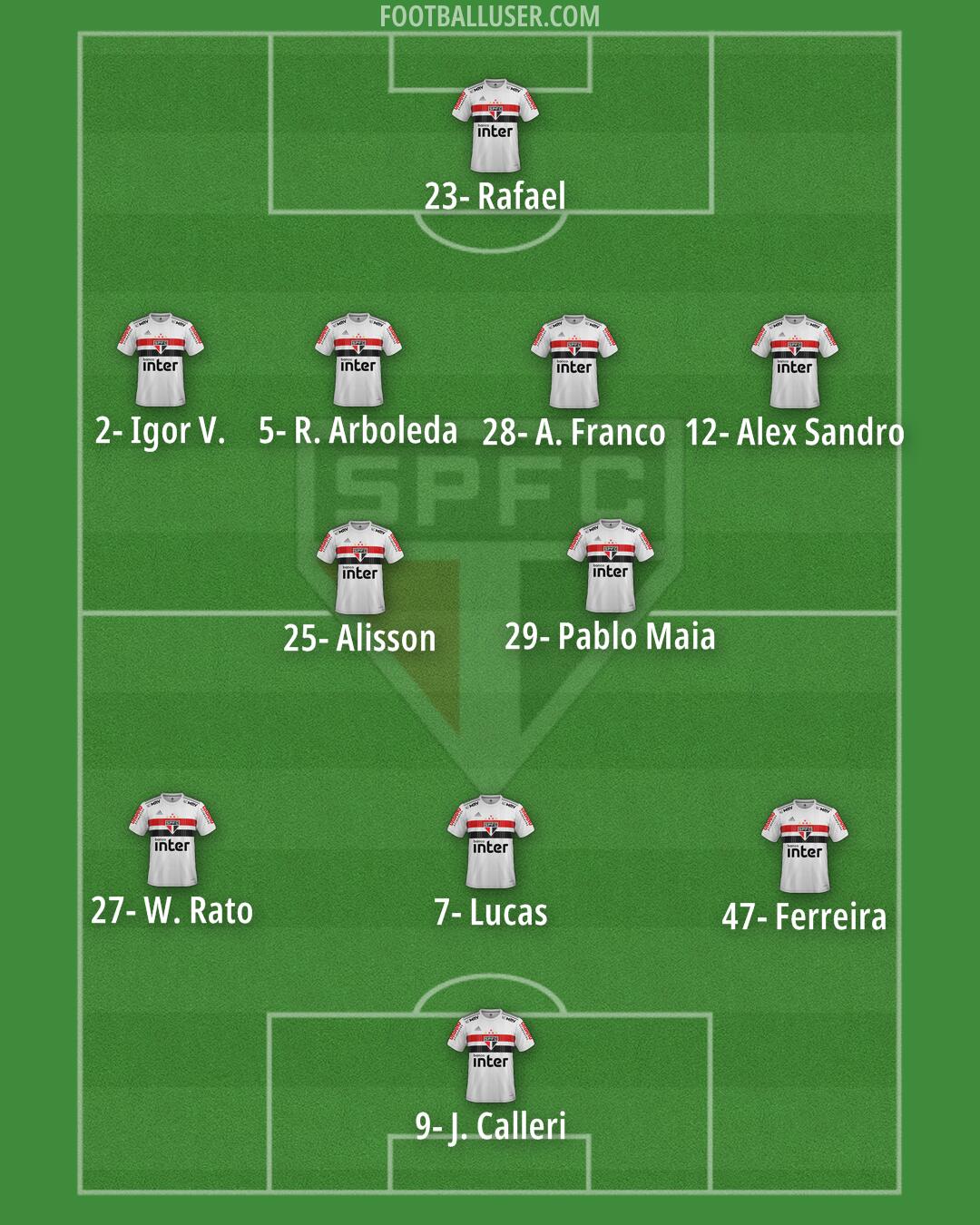

São Paulo Football Formation
 August 12, 2024


Starting Lineup
23- Rafael2- Igor V.
5- R. Arboleda
28- A. Franco
12- Alex Sandro
25- Alisson
29- Pablo Maia
7- Lucas
9- J. Calleri
27- W. Rato
47- Ferreira
This São Paulo lineup focuses on a high press and aggressive verticality, using a 4-2-4 formation. The intent is to stretch the opposition defense and use high energy to win the ball back quickly in the final third. By playing with four attackers, the team seeks to overwhelm opponents through sheer numbers and direct play.
Rafael sits between the posts to start the build up. In front of him, the back four operates as a line designed to squeeze the space. Igor V. provides width on the right while Alex Sandro plays as an attacking left back to push high up the pitch. In the center, R. Arboleda uses his aerial strength to defend crosses and clear the lines, while A. Franco acts as a covering defender to pick up runners. This defensive unit must stay compact to avoid being caught on the break.
The midfield operates as a double pivot to provide some stability. Pablo Maia acts as the primary shield for the defense, working to intercept passes and break up play. Alisson connects the defensive and attacking lines, often looking to carry the ball forward or find the feet of the attackers. These two must work hard to cover the large gaps left when the full backs push high, ensuring they do not get bypassed easily in the middle of the pitch.
São Paulo employs a heavy front line consisting of two central forwards and two wide attackers. J. Calleri acts as a target man, using his strength to hold up the ball and win headers, while Lucas plays in the hole as a second striker to find pockets of space. On the flanks, W. Rato and Ferreira act as inverted wingers who cut inside to create goalscoring chances. This front four is designed to press the opposition back line from the front and create runs in behind.
A major tactical advantage of this formation is the ability to create wide overloads when the full backs join the attack. The team also benefits from numerical superiority in the attacking third, making it difficult for a back four to mark every runner. If the midfield can win the second ball, the speed of transition allows the forwards to attack the defense before they can get organized.
This 4-2-4 formation relies on intense pressing and direct attacking movements to dominate games. It is best suited for matches where the team wants to pin the opponent in their own half and force errors through high pressure.