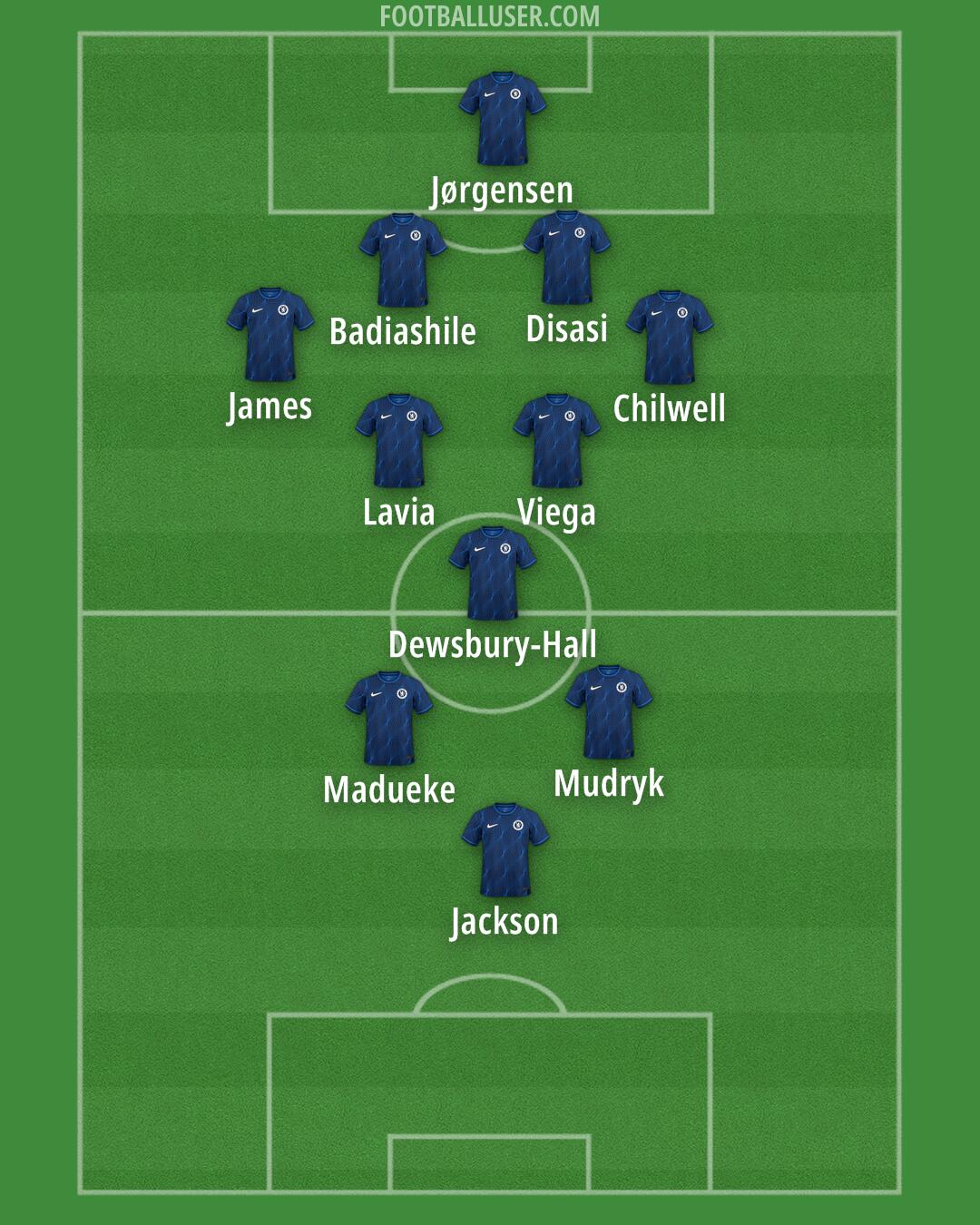
Chelsea Football Formation
 August 12, 2024


Starting Lineup
Jørgensen · Badiashile · James · Viega · Chilwell · Lavia · Dewsbury-Hall · Mudryk · Disasi · Jackson · MaduekeChelsea plays a 4-3-3 formation that focuses on a high press and rapid verticality. The lineup is built to win the ball high up the pitch and attack the opposition defense quickly through direct passing and wide play. This formation allows Chelsea to control the game by squeezing the space in the middle of the pitch and using the width of the field to stretch the defense.
In goal, Jørgensen acts as the first point of the defensive unit. The back four functions as a zonal line that can step up to set the offside trap. James plays as an attacking full back to provide width on the right, while Chilwell looks to overlap on the left. In the center, Disasi and Badiashile occupy the two central defender roles. Badiashile acts as a ball playing defender to help play out from the back, while Disasi covers the space behind to handle runs in behind.
The midfield consists of a three man unit that connects the defense and the attack. Lavia sits in the defensive role to shield the defense and intercept passes. Beside him, Viega works as a carrier to drive forward with the ball and progress through the thirds. Dewsbury-Hall plays as an attacking ten behind the striker, looking to arrive late into the box and play through the lines. This group works to win the second ball and recycle possession to maintain control.
The attacking front line uses three attackers to pin the last defender. Jackson works as a pressing centre forward to force long balls from the opposition. On the flanks, Mudryk acts as an inverted winger who cuts inside to create space, while Madueke stays wide to isolate a one on one situation. Madueke uses his dribbling to beat his marker. James and Chilwell often overlap the winger to create overloads. Jackson looks to hold up the ball for the oncoming midfielders.
The primary strengths of this Chelsea formation are the speed of transition and the ability to press in high waves. By using Lavia to hold the formation, the team can commit more players forward. The team can also create wide overloads by having the full backs push up. This creates many options to deliver early crosses or cut it back from the byline.
This 4-3-3 formation relies on high intensity and quick ball movement to break down opponents. It is best suited for matches against teams that play a high defensive line and can be caught on the transition.