
Rosario Central Football Formation
 August 12, 2024


Starting Lineup
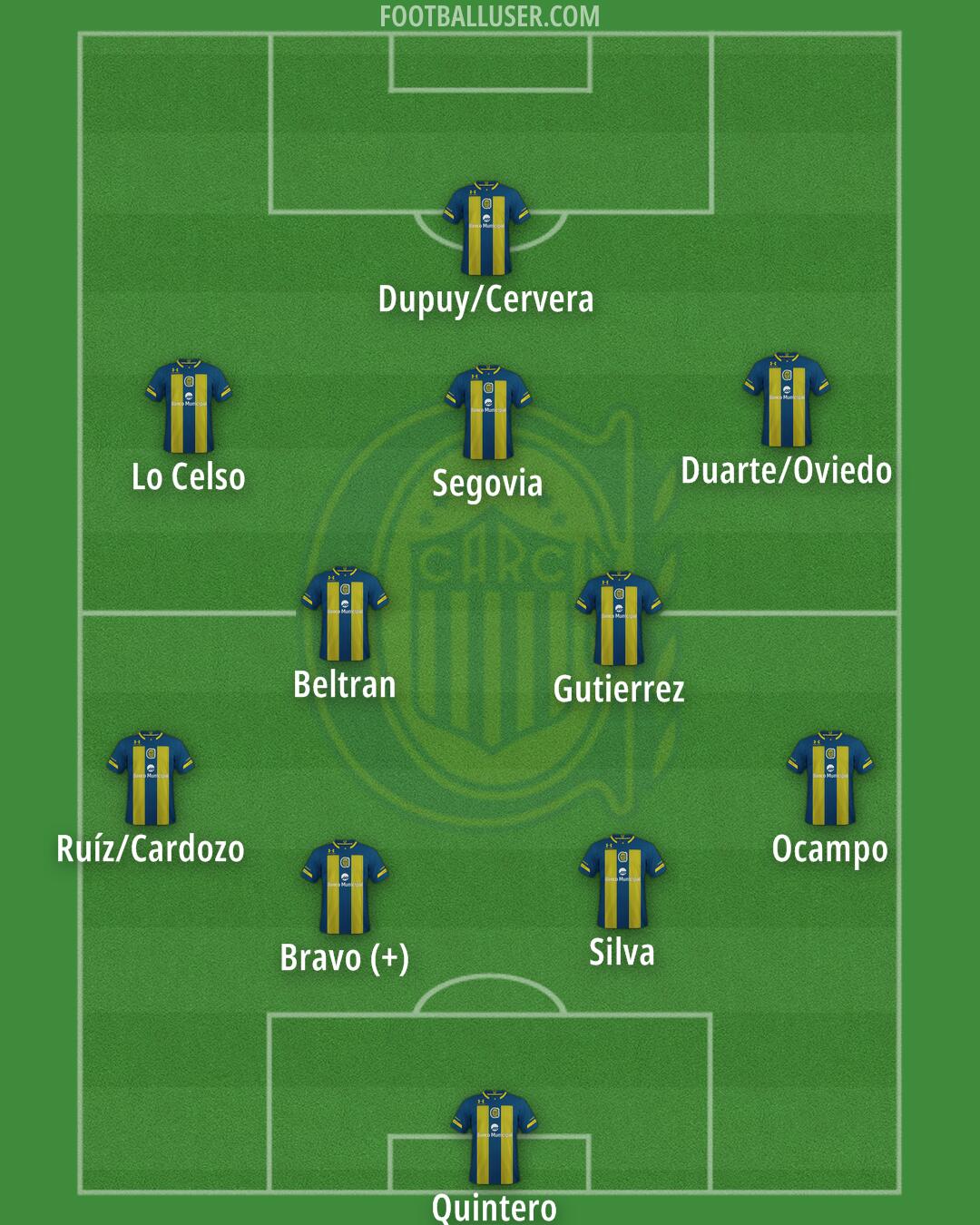
Quintero · Bravo (+) · Silva · Ocampo · Ruíz/Cardozo · Beltran · Lo Celso · Gutierrez · Segovia · Duarte/Oviedo · Dupuy/CerveraHeavy pressure and direct attacking play define the identity of Rosario Central. The team utilizes a 4-2-4 formation to hunt for the ball high up the pitch. This lineup is built to play a vertical game, looking to move from defense to attack with as few touches as possible.
Quintero guards the goal as the primary line of defense. The back four features Ocampo at right back and Ruíz or Cardozo at left back to provide width. In the center, Bravo, the captain, and Silva act as the two central defenders. Bravo uses his aerial strength to win headers and lead the line, while Silva focuses on his ability to cover the space behind a high line. The defenders must stay close together to defend zonally and prevent the opposition from playing through the lines.
The midfield is built around a double pivot consisting of Gutierrez and Beltran. This duo is tasked with shielding the defense and winning the second ball whenever the front four press. Gutierrez and Beltran must work to compress the midfield and prevent opponents from turning in the center. They serve as the connection, looking to receive the ball from the defenders and carry the ball forward to start the attack.
The attacking unit is split into four players to stretch the opposition defense. Lo Celso operates on the left wing, using his technical ability and passing range to cut inside and find the feet of the strikers. Duarte or Oviedo provides width on the right wing. Segovia and either Dupuy or Cervera lead the line as two central forwards. This formation encourages the wingers to cut inside to create goal-scoring chances, often aiming to hit in behind on the transition.
A primary tactical advantage of this 4-2-4 formation is the ability to press high in coordinated waves. By placing four players near the opposition back line, Rosario Central can trigger a press and win it back high up the pitch. The team also benefits from numerical superiority in the attacking third, which allows them to isolate wide players in one on one situations. This creates many opportunities to combine in tight spaces and break the line.
This formation is designed for an aggressive, high-pressing style of play. It is best suited for matches where the team needs to force a long ball from the opponent and exploit space behind a high defensive line.