Celtic Football Formation
 August 16, 2024


Starting Lineup
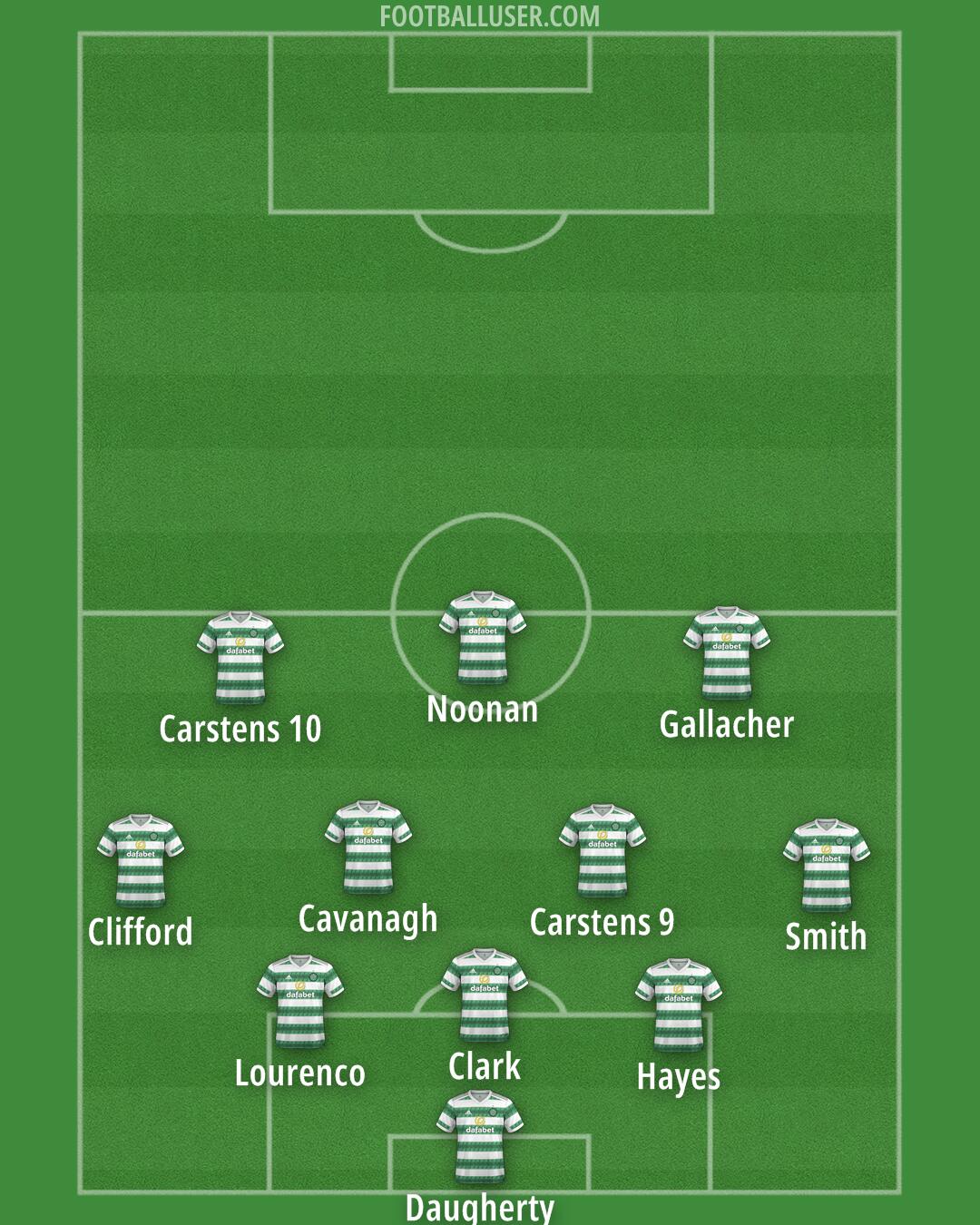
Daugherty · Clark · Hayes · Lourenco · Smith · Carstens 9 · Cavanagh · Clifford · Noonan · Gallacher · Carstens 10Celtic plays a high press, vertical game using a 3-4-3 formation. This lineup is built to win the ball high up the pitch and hit the opposition quickly. The goal is to create constant pressure in the final third and use rapid transitions to catch defenders out of position.
Daugherty plays between the posts to manage the defensive unit. Behind the midfield, a back three consisting of Hayes, Clark, and Lourenco maintains a high line to keep the team compact. Hayes and Lourenco operate as wide centre-backs who can step up into space, while Clark holds the line to cover any runs in behind. This defensive unit works together to squeeze the space between the lines and force the opposition into long balls.
The midfield utilizes a central pairing of Carstens and Cavanagh to control the middle of the pitch. Carstens and Cavanagh act as the engine, with one player tasked to press aggressively to win the ball high and the other to recycle possession and connect the back line to the attack. Smith and Clifford operate as wide midfielders, providing width and much needed cover for the defenders. They must track back to help the defense while also being ready to carry the ball forward into the attacking third.
In the attacking phase, Celtic uses three forwards to stretch the defence. Noonan leads the line as a pressing centre-forward, looking to harass the opposition defenders and find space in the box. Carstens and Gallacher play as wide attackers, with Carstens cutting inside to create more central presence and Gallacher looking to pull wide and deliver crosses. This front three works to pin the last defender and create chances through combinations and quick movements.
One tactical advantage for Celtic is the ability to press in coordinated waves, making it difficult for opponents to play out from the back. The formation also allows for wide overloads when Smith and Clifford push forward to support the wingers. This creates numerical superiority in various areas of the pitch and forces the opposition to shift constantly, often leaving gaps for late runs into the box.
This 3-4-3 formation focuses on aggressive pressing and rapid attacking transitions. It is best suited for games against opponents who struggle to play under intense pressure or who leave large spaces behind their midfield.