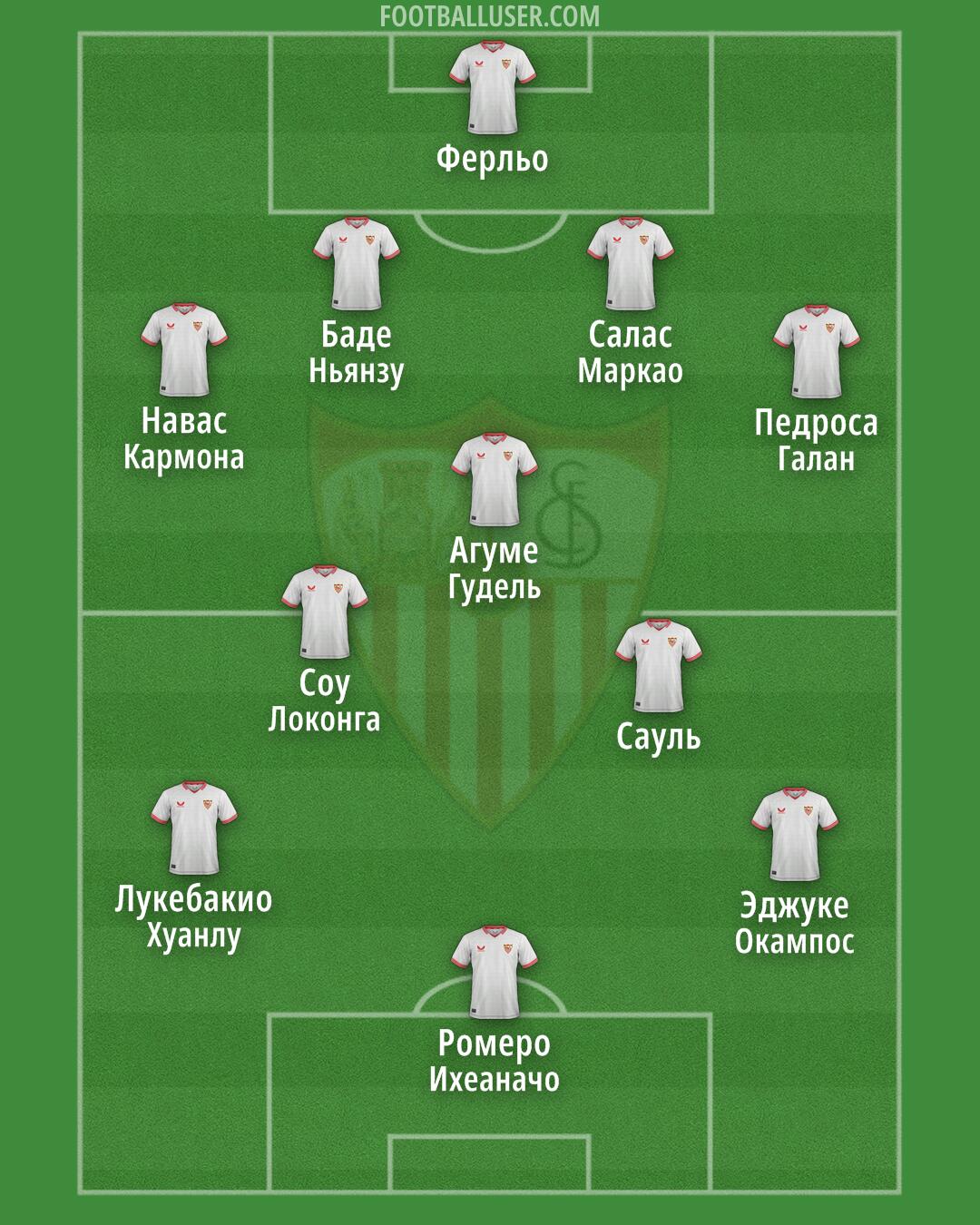

Sevilla Football Formation
 August 19, 2024


Starting Lineup
Ферльо · Навас (Кармона) · Баде (Ньянзу) · Салас (Маркао) · Педроса (Галан) · Агуме (Гудель) · Соу (Локонга) · Сауль · Лукебакио (Хуанлу) · Эджуке (Окампос) · Ромеро (Ихеаначо)Sevilla focuses on a quick transition game using a 5-2-3 formation. This lineup is built to be a counter attacking force that sits deep to lure the opposition forward. By staying compact, the team aims to win the second ball and strike quickly when the opponent loses control.
Ферльо stands between the posts to anchor the defense. The back five consists of Агуме, Баде, and Салас in the central trio, with Агуме acting as the primary presence to win the header and clear the lines. Баде provides significant aerial strength, while Салас stays close to the center to cover the space. On the flanks, Навас works as an attacking wing back on the right, using his immense experience to overlap the winger. Педроса plays as the left wing back, providing width and helping to press the opposition in a mid block.
A double pivot manages the midfield. Сауль and Соу are tasked with controlling the central zone. Сауль uses his wide passing range to switch play and connect the defensive and attacking lines. He often carries the ball forward to drive the team out of their own half. Соу acts as the shield for the defense, pressing aggressively to win the ball high up the pitch and breaking up play. This duo works to recycle possession and find the passing lanes to the front three.
When attacking, Sevilla uses three players to create constant pressure. Ромеро plays as the lone striker, working to hold up the ball and wait for support. Эджуке and Лукебакио operate as inverted wingers on the left and right, often cutting inside to attack the near post or the far post. These players move into the half spaces to pull defenders out of position. The front line is designed to press from the front, forcing the opponent to play long and allowing the back five to defend zonally.
One major advantage is the wide overloads created by Навас and Педроса when they push high. This forces the opposition to track back and leaves gaps in their own midfield. Another strength is the speed of transition, as the team can quickly hit in behind on the transition once the midfield wins possession. The compactness of the back five makes it very difficult for opponents to find space in central areas.
This formation is a heavy defensive unit designed to strike on the break. It works best when facing possession based teams that push too many players into the final third.