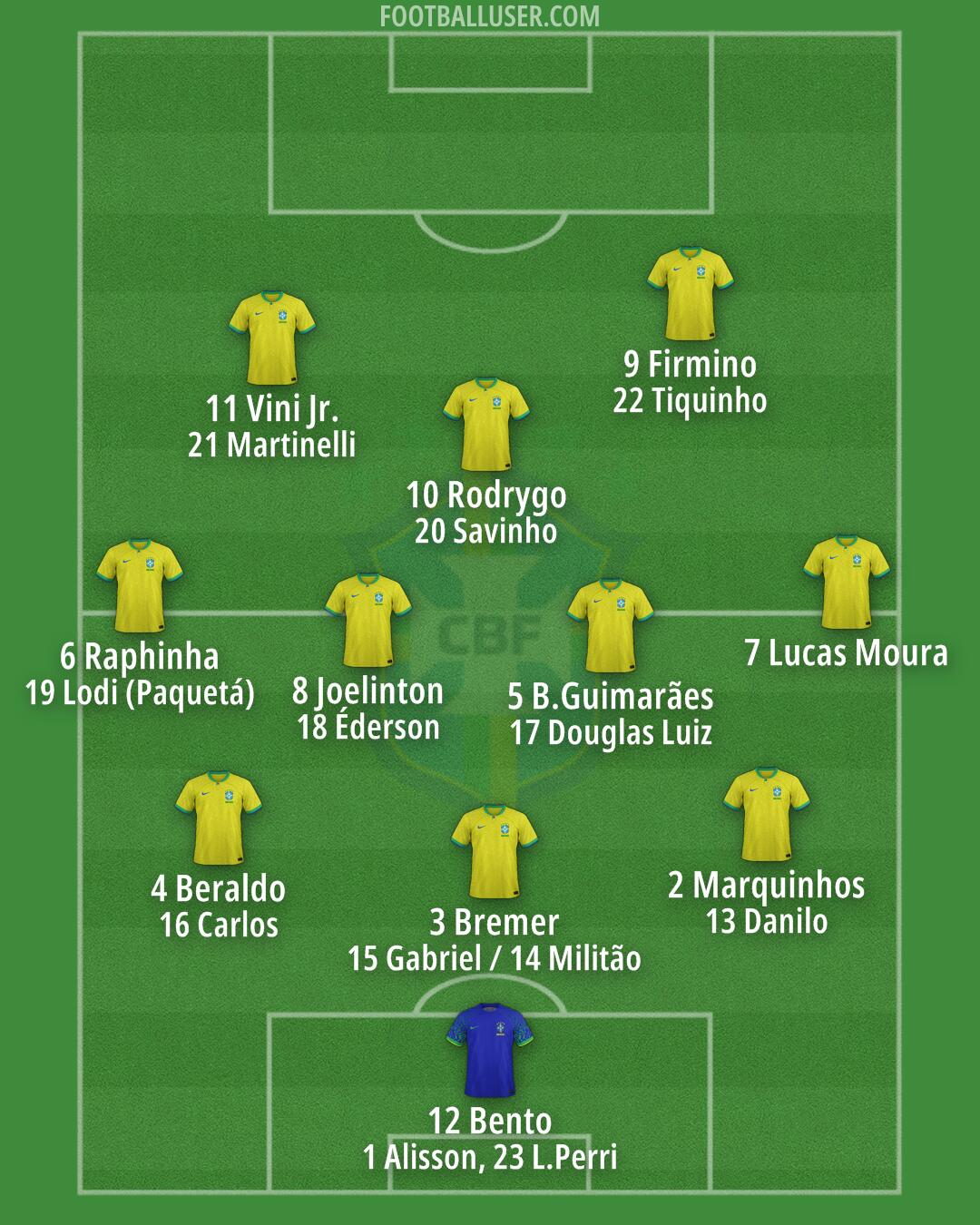

Brazil National Football Team Formation
 August 22, 2024


Starting Lineup
12 Bento (1 Alisson, 23 L.Perri)2 Marquinhos (13 Danilo)
3 Bremer (15 Gabriel / 14 Militão)
4 Beraldo (16 Carlos)
7 Lucas Moura
5 B.Guimarães (17 Douglas Luiz)
8 Joelinton (18 Éderson)
6 Raphinha (19 Lodi (Paquetá))
10 Rodrygo (20 Savinho)
9 Firmino (22 Tiquinho)
11 Vini Jr. (21 Martinelli)
Brazil looks to control the tempo through a high press and rapid transitions using a 3-5-2. This formation relies on verticality to catch opponents out of position, making it a setup built to strike quickly once the ball is won. The lineup is designed to dominate the central areas while using wing backs to provide necessary width in the final third.
Bento plays between the posts to anchor the defensive unit. Ahead of him, a back three consists of Marquinhos, Beraldo, and Bremer. Marquinhos acts as a ball playing defender on the right, while Beraldo covers the left side. Bremer provides aerial strength and physical presence to hold the line. This back three functions as a zonal line that can shift to cover wide areas when the wing backs push high, ensuring the team remains compact when defending.
The midfield is a five man unit that connects the defense to the attack. B.Guimarães and Joelinton operate in a double pivot to shield the defense and win the second ball. B.Guimarães uses his passing range to recycle possession, while Joelinton provides the engine to drive forward with the ball. Raphinha and Lucas Moura operate as wide players who must cover the entire flank, acting as wing backs to provide width. Rodrygo plays as an attacking ten behind the strikers, looking to find pockets of space and play through the lines to break the opposition defensive block.
In the attacking phase, Brazil employs two forwards in a partnership. Vini Jr. operates as a mobile striker who often cuts inside to use his dribbling style, while Firmino plays as a second striker who drops into the hole to link up play. This movement creates space for Rodrygo to arrive late into the box. The team builds attacks by spreading wide with Raphinha and Lucas Moura, using their runs to stretch the defence and create cutbacks from the byline. The forwards press the opposition back line intensely to force a long ball.
This formation offers Brazil several tactical advantages. The double pivot of B.Guimarães and Joelinton provides numerical superiority in the middle of the pitch, making it hard for opponents to control the game. The use of Raphinha and Lucas Moura allows for wide overloads when they overlap the winger, creating chaos in the final third. Additionally, the movement of Firmino and Rodrygo allows the team to combine in tight spaces, making them very dangerous in transition.
The 3-5-2 formation gives Brazil a powerful central presence and the ability to attack with speed. It is a setup best suited for matches against teams that play a high line or struggle to manage central overloads.