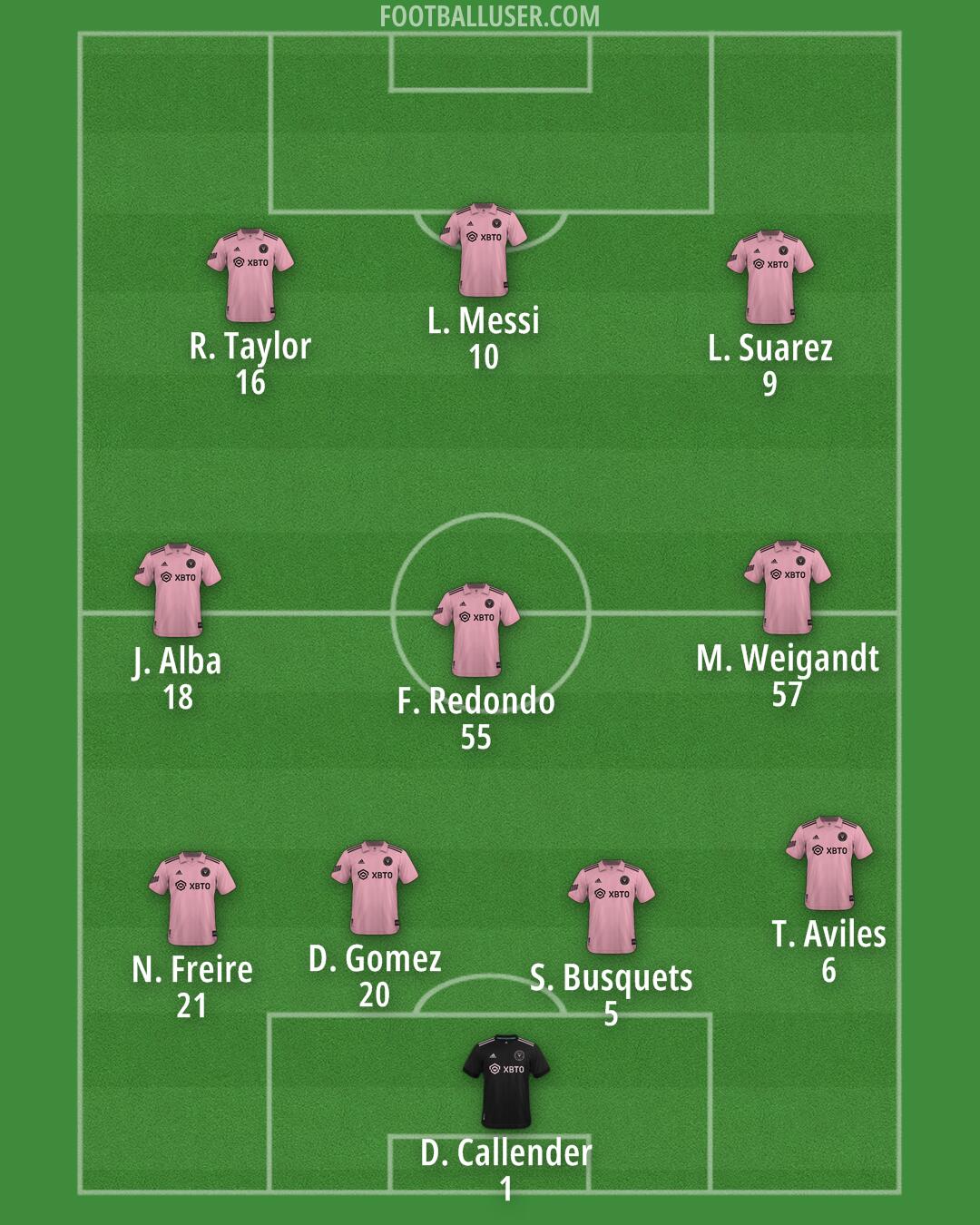
Inter Miami Soccer Formation
 August 27, 2024


Starting Lineup
D. Callender (1) · M. Weigandt (57) · J. Alba (18) · N. Freire (21) · T. Aviles (6) · F. Redondo (55) · D. Gomez (20) · S. Busquets (5) · L. Messi (10) · R. Taylor (16) · L. Suarez (9)Inter Miami focuses on high possession and controlling the game through a 4-3-3 formation. The team aims to dominate the ball and use technical players to move the opposition around the pitch. This lineup is built to play a game where they dictate the tempo and use high levels of creativity to break down defensive lines.
D. Callender starts in goal to organize the defensive unit. The team operates with a flat back four where T. Aviles covers the right flank and N. Freire occupies the left. In the center, D. Gomez acts as a ball playing defender to help play out from the back while S. Busquets operates on the right side of the central pair. This defensive unit works together to maintain a compact shape and manage the space between the lines.
The midfield functions as a three man midfield with a carrier and creative specialists. F. Redondo works to shield the defense and win the second ball to keep play moving. M. Weigandt provides energy to drive forward with the ball, while J. Alba acts as a creator from deep to connect the defense and the attack. This trio works to recycle possession and ensure the team maintains control in the middle of the pitch.
The attack utilizes three attackers across the front to stretch the opposition. L. Messi plays as a central striker who often drops deep to link up play between the lines. On the flanks, L. Suarez operates on the right and R. Taylor plays on the left. These players look to create space for each other through runs in behind and combinations in tight spaces. They press the opposition back line to win the ball back high up the pitch.
Inter Miami offers several tactical advantages with this formation. The presence of high quality technical players allows for numerical superiority in midfield during buildup phases. The team can also create wide overloads when full backs push forward to support the wingers. This setup makes it difficult for opponents to track runners from deep or deal with the quick transitions when the ball is won back.
This 4-3-3 formation relies on technical superiority to control the rhythm of the match. It is best suited for games where the team can dominate possession and exploit gaps in a retreating defense.