Liverpool Football Formation
 August 31, 2024


Starting Lineup
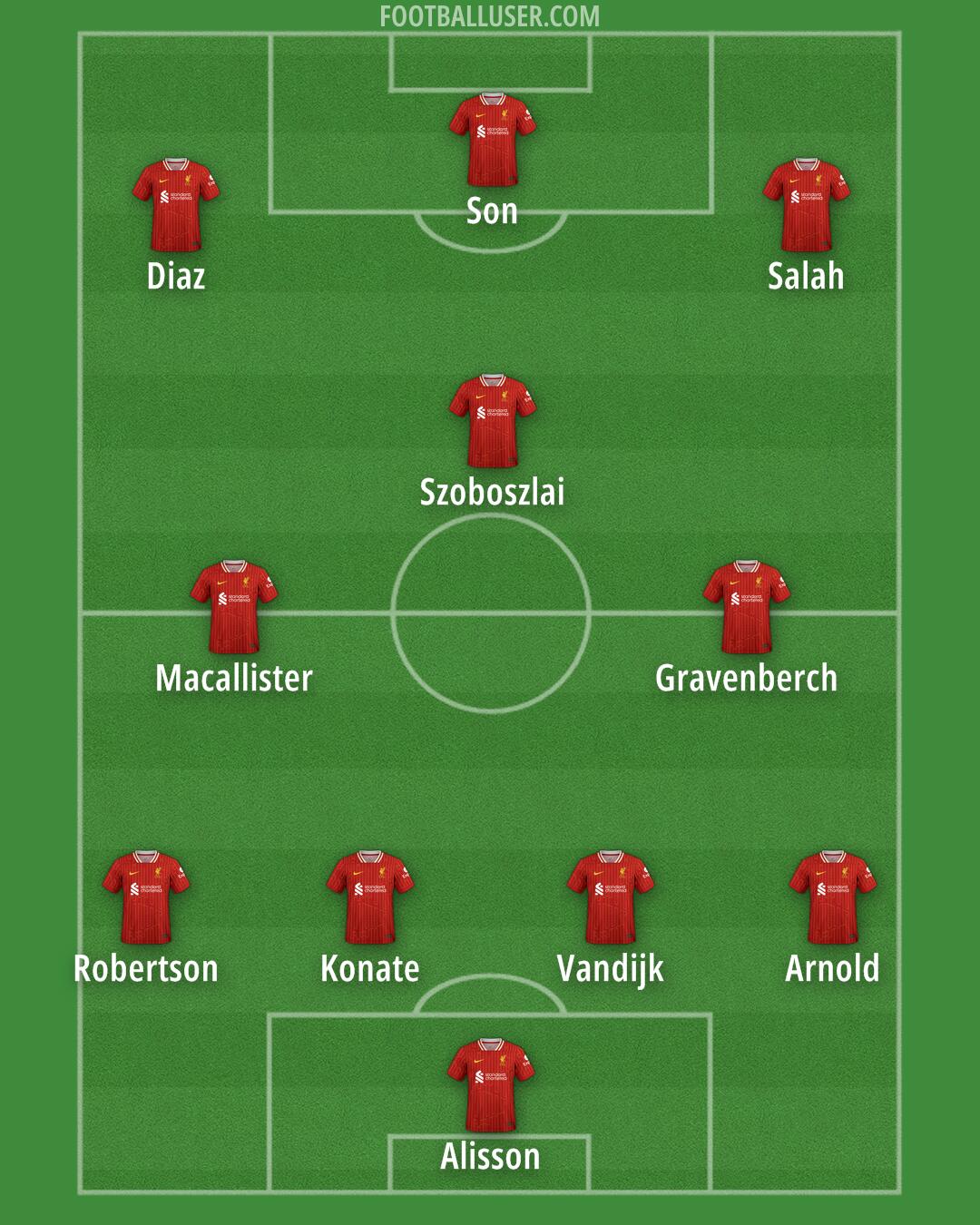
Diaz · Salah · Szoboszlai · Gravenberch · Son · Macallister · Arnold · Robertson · Konate · Vandijk · AlissonLiverpool plays with a high press and vertical intent in a 4-3-3 formation. This lineup is built to win the ball back high up the pitch and hit the opposition in behind as soon as possible. The team looks to move the ball forward quickly through the lines to catch opponents before they can get organized.
Alisson starts in goal to sweep behind a high line and command his area. The back four operates with a high line to squeeze the space in the middle of the pitch. Virgil van Dijk acts as a ball playing defender who can organize the unit, while Konate provides physical presence to defend zonally. Trent Alexander-Arnold functions as an attacking full back to provide width, whereas Robertson pushes high to support the left side. This defensive unit works together to keep the team compact and ready to trigger a press.
The midfield consists of a three-man unit that connects the defence to the attack. Mac Allister operates as a deep lying playmaker to recycle possession and find teammates. Gravenberch drives forward with the ball to carry it through the middle, while Dominik Szoboszlai plays as an attacking ten behind the striker to find pockets of space. These players work to compress the midfield and win the second ball to keep the pressure on the opponent.
In the final third, Liverpool uses three attackers to stretch the defence. Luis Diaz and Mohamed Salah act as inverted wingers who cut inside to shoot or create. Son plays as a pressing centre forward to lead the line and pin the last defender. The attack relies on runs in behind and overlapping runs from the full backs to create chances. They look to play one two passes to split the defence with a through ball or whip it in from wide areas.
One major strength of this Liverpool formation is the ability to press high in coordinated waves to force a long ball. The team also creates wide overloads when Alexander-Arnold and Robertson push up to support the wingers. Another advantage is the speed of transition, allowing the front three to attack the space immediately after a turnover.
This 4-3-3 formation relies on high intensity to dominate games through directness and pressure. It is best suited for matches against teams that struggle to play out from the back under pressure.