
Real Madrid Football Formation
 September 3, 2024


Starting Lineup
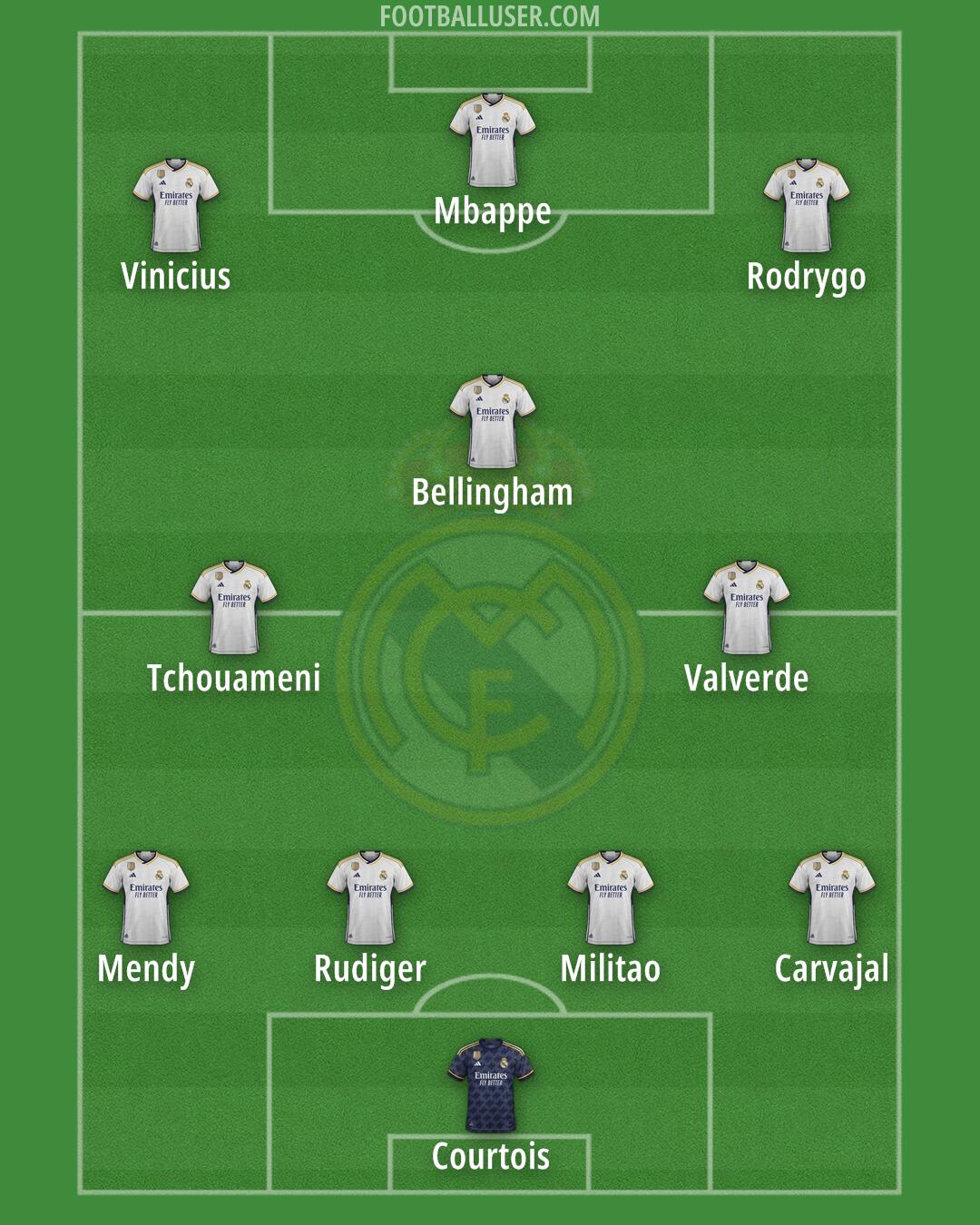
Vinicius · Rodrygo · Bellingham · Valverde · Mbappe · Tchouameni · Carvajal · Mendy · Rudiger · Militao · CourtoisReal Madrid focuses on a high press and rapid verticality to dominate matches. The team uses a 4-3-3 formation to control the pitch through quick movement and direct play. This lineup is built to catch opponents on the break and use speed to exploit gaps in the opposition block.
Courtois acts as the goalkeeper to start the play. A flat back four forms the primary defensive line. Rudiger and Militao operate as the two central defenders. He uses his aerial strength to win the header and clear the lines during set pieces. Militao works to cover the space behind the line and acts as a ball playing defender. Carvajal and Mendy occupy the full back positions to manage the flanks. While Carvajal pushes high to provide width, Mendy stays back to ensure the team can defend zonally.
The midfield features a three-man unit to control the centre. Tchouameni acts as the single pivot to shield the defence and intercept passes. Valverde is a carrier who drives forward with the ball to break the line. Bellingham plays in the half-spaces to connect the lines. He often makes late runs into the box to arrive late and create scoring chances. This group works to press in a mid-block to win it back high up the pitch.
In the attacking phase, Real Madrid uses three players across the front line. Mbappe plays as a lone striker to hold up the ball and lead the line. Vinicius and Rodrygo act as wide wingers to stretch the defence. Vinicius uses his dribbling style to pull wide and beat his marker on the flank. Rodrygo tends to cut inside to create chances in tight spaces. They press from the front to force a long ball from the opposition. The team looks to hit in behind on the transition using quick combinations.
The formation provides several tactical advantages for Real Madrid. The team creates wide overloads when Carvajal overlaps the winger to send a cross into the area. The midfielders can compress the midfield to squeeze the space between the lines. The speed of transition allows the team to counter at pace once the ball is won back. This formation also allows the team to build in triangles to progress through the thirds.
This 4-3-3 identity relies on high energy and clinical movement in the final third. It is best used against teams that struggle to defend large amounts of space on the transition.