QPR Football Formation
 September 4, 2024


Starting Lineup
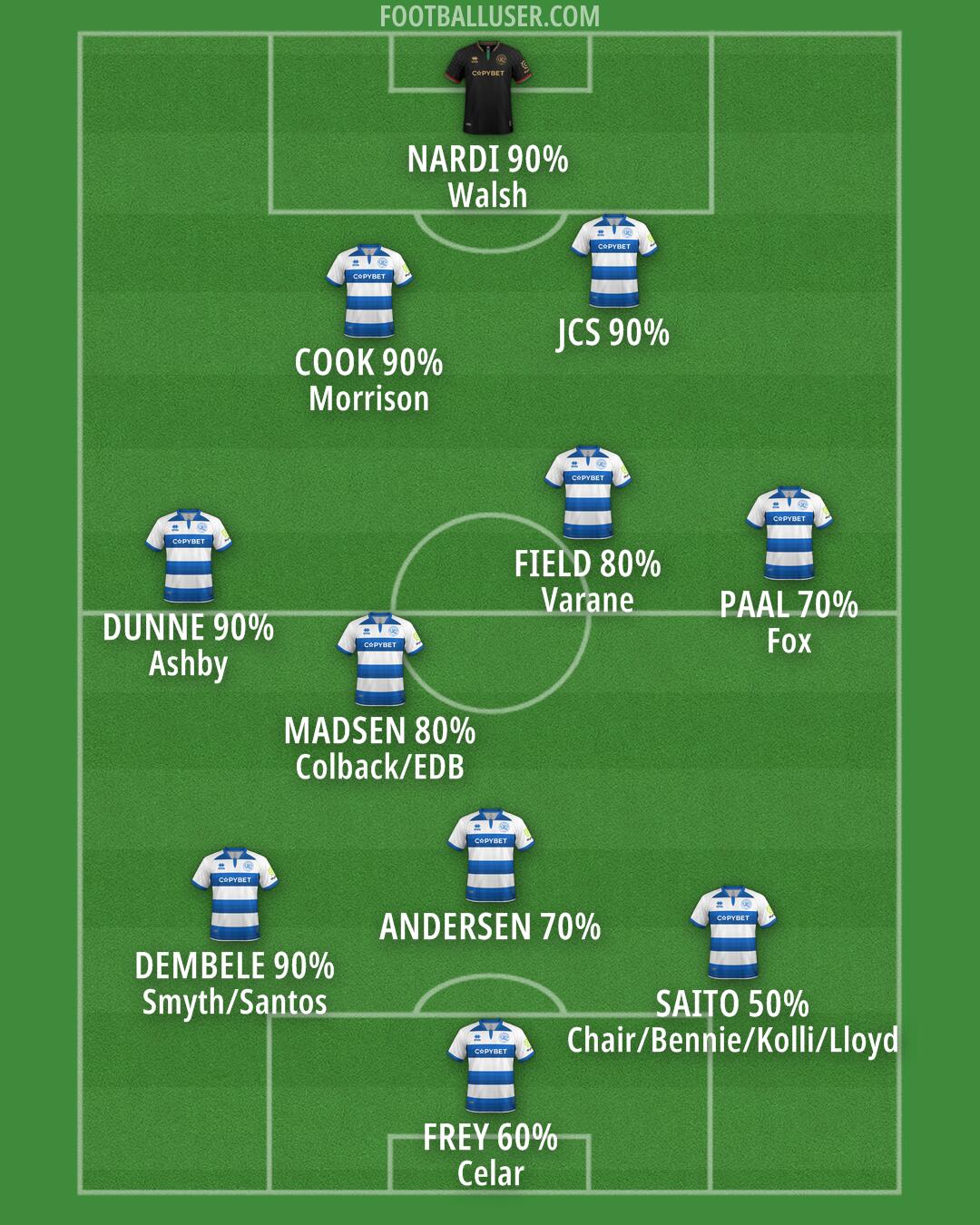
NARDI 90% (Walsh) · DUNNE 90% (Ashby) · COOK 90% (Morrison) · JCS 90% · PAAL 70% (Fox) · FIELD 80% (Varane) · MADSEN 80% (Colback/EDB) · DEMBELE 90% (Smyth/Santos) · ANDERSEN 70% · SAITO 50% (Chair/Bennie/Kolli/Lloyd) · FREY 60% (Celar)QPR aim to dominate through high pressing and verticality in this 2-4-4 formation. This lineup is built to overload the attacking third and win the ball back high up the pitch. By pushing so many players forward, the team seeks to create chaos in the opposition half and strike with speed.
Nardi stays between the posts to organize the defensive line. The back line consists of a narrow two man central pairing with JCS and Cook. Since there are only two central defenders, they must play a high line to squeeze the space and reduce the distance to the midfield. JCS and Cook need to be ready to step up to intercept long balls or cover wide areas if the opposition breaks quickly. The defensive unit functions by staying compact and relying on the midfield to win the ball back before the opponent can target the small defensive block.
The midfield is a four man unit designed to control the center and support the attack. Dunne and Paal act as a double pivot to protect the two defenders and hold the center. Dunne often works to shield the defense while Paal has more license to carry the ball forward. Madsen operates as an attacking ten behind the strikers to connect the midfield to the front line. Field works to link the defensive and attacking lines by recycling possession and finding the pockets of space between the lines.
QPR utilize four attackers to stretch the defense and pin the last defender. Andersen and Frey work as a two man partnership in the center, often looking to play one-two combinations to break the line. On the flanks, Dembele and Saito act as wide wingers who stretch the pitch. Dembele prefers to cut inside to create goal threats, while Saito provides width and can whip it in from the sides. This front line is designed to press the opposition back line hard and create chances through rapid transitions.
One major advantage for QPR is the ability to press high in coordinated waves, making it hard for opponents to build from the back. The numerical superiority in the attacking third forces the opposition to sit deep. Another strength is the speed of transition when the midfield wins the ball, allowing the four attackers to exploit gaps immediately.
This 2-4-4 formation is a high risk, high reward system built for aggressive attacking football. It is best suited for games where QPR need to overwhelm a deep defending opponent or chase a result.