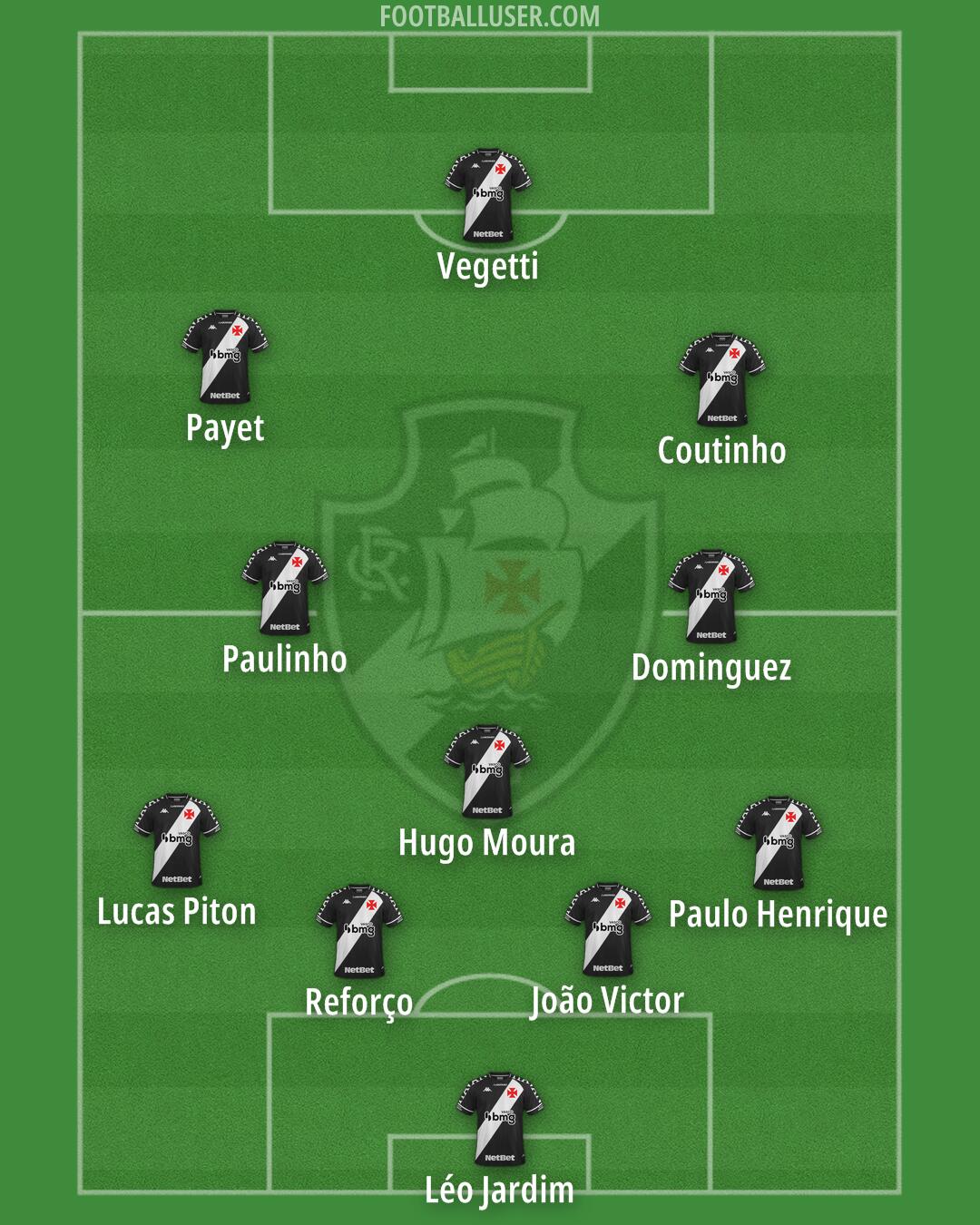

Vasco da Gama Football Formation
 September 4, 2024


Starting Lineup
Vegetti · Payet · Coutinho · Paulinho · Dominguez · Hugo Moura · Lucas Piton · Paulo Henrique · João Victor · Reforço · Léo JardimVasco da Gama looks to control games through a direct and aggressive high press in a 5-2-3. This formation aims to win the ball high up the pitch and use verticality to punish opponents. The lineup relies on quick transitions and creating chaos in the final third to drive the team forward.
Léo Jardim starts in goal to organize the defensive unit. The back line functions as a back five with Hugo Moura acting as the central defender to hold the line. Reforço and João Victor operate as the wide centre-backs, providing cover and strength in the air. The wing backs, Lucas Piton and Paulo Henrique, are expected to push high to provide width. While they occupy the flanks in attack, they must track back quickly to form a compact defensive block when the team loses the ball.
The midfield consists of a two man central unit with Dominguez and Paulinho. These two work as a double pivot to control the middle of the pitch. Paulinho helps to shield the defense, while Dominguez looks to carry the ball forward and connect the defensive line to the attack. They must press aggressively in a mid block to prevent the opposition from playing through the lines. The work of the midfield is vital to ensure the team does not get bypassed during transition.
In the attacking third, Vasco da Gama utilizes three attackers. Vegetti plays as the lone striker and acts as a target man to hold up the ball. On the flanks, Coutinho and Payet operate as inverted wingers who cut inside to create chances. They look to find the feet of the striker or arrive late into the box to score. The movement of the wingers creates space for the wing backs to overlap. This front three focuses on pressing the opposition back line to force errors.
One major advantage of this formation for Vasco da Gama is the ability to create wide overloads when the wing backs join the attackers. The team also benefits from numerical superiority in the attacking phase when the wingers move inside. This creates space for the wide centre-backs to step up and help in possession. The compactness of the back five makes it difficult for opponents to find space between the lines.
This formation provides a strong platform for a high pressing game that looks to exploit vertical lanes. It is particularly effective against teams that struggle to play out from the back under pressure.