
Austria National Football Team Formation
 September 5, 2024


Starting Lineup
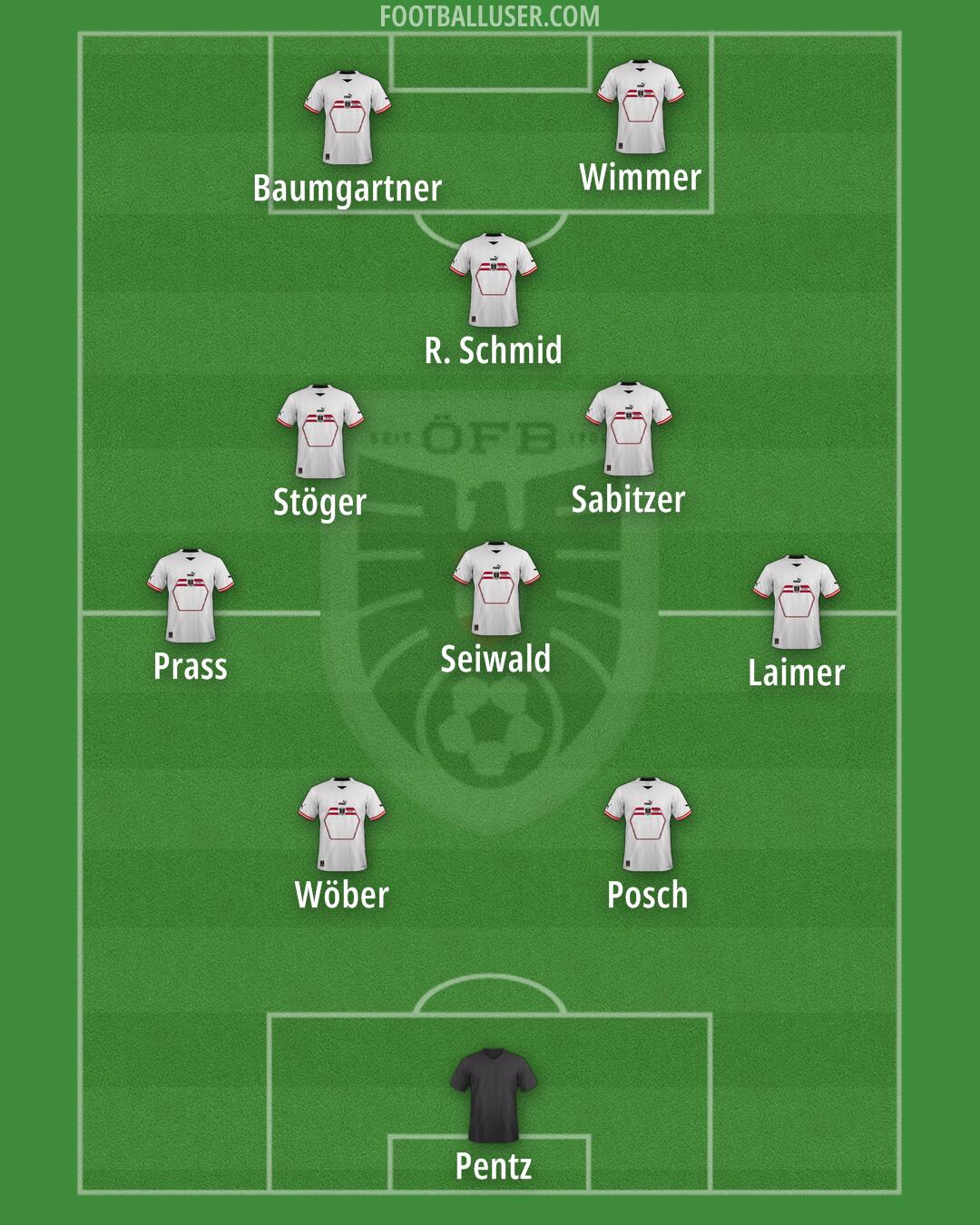
Pentz · Prass · Laimer · Wöber · Posch · Seiwald · Wimmer · Baumgartner · R. Schmid · Stöger · SabitzerAustria focuses on extreme central congestion to suffocate opponents, utilizing a 2-6-2 formation. This lineup aims to win the ball back high up the pitch and use a massive midfield to dominate every second ball. The intent is to control the tempo by overcrowding the center and forcing the opposition into mistakes.
Pentz sits in goal to oversee the defensive unit. The back line is a very narrow duo consisting of Wöber and Posch. Since the formation lacks full backs, Wöber and Posch must defend as two central defenders who are ready to cover wide areas or step up to catch players offside. They need to be dominant in the air and quick to intercept passes that bypass the massive midfield. The duo must hold the line carefully to avoid being caught by players making runs in behind.
The midfield is the engine of the team, featuring six players who dominate the central zones. Prass, Seiwald, and Laimer form a deep trio to shield the two defenders and win the second ball. Laimer uses his energy to carry the ball forward and help move the play. Ahead of this trio, Stöger, Sabitzer, and R. Schmid operate in the half spaces to link the defense to the attack. Sabitzer uses his passing range to switch play, while Stöger and R. Schmid look to play through the lines to reach the strikers. This central mass works to compress the midfield and deny the turn to anyone trying to build play.
For the attack, Austria employs two forwards in Baumgartner and Wimmer. They operate as a pair to attack the space behind the opposition defense. Baumgartner acts as a pressing centre-forward to trigger a press from the front, while Wimmer looks to pull wide or make runs in behind to stretch the defense. The attack relies on the midfielders to find the feet of the striker or deliver early balls into the channels. When the ball is recycled, the forwards work to lay it off to the advancing midfielders who arrive late into the box.
One major advantage of this lineup is the massive numerical superiority in midfield. This allows Austria to win it back high up the pitch and create quick transitions. By having so many players in the center, they can also squeeze the space and force the opponent to play long balls that Wöber and Posch can easily clear the lines.
This 2-6-2 formation is a brave way to play that prioritizes central dominance and high intensity. It is best suited for situations where Austria faces a team that relies on playing short from the back.