Preston Football Formation
 September 5, 2024


Starting Lineup
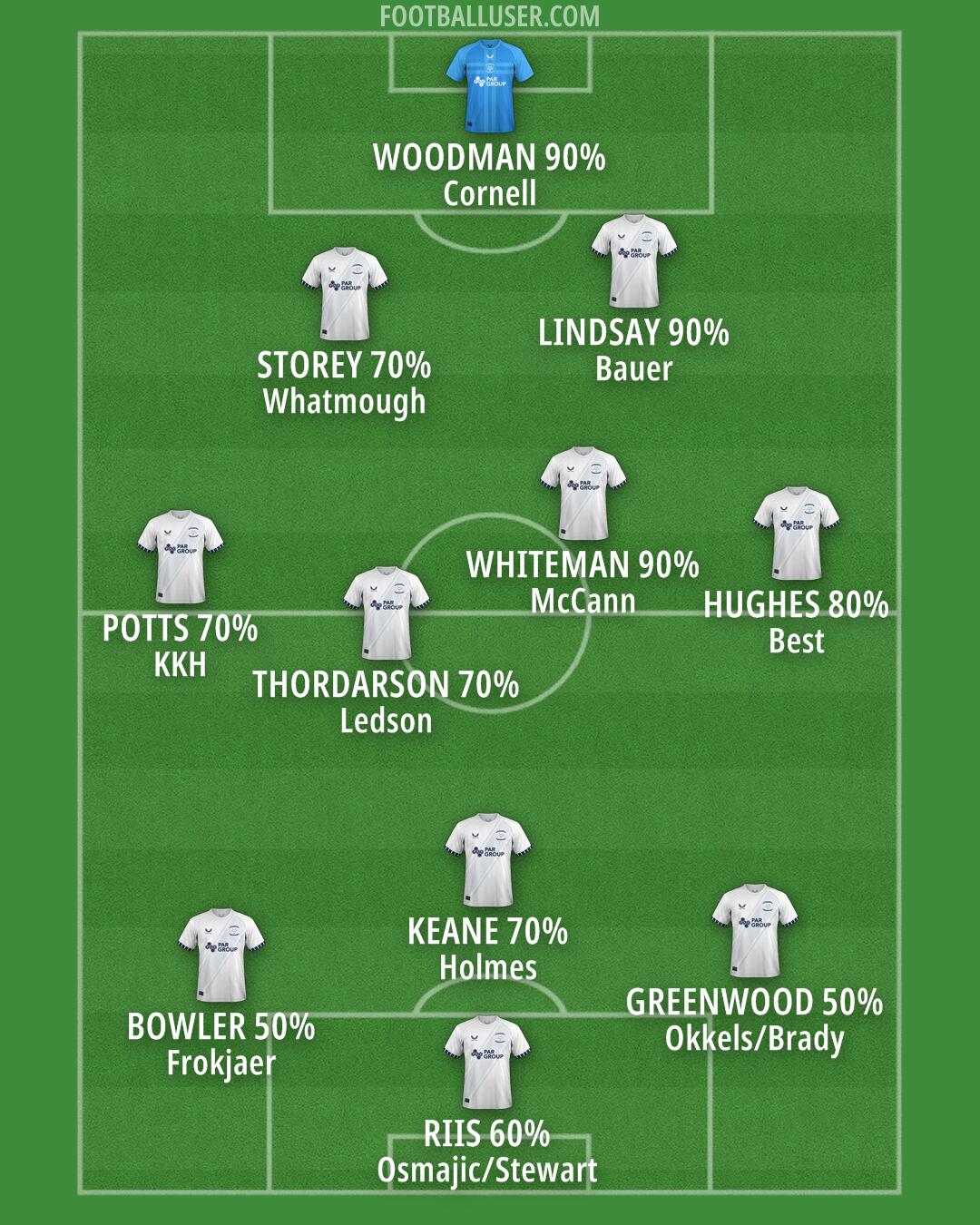
WOODMAN 90% (Cornell) · STOREY 70% (Whatmough) · LINDSAY 90% (Bauer) · HUGHES 80% (Best) · POTTS 70% (KKH) · WHITEMAN 90% (McCann) · THORDARSON 70% (Ledson) · GREENWOOD 50% (Okkels/Brady) · BOWLER 50% (Frokjaer) · RIIS 60% (Osmajic/Stewart) · KEANE 70% (Holmes)Preston looks to play a vertical game built on directness and high intensity using a 2-4-4 formation. This lineup focuses on quick transitions and sending numbers forward to catch the opposition off guard. By pushing players into high positions, the team aims to overwhelm the opponent through sheer volume of attackers in the final third.
Woodman operates between the posts to anchor the defensive unit. The back line consists of a narrow two man pairing with Lindsay and Storey acting as the central defenders. Lindsay and Storey must defend in a high line to squeeze the space between the defense and the midfield. They need to be dominant in the air and quick to cover when the team loses the ball, as the two defenders are often isolated against multiple runners.
In the middle of the pitch, Preston utilizes a four man midfield line that connects the defense to the attack. Thordarson and Whiteman act as the central pair to control the tempo and shield the two center backs. Thordarson and Whiteman work to win the second ball and progress the play through the thirds. Hughes and Potts provide the width from the wide positions, with Hughes acting as a right sided outlet and Potts working on the left to stretch the defence.
The attacking force is incredibly heavy with four players pushing into the final third. Keane and Riis lead the line as a two man partnership, often looking to find the feet of the striker or run in behind. Greenwood and Bowler operate as wide attackers to create constant threats. Greenwood and Bowler look to cut inside or deliver crosses into the box to support Keane and Riis. This front four is designed to press the opposition back line and create chaos in transition.
A major tactical advantage for Preston is the ability to create wide overloads by using Hughes and Potts to support the wingers. The team also gains numerical superiority in the attacking third, which can pin the last defender and create multiple passing lanes. This heavy presence allows the team to win the ball back high up the pitch when they press in coordinated waves.
This aggressive formation is built to overwhelm teams that sit deep and struggle with numbers in the box. It is most effective when playing against opponents that leave large gaps between their midfield and defensive lines.