Oxford United Football Formation
 September 6, 2024


Starting Lineup
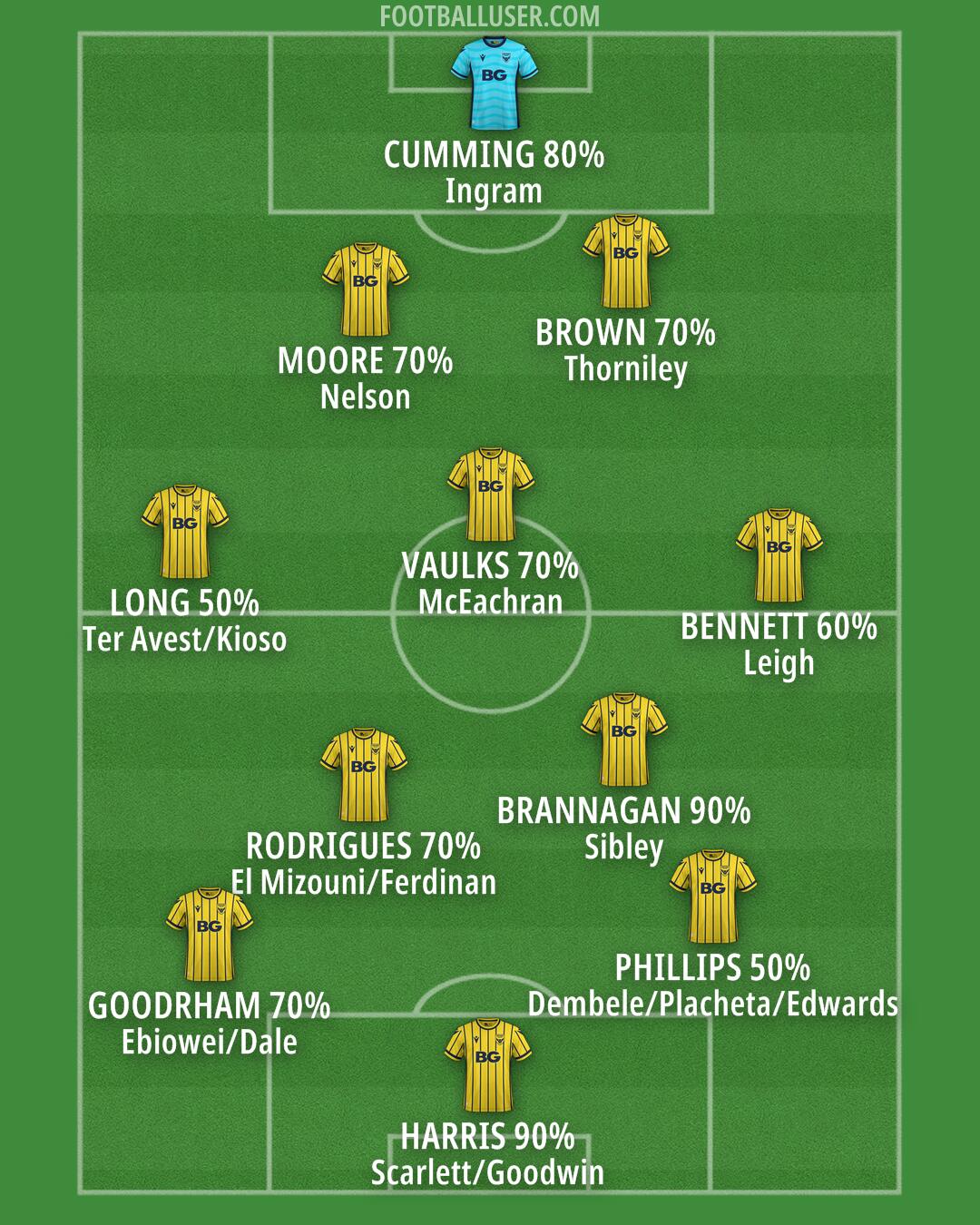
CUMMING 80% (Ingram) · LONG 50% (Ter Avest/Kioso) · MOORE 70% (Nelson) · BROWN 70% (Thorniley) · BENNETT 60% (Leigh) · VAULKS 70% (McEachran) · RODRIGUES 70% (El Mizouni/Ferdinan) · BRANNAGAN 90% (Sibley) · GOODRHAM 70% (Ebiowei/Dale) · PHILLIPS 50% (Dembele/Placheta/Edwards) · HARRIS 90% (Scarlett/Goodwin)Oxford United focuses on a heavy verticality and aggressive pressing to disrupt the opposition. This lineup utilizes a 2-5-3 formation designed to overwhelm the opponent in the final third. The team looks to win the ball high up the pitch and move quickly toward the goal, prioritizing directness over slow possession.
Cumming acts as the lone man between the posts to manage the space behind the defense. The defensive line consists of a back two with Brown and Moore working as central defenders. These two must stay compact to protect the center, often playing a high line to squeeze the space. Because they operate without full backs, Brown and Moore must be ready to defend wide areas and cover any runners that break the line.
In the middle of the pitch, the five-man unit provides massive density. Vaulks, Long, and Bennett form a central trio to control the game, with Vaulks looking to drive forward with the ball and connect the lines. Brannagan and Rodrigues operate in the half spaces as attacking midfielders to create chances. Brannagan works to find pockets of space and deliver passes into the box, while Rodrigues helps to press from the front and win the second ball.
The attack is built around a three-man front line that stretches the defense. Harris acts as the central striker to hold up the ball and pin the last defender. Phillips and Goodrham play as wide attackers who can either hug the touchline or cut inside to create overloads. This front three works together to press the opposition back line, creating chances through quick combinations and runs in behind.
This formation offers significant tactical advantages through its ability to create numerical superiority in the attacking zones. By pushing five players into the midfield and three into the attack, Oxford United can overwhelm standard defensive blocks. The setup also allows for intense pressing in coordinated waves, making it very difficult for opponents to play out from the back without making mistakes.
Oxford United relies on this aggressive 2-5-3 to dominate high-pressing games. This formation is best suited for situations where the team needs to force errors and strike quickly on the transition.