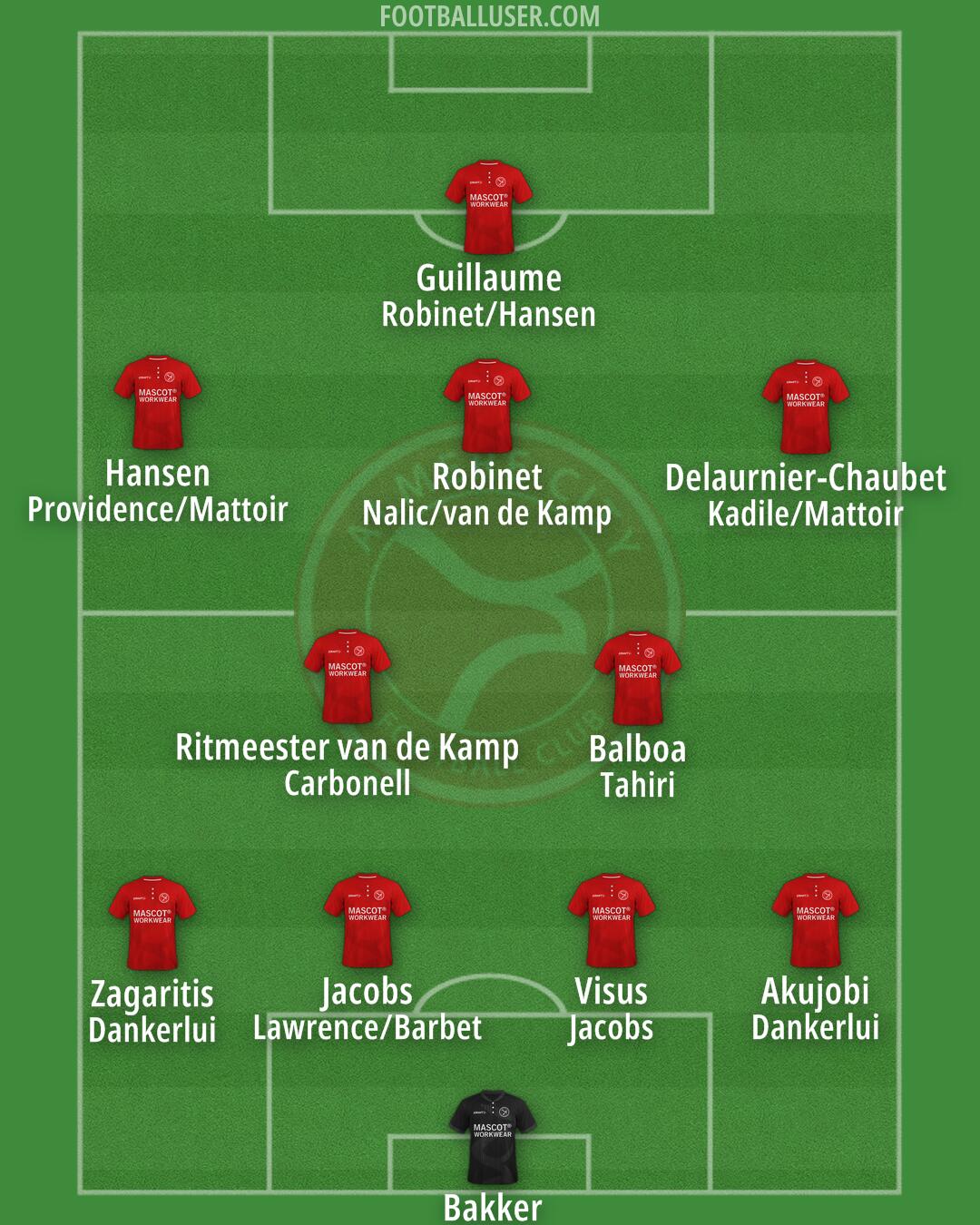

Almere City Football Formation
 September 7, 2024
 MrFinba


Starting Lineup
Bakker · Akujobi (Dankerlui) · Visus (Jacobs) · Jacobs (Lawrence/Barbet) · Zagaritis (Dankerlui) · Balboa (Tahiri) · Ritmeester van de Kamp (Carbonell) · Hansen (Providence/Mattoir) · Delaurnier-Chaubet (Kadile/Mattoir) · Robinet (Nalic/van de Kamp) · Guillaume (Robinet/Hansen)Almere City focuses on a highly vertical game style designed to catch opponents on the break. This team plays a 4-2-4 formation. The intention is to get numbers forward as quickly as possible to overwhelm the opposition defensive line. By using such an aggressive lineup, the team aims to stretch the pitch and create chances through rapid transitions.
Bakker operates between the posts to command the area. The defensive unit consists of a flat back four. Akujobi and Zagaritis act as the wide defenders, where they must be ready to overlap the wingers when the team has the ball. In the middle, Visus and Jacobs form the central pairing. Visus uses his aerial strength to win headers, while Jacobs works to cover the space behind him when the line steps up. The whole unit must stay compact to avoid being split by long balls.
To manage the center of the pitch, the midfield of Almere City relies on a double pivot. Balboa and Ritmeester van de Kamp work together to hold the middle. Acting as a shield for the defenders, Balboa makes sure to intercept passes and win the second ball. Ritmeester van de Kamp is tasked to drive forward with the ball to connect the defensive unit with the attacking line. This pairing must work hard to cover the gaps left by the attacking players when the team loses possession.
Across the front line, four players occupy the attacking half. Hansen and Delaurnier-Chaubet provide the width on the flanks. While Hansen likes to cut inside to create more central presence, Delaurnier-Chaubet stays wide to pull defenders apart. In the center, Robinet and Guillaume work as a striking partnership. These two forwards press the opposition back line from the front to force mistakes. The formation is designed to create runs in behind and allow the wingers to deliver crosses into the box.
One major advantage of this lineup is the ability to create wide overloads when the full backs push up. This puts immense pressure on the opposition wingers. The team also benefits from a high level of speed in transition, moving from a defensive block to an attacking position in seconds. Another strength is the ability to pin the last defender by having two strikers constantly competing for space in the penalty area.
This 4-2-4 formation is a high-risk, high-reward system that thrives on direct play. It is best suited for games against opponents who sit deep and struggle to track runners in the wide areas.