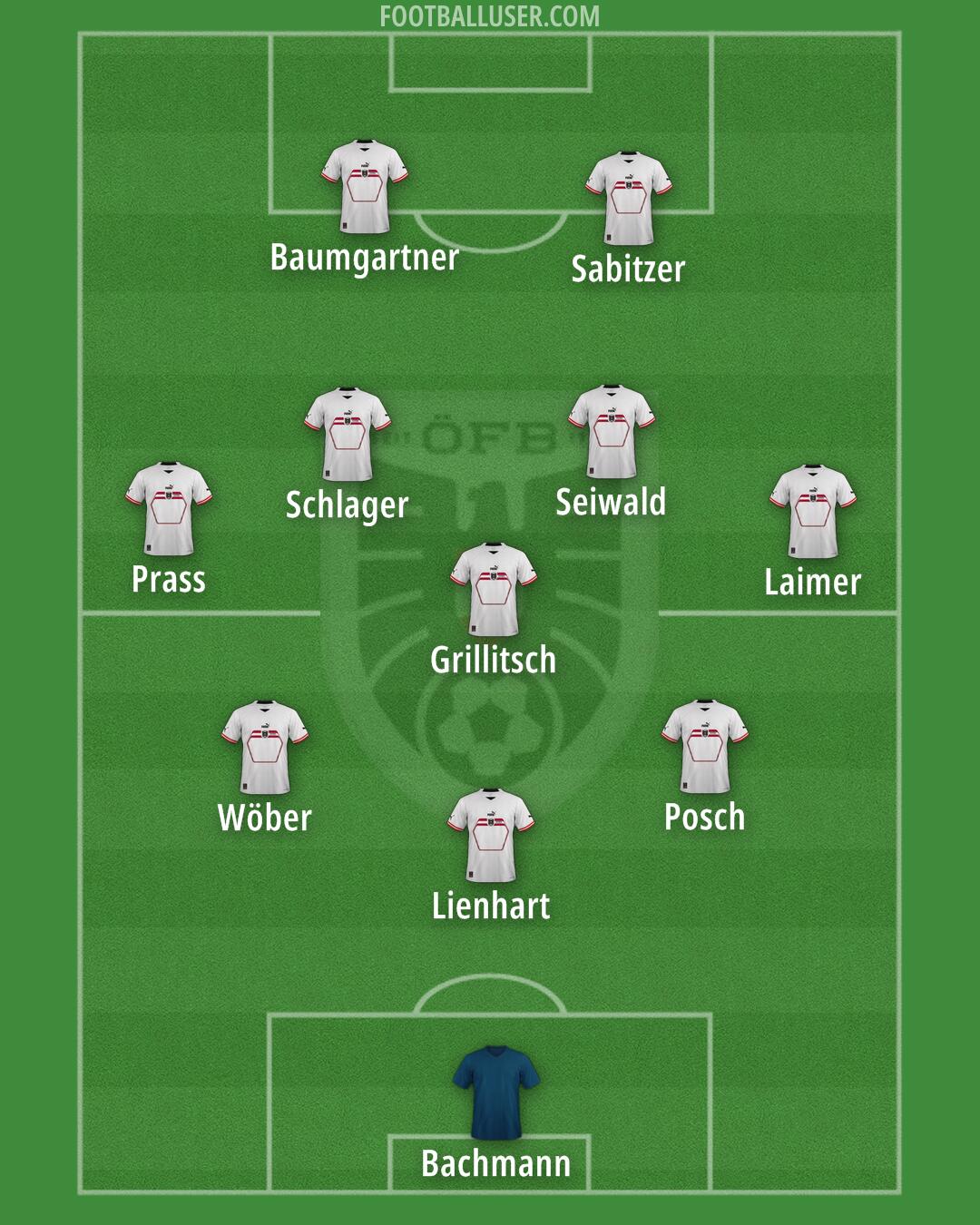

Austria National Football Team Formation
 September 13, 2024


Starting Lineup
Prass · Laimer · Grillitsch · Schlager · Seiwald · Baumgartner · Sabitzer · Lienhart · Wöber · Posch · BachmannAustria relies on a high press and rapid transitions through a 3-5-2 formation. This lineup is built to win the ball high up the pitch and move the opposition back quickly with direct passing. By using a compact mid-block and aggressive movement, the team aims to dominate the central areas of the field while using width to stretch the opposition.
Bachmann sits between the posts to organize the defensive unit. The back three consists of Wöber, Lienhart, and Posch, who form a solid line to protect the middle. Wöber and Posch act as wide centre-backs to cover the spaces behind the wingers, while Lienhart remains central to win the header and command the area. This defensive group works to hold a high line, squeezing the space between the defense and the midfield.
The midfield functions with a single pivot alongside several runners. Grillitsch sits deep to shield the defense and recycle possession, acting as the primary link to the rest of the team. Laimer and Prass operate as the engine, with Laimer using his high pressing intensity to win the ball back. Schlager and Seiwald play in the half spaces to connect the midfield to the attack, with Schlager looking to arrive late into the box to support the front two.
In the final third, Austria utilizes two forwards in a partnership. Baumgartner acts as the primary pressing centre-forward, working to harass the opposition back line. Sabitzer plays alongside him, often looking to drop deep to link up play or make runs in behind the defenders. The wide players push high to provide width, allowing the attackers to combine in tight spaces and look for through balls to split the defense.
One major advantage for Austria is the ability to press high in coordinated waves, making it difficult for opponents to play out from the back. The team also benefits from numerical superiority in the middle of the pitch when the wingers and attacking midfielders squeeze the space. This creates several chances to win the second ball and launch quick attacks before the opposition can get organized.
This formation provides a balanced way to control the tempo through a central midfield block. It is best suited for games where the team needs to exploit space behind a high defensive line or face opponents that struggle with intense physical pressure.