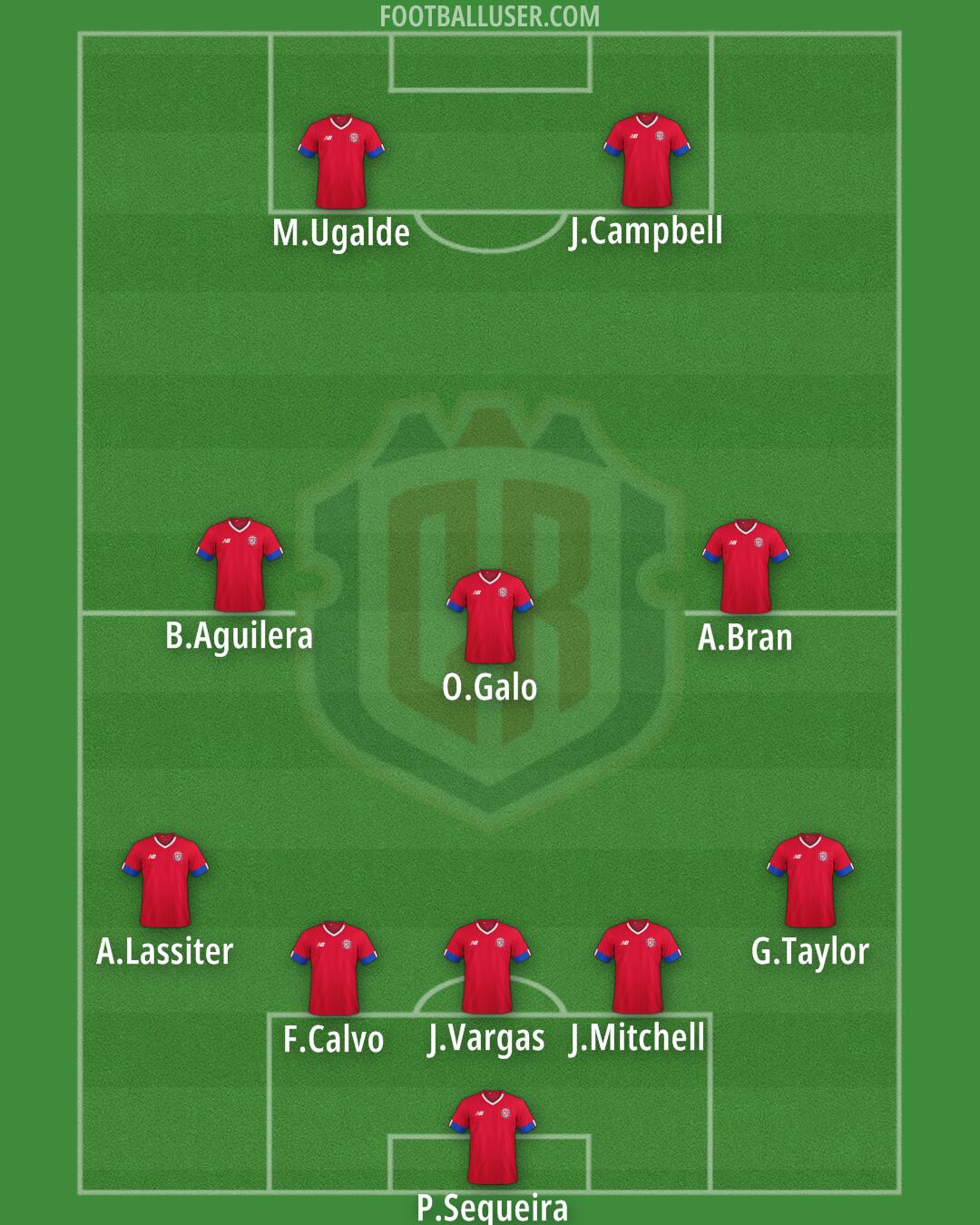

Costa Rica National Football Team Formation
 September 17, 2024


Starting Lineup
P.Sequeira · F.Calvo · J.Vargas · J.Mitchell · G.Taylor · A.Lassiter · O.Galo · B.Aguilera · A.Bran · M.Ugalde · J.CampbellCosta Rica relies on a heavy defensive identity built to absorb pressure and hit on the transition, utilizing a 5-3-2 formation. This lineup focuses on staying compact and keeping the lines close to one another to deny space between the units. The goal is to force the opposition into wide areas and then strike quickly when the ball is won back in the middle third.
In front of the goal, P.Sequeira acts as the last line of defense. The back line works as a sturdy back five, with J.Vargas acting as the central anchor to hold the line and win the header. Flanking him, F.Calvo and J.Mitchell serve as wide centre-backs, providing cover and ready to step up to intercept passes. On the flanks, G.Taylor and A.Lassiter act as attacking wing backs, tasked with providing width and pushing high up the pitch to support the attack. This unit functions as a narrow defensive block when the team sits deep.
The midfield consists of a three-man midfield with a carrier to bridge the gap between the defense and the forwards. B.Aguilera operates as the left midfielder, while A.Bran holds the right side, and O.Galo sits centrally to shield the defense. These players must work hard to press in a mid-block and protect the space in front of the centre-backs. They aim to recycle possession and find the outlets in the wide areas or through the middle to start a break.
Costa Rica employs two forwards in a partnership to lead the line. J.Campbell and M.Ugalde act as the strike duo, with one often acting as a target man to hold up the ball while the other looks to make runs in behind. They work together to press the opposition back line and create link-up play between the lines. The attack relies on the width provided by G.Taylor and A.Lassiter to deliver crosses or allow the strikers to find space in central areas.
This formation offers great compactness when defending, making it very hard for opponents to play through the center. The presence of three central defenders allows the wing backs to push forward, creating wide overloads when Costa Rica moves into the attacking third. The team also benefits from speed of transition once they win the ball in the middle of the pitch.
This 5-3-2 formation is built for a team that wants to sit deep and absorb pressure. It is best suited for matches against teams that dominate possession, allowing Costa Rica to strike on the counter at pace.