Brighton Football Formation
 September 27, 2024


Starting Lineup
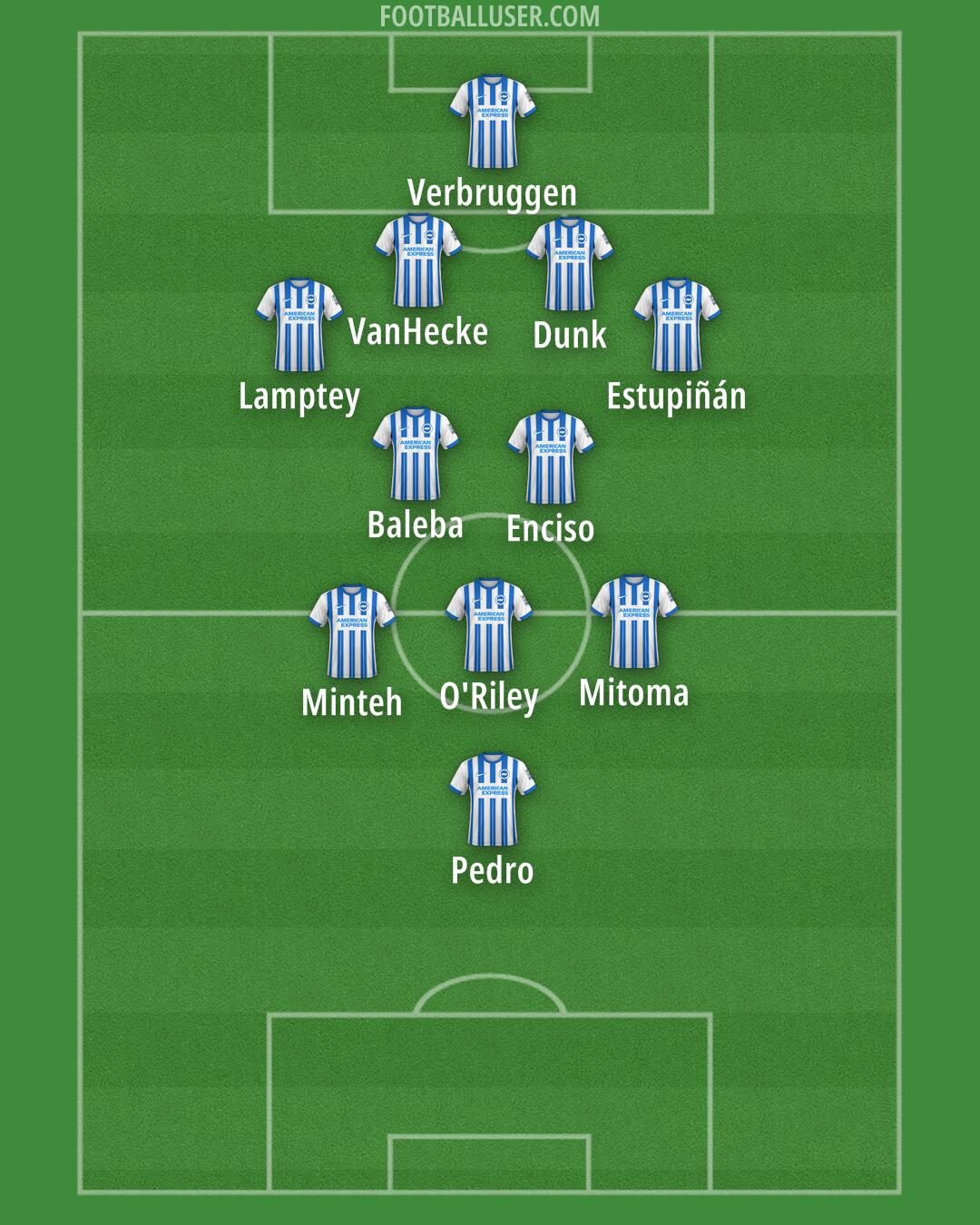
Verbruggen · Pedro · Minteh · Mitoma · O'Riley · Enciso · Baleba · Dunk · Lamptey · Estupiñán · VanHeckeBrighton relies on a high press to win the ball back high up the pitch, utilizing a 4-5-1 formation. This lineup is built to squeeze the space and play through the lines once possession is regained to catch the opponent out of position.
Verbruggen plays in goal to play short from the back and initiate attacks. The back four works as a unit, with Lamptey and Estupiñán acting as attacking wing backs to provide width and overlap the winger. VanHecke and Dunk form the central pairing, where Dunk is dominant in the air and VanHecke is tasked to cover the space when the line steps up. The unit aims to hold the line and defend zonally to prevent central penetrations.
In the middle of the pitch, the midfield functions with a double pivot to protect the defense. Baleba and Enciso act as the holding duo, looking to intercept passes and win the second ball. O'Riley operates in the center, looking to carry the ball forward and link the lines. Mitoma and Minteh occupy the half-spaces, with Mitoma using his dribbling to beat players in one on one situations. This group works to compress the midfield and progress through the thirds.
The attack is led by a lone striker, Pedro, who acts as a pressing centre-forward to disrupt the opposition back line. He works to hold up the ball and find the feet of teammates in advanced positions. The team uses Mitoma and Minteh to pull wide and stretch the defence, often looking to hit in behind on the transition. The movement is designed to create cutbacks from the byline or allow Pedro to receive on the half-turn.
A major strength of Brighton is the ability to press high in coordinated waves to win it back high up the pitch. The team also benefits from wide overloads when Lamptey and Estupiñán overlap the wingers to create crossing opportunities. Furthermore, the speed of transition allows the team to break quickly once they win the ball in the middle third.
This formation creates a compact shape that is difficult to break down through the middle. It is ideally suited for facing teams that rely on slow buildup play or struggle to deal with high intensity pressing.