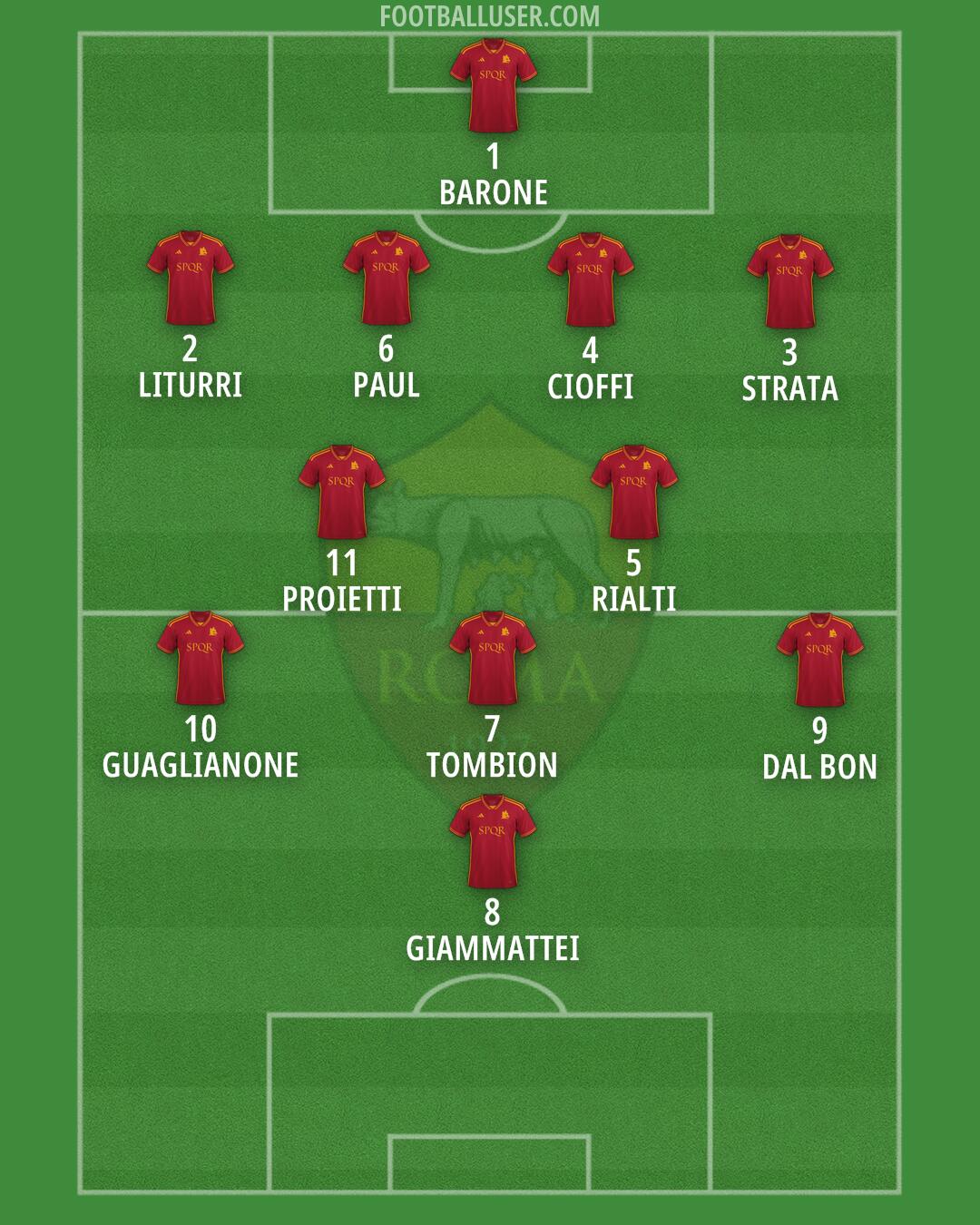

Roma Football Formation
 September 29, 2024


Starting Lineup
1 (BARONE)2 (LITURRI)
6 (PAUL)
4 (CIOFFI)
3 (STRATA)
11 (PROIETTI)
5 (RIALTI)
9 (DAL BON)
7 (TOMBION)
10 (GUAGLIANONE)
8 (GIAMMATTEI)
Roma relies on a compact defensive lineup to control the middle of the pitch using a 4-5-1. This formation focuses on maintaining a tight block to deny space between the lines and wait for the right moment to strike. The team looks to sit deep and absorb pressure before hitting the opposition on the break. By crowding the central areas, Roma intends to force the opponent into wide areas where they are less dangerous.
In the defensive unit, 1 stays between the posts to command the area. The back line consists of a flat back four with 2 at right back and 3 at left back. Central defenders 6 and 4 work together to hold the line and win the second ball. While 6 and 4 focus on defending zonally, 2 and 3 must track back to cover wide runners. The defensive unit stays narrow to protect the middle, forcing the play out wide.
The midfield is the engine of this formation, featuring a heavy presence in the center. 11 and 5 act as a double pivot to shield the defence and intercept passes. In front of them, 7, 10, and 9 operate as a trio of central midfielders to connect the defence and the attack. 11 and 5 focus on sitting deep to protect the back four, while 7, 10, and 9 look to drive forward with the ball and carry it into the final third. These players work to win the ball high up the pitch or in a mid-block to trigger a transition.
Up front, 8 operates as a lone striker to lead the line. As a pressing centre-forward, 8 works to pin the last defender and force long balls. The attacking movement relies on 7, 10, and 9 making late runs into the box to support 8. Since there are no natural wingers, the team uses the midfielders to spread wide and provide width. The goal is to find the feet of the striker or play through the lines to create chances in transition.
A main advantage of this formation is the numerical superiority in midfield, making it very difficult for opponents to play through the middle. The combination of 11, 5, 7, 10, and 9 creates a wall that is hard to bypass. Additionally, the team gains an advantage in speed of transition when the midfielders quickly move the ball to 8. This formation allows the team to stay compact when defending while remaining dangerous when the ball is won.
This 4-5-1 formation provides a robust way to control central spaces and frustrate attacking teams. It is best suited for games against dominant sides where the goal is to sit deep and strike on the break.