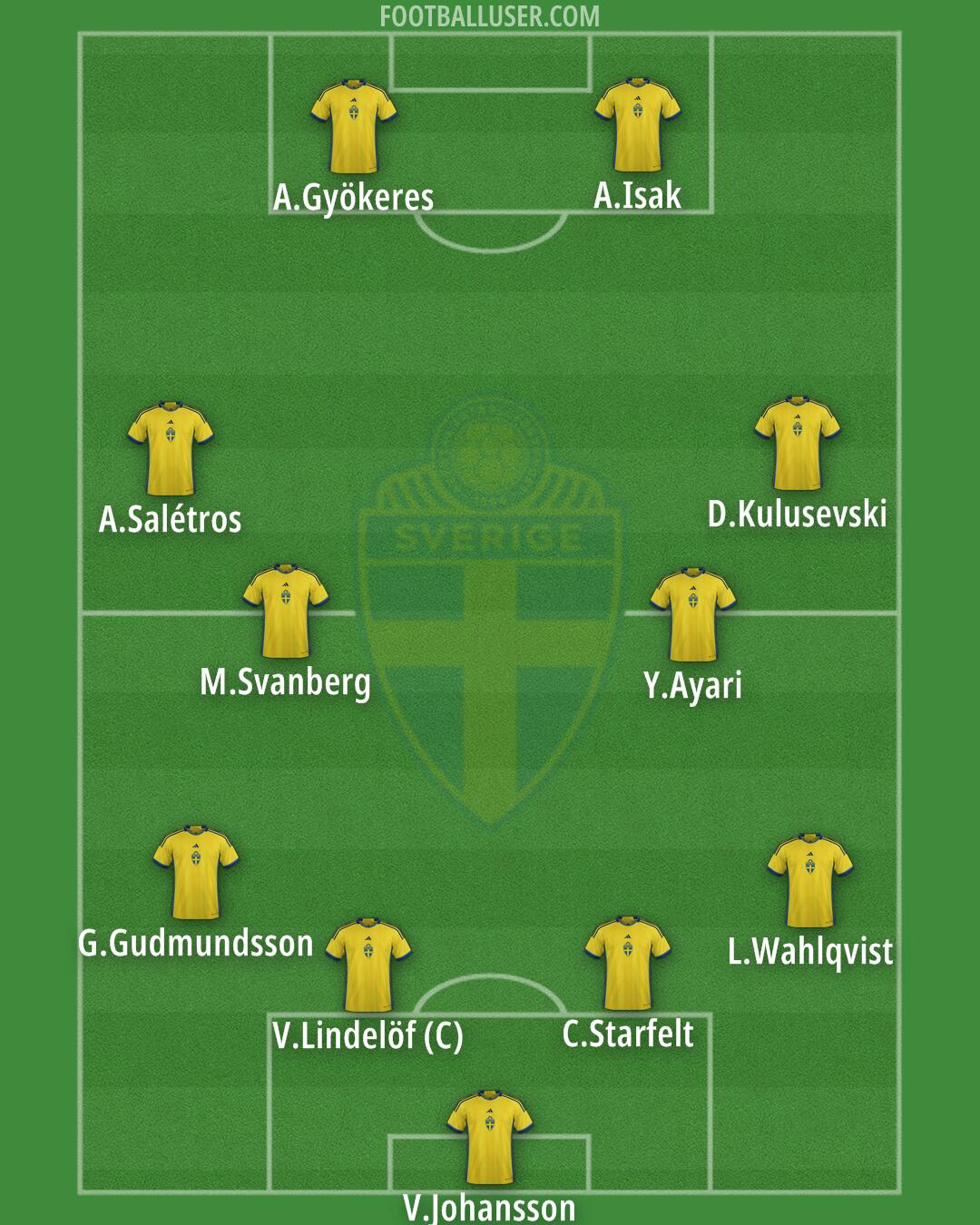

Sweden National Football Team Formation
 September 30, 2024


Starting Lineup
V.Johansson · C.Starfelt · V.Lindelöf (C) · G.Gudmundsson · L.Wahlqvist · M.Svanberg · Y.Ayari · A.Salétros · D.Kulusevski · A.Gyökeres · A.IsakSweden relies on a defensive identity built to absorb pressure and strike on the break, utilizing a 5-4-1 formation. This lineup is designed to sit deep and deny space in the central areas, making the team difficult to break down. The primary goal is to maintain a compact block and wait for the opposition to commit bodies forward before hitting them in behind.
A.Isak stays between the posts to organize the defensive line from the back. The back five consists of Y.Ayari as the left centre-back, M.Svanberg as the central defender, and A.Gyökeres as the right centre-back. These three focus on winning headers and clearing the lines when under heavy pressure. On the flanks, D.Kulusevski and A.Salétros act as attacking wing backs who must track back to form a five man line when defending. They are tasked with covering the wide areas and ensuring the opposition cannot find easy crosses.
The midfield functions as a flat four to protect the central zone. V.Lindelöf (C) acts as the captain and sits in the left central midfield role to shield the defence and win the second ball. He works alongside C.Starfelt to compress the midfield and disrupt passing lanes. On the wings, G.Gudmundsson and L.Wahlqvist operate as wide midfielders who help the wing backs and press the opposition when they receive the ball. This unit links the defensive block to the lone striker by recycling possession and driving the ball forward into the middle third.
In the attacking phase, V.Johansson operates as a lone striker. He is expected to hold up the ball and fight for long balls to allow the rest of the team to move up the pitch. The team attacks in transition, looking to use the width provided by D.Kulusevski and A.Salétros to stretch the defence. While the midfielders try to play through the lines, the main intent is to get the ball to the flanks or find the feet of the striker in tight spaces.
This formation offers significant tactical advantages through its compactness when defending deep. By keeping a narrow block, Sweden can deny the turn to opposition playmakers and force a long ball. The ability to use the wing backs to create wide overloads also provides a way to transition quickly from a low block into an attacking phase.
Sweden uses this 5-4-1 to remain defensively solid against heavy possession teams. It is a setup best suited for matches where the opponent dominates the ball and the team must rely on clinical counter attacks.