Liverpool Football Formation
 September 30, 2024


Starting Lineup
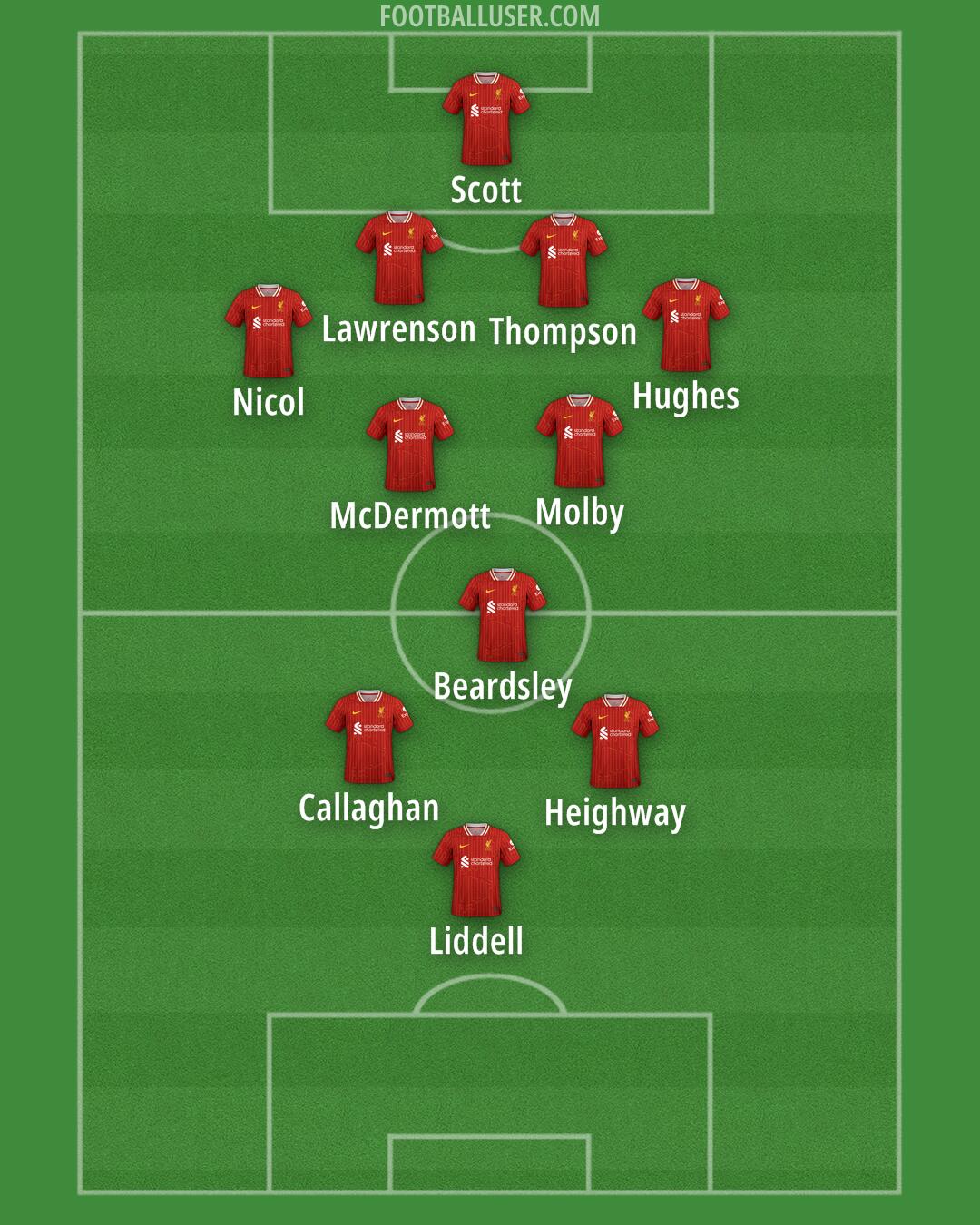
Nicol · Callaghan · Heighway · Beardsley · Lawrenson · Thompson · Hughes · Liddell · McDermott · Molby · ScottLiverpool aims to control games through high pressing and verticality with a 4-3-3. This formation is built to squeeze the pitch and win the ball high up the pitch to catch opponents in transition. By staying compact and aggressive, the Reds look to drive the game forward with quick passing and direct runs.
Scott stays between the posts to command his area. The back line operates as a flat back four, with Nicol acting as the right back and Hughes occupying the left back position. Lawrenson and Thompson act as the central defensive pairing, where Lawrenson stays deep to cover while Thompson works to step up and intercept play. The defenders must hold the line to ensure the team does not get caught by long balls, while the full backs push up to provide width.
The midfield functions as a three-man midfield with a carrier and a creative core. Molby operates as the deep lying playmaker who looks to recycle possession and switch play with a great passing range. McDermott works alongside him to connect the defensive and attacking lines, often pressing aggressively to win the ball back. Beardsley plays as an attacking ten behind the striker, looking to arrive late into the box and find pockets of space between the lines to drive the team forward.
In the final third, Liverpool uses three attackers across the front. Liddell acts as a pressing centre forward to harass the opposition back line and disrupt their build up. Heighway plays as an inverted winger on the left to cut inside and create chances, while Callaghan stays wide on the right to stretch the defence. This front line works to create runs in behind and use combinations in tight spaces to split the defence with a through ball.
One major tactical strength for Liverpool is the ability to press high in coordinated waves, forcing the opposition into mistakes. The team also gains a massive advantage through the passing range of Molby, which allows them to bypass the midfield quickly. Additionally, the movements of Beardsley and Liddell create constant chaos in the central areas, making it hard for opponents to mark runners.
This 4-3-3 formation relies on high intensity and quick transitions to dominate the game. It is best suited for facing teams that play a high line or struggle to play out from the back under pressure.