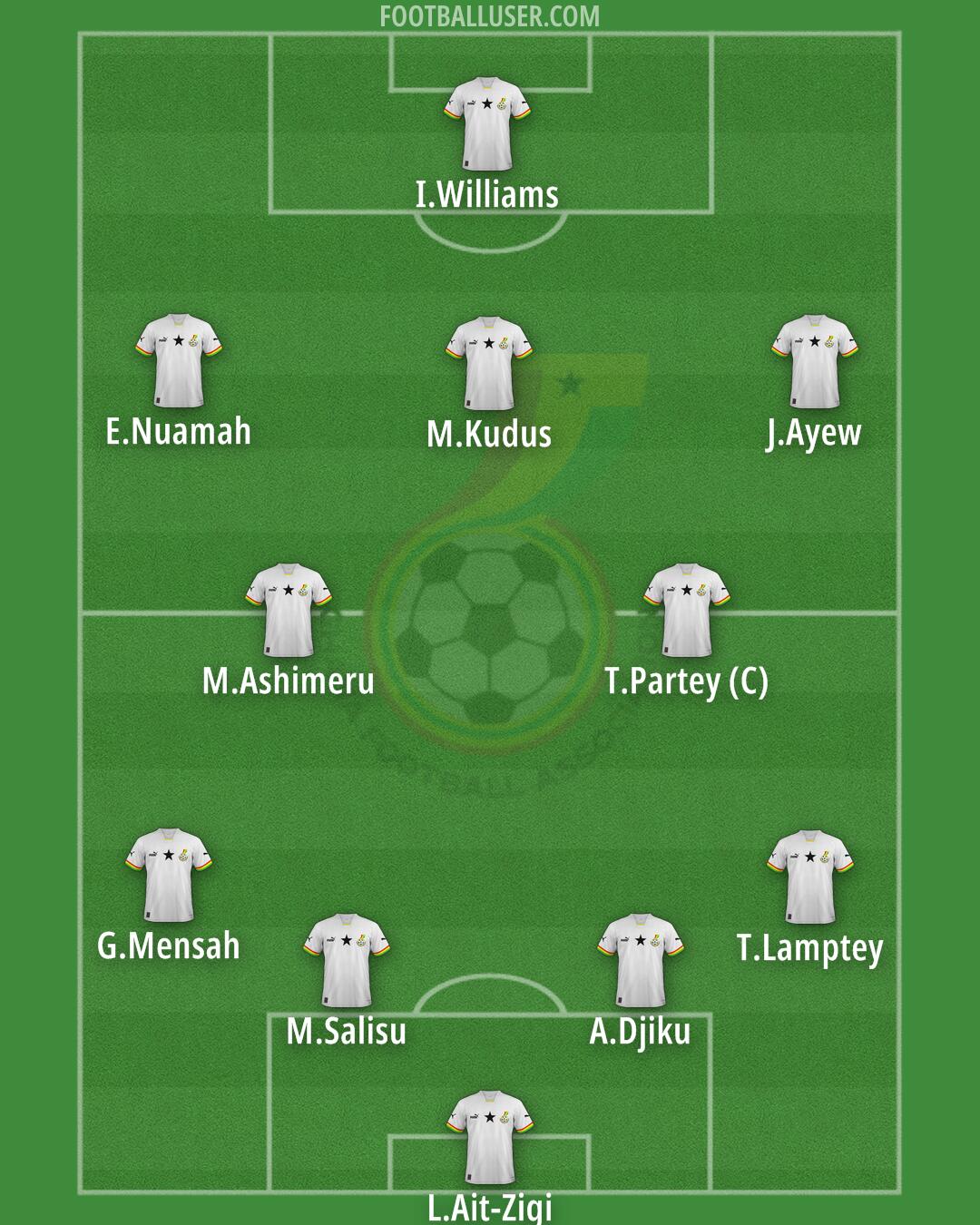

Ghana National Football Team Formation
 October 8, 2024


Starting Lineup
L.Ait-Zigi · M.Salisu · A.Djiku · G.Mensah · T.Lamptey · T.Partey (C) · M.Ashimeru · M.Kudus · E.Nuamah · J.Ayew · I.WilliamsGhana aims to be defensively solid and rely on quick transitions using a 5-4-1 formation. This lineup is built to sit deep and absorb pressure, waiting for the right moment to hit the opposition on the break. By packing the central areas, the Black Stars look to frustrate attackers and remain compact when the ball is lost.
I.Williams starts in goal to organize the defensive unit. The back line functions as a back five, using a narrow defensive block to deny central penetration. T.Partey (C) leads the line as the captain and left centre-back, providing leadership and reading the game to cover space. He works alongside M.Ashimeru at right centre-back and M.Kudus on the left of the central trio to win the second ball. E.Nuamah acts as a right wing back to provide width, while J.Ayew operates as the left wing back to cover the flank and help the transition.
The midfield operates as a flat four to maintain a compact shape. M.Salisu and A.Djiku sit in the center to shield the defence and win duels in the middle of the pitch. They act as the engine, with Salisu often looking to carry the ball forward to connect the lines. On the flanks, G.Mensah and T.Lamptey provide the width in midfield, working to track back and help the wing backs when the team is under pressure. This midfield group aims to compress the space between the lines and deny the opposition time on the ball.
In the attacking phase, L.Ait-Zigi plays as a lone striker. His role is to hold up the ball and wait for support from the midfield and wide players. Ghana builds attacks by looking for runs in behind or using the wing backs to provide width. The team relies on the speed of the wide players to push forward and create numbers in the final third. When the ball is won high up the pitch, the forwards aim to find the feet of the striker or spread wide to stretch the defence.
The tactical advantages of this formation include the ability to defend in a very compact shape that is hard to break down. The presence of five defenders allows Ghana to match numbers against most attacks. Another strength is the potential for speed of transition, using the wide players to move the ball quickly from a deep block to the forward. This creates situations where the opposition can be caught out of position.
This 5-4-1 formation provides a reliable way to defend against teams that dominate possession. It is best suited for matches where Ghana needs to sit deep and play on the counter at pace.