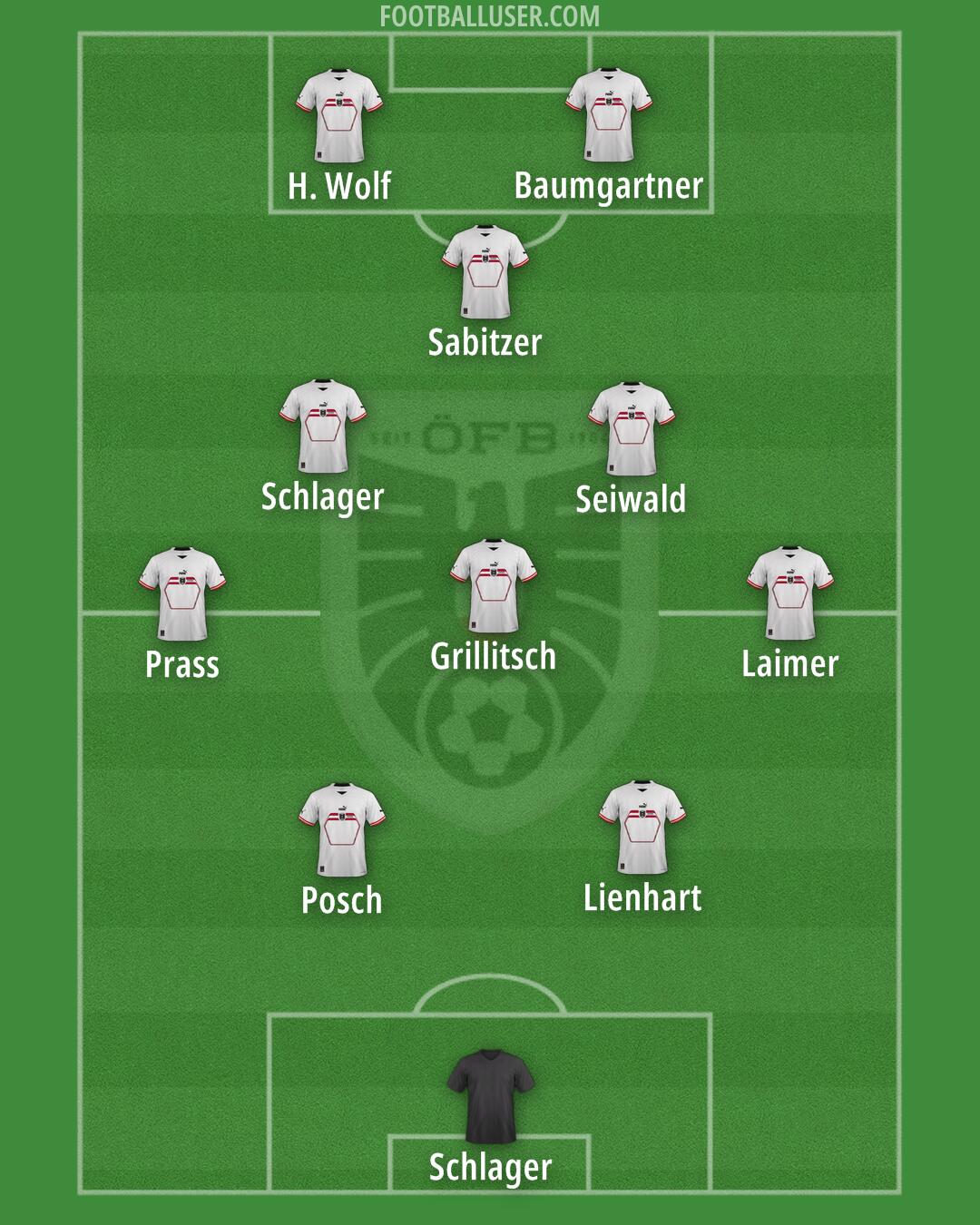

Austria National Football Team Formation
 October 15, 2024


Starting Lineup
Prass · Laimer · Posch · Lienhart · H. Wolf · Grillitsch · Baumgartner · Sabitzer · Schlager · Seiwald · SchlagerAustria aims to dominate the center of the pitch and squeeze the opposition through a highly aggressive high press using a 2-6-2 formation. This lineup is built to overwhelm opponents in the middle third and quickly recover the ball to sustain pressure. The team focuses on verticality and heavy concentration of players in central zones to deny the opposition any time to settle.
Schlager operates between the posts to start moves from the back. Behind a massive midfield block, the defensive unit consists of a two man back line. Posch and Lienhart act as the central defenders, where Lienhart uses his aerial strength to defend long balls and Posch covers the space behind the advancing midfield. These two must stay alert to defend against runners in behind as the team pushes high up the pitch.
The midfield is a crowded engine room designed to control every blade of grass. A deep three man midfield features Prass, Grillitsch, and Laimer who shield the two defenders and win the second ball. Grillitsch provides passing range from deep while Laimer carries the ball forward to link the lines. Ahead of them, the three attacking midfielders consisting of Schlager, Sabitzer, and Seiwald operate in the half spaces. Sabitzer uses his driving runs to break the line, while Schlager and Seiwald press aggressively to win it back high up the pitch.
In the final third, Austria uses two forwards to stretch the defense. H. Wolf works as a pressing centre-forward to pin the last defender, while Baumgartner looks for runs in behind. The team attacks in combinations through the dense midfield, looking to play through the lines with quick passes. When the midfielders move into the box, the forwards hold up the ball to allow late runners to arrive.
A primary strength of this Austria lineup is the immense numerical superiority in midfield which makes it very difficult for opponents to find passing lanes. The coordination of the six players in the middle allows for coordinated waves of pressure that can trap opponents in their own half. This high density also makes the team very hard to play through once the initial press is triggered.
This formation is a high risk, high reward system built for total central dominance. It is best suited for games where Austria can squeeze the space and force the opponent into mistakes through constant pressure.