
Austria National Football Team Formation
 October 29, 2024


Starting Lineup
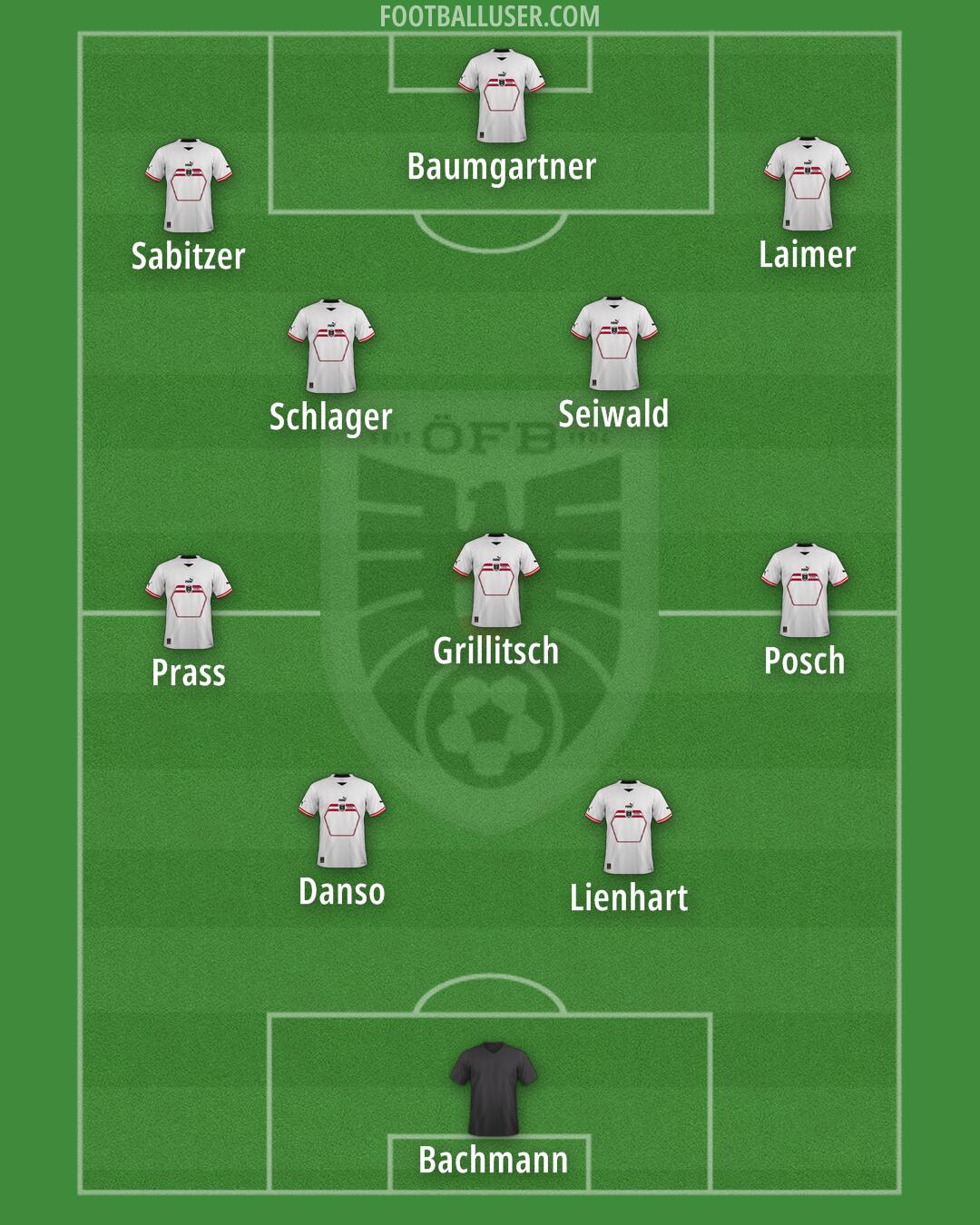
Danso · Lienhart · Prass · Posch · Laimer · Schlager · Sabitzer · Baumgartner · Grillitsch · Seiwald · BachmannAustria focuses on a high press and verticality using a 5-2-3 formation. This lineup is built to win the ball high up the pitch and hit the opposition quickly. The Austrian national team wants to use the intensity of their movement to force mistakes and score from transitions. They aim to progress through the thirds with speed.
Bachmann stays in goal to command the area. The back five consists of Lienhart, Danso, and Grillitsch in the center, with Prass and Posch as the wide players. Lienhart acts as a ball playing defender to start attacks, while Danso uses his aerial strength to win the header in central duels. Grillitsch helps to hold the line when the team pushes up. Prass and Posch act as attacking wing backs to provide width and can carry the ball forward into the final third. The defensive unit works to squeeze the space and prevent the opponent from playing through the lines.
In the middle of the pitch, Schlager and Seiwald form a double pivot. Schlager presses aggressively to win it back high up the pitch, while Seiwald helps to cover the space in front of the defenders and protects the center. This midfield pairing connects the defensive unit to the front three. They work to intercept passes and recycle possession when the initial press is broken. By staying compact, they can quickly shift to cover the width of the pitch.
The attacking front three features Sabitzer, Laimer, and Baumgartner. Sabitzer plays as an inverted winger on the left, using his passing range to find teammates in dangerous areas. Laimer operates on the right and uses his pressing intensity to harass the opposition back line. Baumgartner acts as a lone striker to hold up the ball and lead the attack. The wingers cut inside to create space for Prass and Posch to overlap the winger. This movement creates many chances to hit in behind on the transition and deliver early crosses.
This formation provides great wide overloads because the wing backs push high up the pitch to stretch the defence. Austria can also use its ability to press high in coordinated waves to trap opponents in their own half. The speed of transition is a major advantage when they win the ball. This allows them to move from a mid-block to an attacking state in seconds.
The 5-2-3 formation is built for a heavy pressing game that relies on quick recovery. This formation is best suited for matches against teams that struggle to play short from the back under pressure.