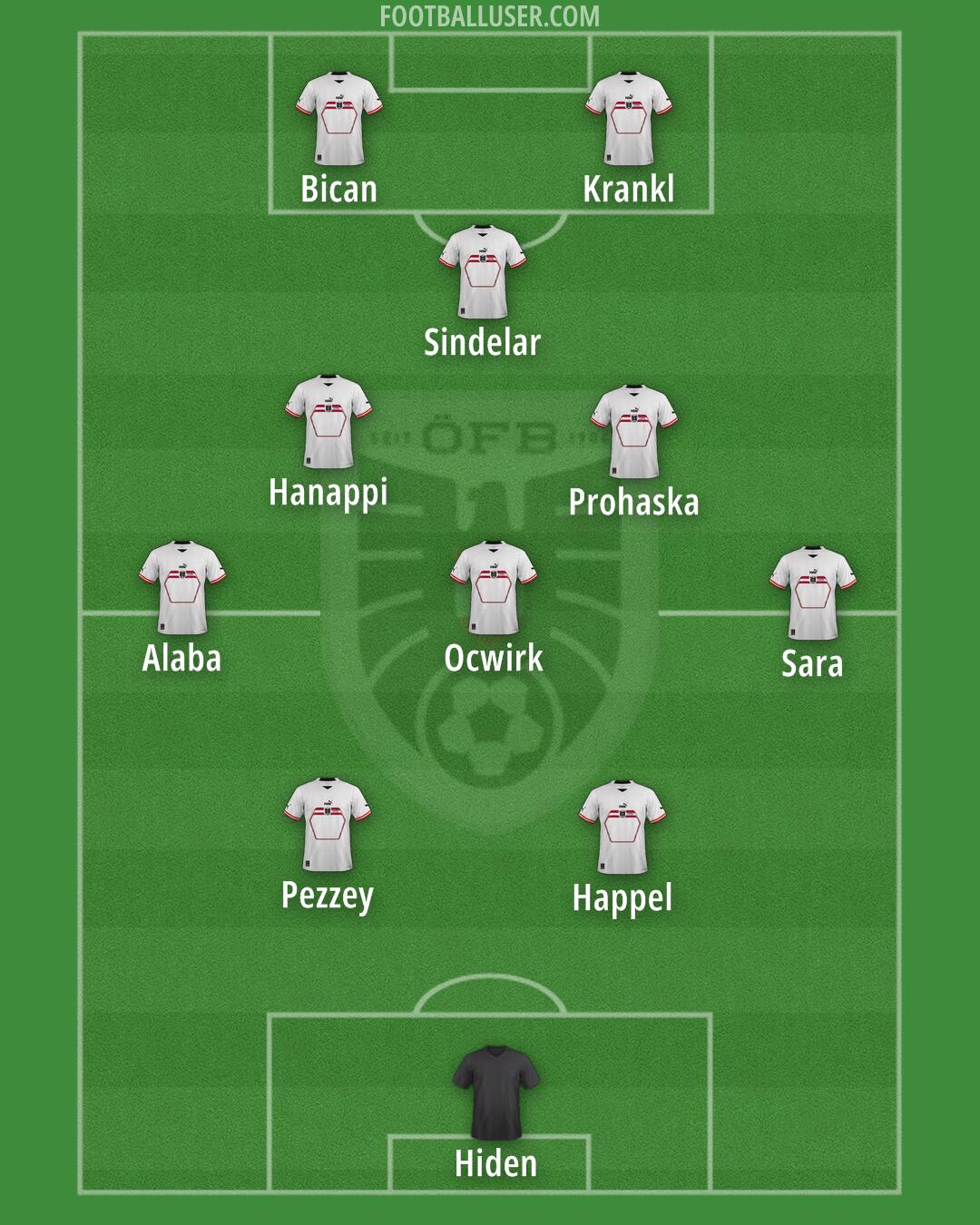

Austria National Football Team Formation
 November 2, 2024


Starting Lineup
Krankl · Bican · Prohaska · Hanappi · Alaba · Pezzey · Happel · Hiden · Sara · Sindelar · OcwirkAustria focuses on controlling the central areas of the pitch through extreme density. They employ a 2-6-2 formation to overwhelm opponents in the middle third. This lineup is built to play a very aggressive game that relies on winning possession quickly and keeping it through a crowded midfield.
Hiden sits in goal to protect the back line. The defense consists of a narrow pair of central defenders, Happel and Pezzey, who must play a very high line. Pezzey and Happel need to be dominant in the air and ready to cover space when the team pushes up. Because the formation only uses two defenders, they must defend zonally and be prepared to win one on one battles if the opposition breaks the lines.
The midfield is the heart of the Austria lineup, featuring six players who cover every zone. A deep trio of Alaba, Ocwirk, and Sara acts as the base to shield the defense and recycle possession. Alaba uses his passing range to find teammates and progress through the thirds. Ocwirk and Sara focus on winning the second ball and sitting in front of the defenders. Ahead of them, Prohaska, Hanappi, and Sindelar operate as attacking midfielders who press aggressively to win the ball high up the pitch. This unit connects the defense to the attack by moving the ball through the lines.
The attack relies on a partnership of two forwards, Krankl and Bican. They work in tandem to stretch the defense, with Krankl often looking to run in behind while Bican works to hold up the ball. The width is provided by the advanced midfielders, where Hanappi and Sindelar can pull wide to create overloads. This allows the team to attack in combinations and use the central presence of the forwards to link up play between the lines.
This formation provides massive numerical superiority in the center of the pitch. By packing the middle, Austria can squeeze the space and deny the turn of opposing players. The ability to press in coordinated waves is a major advantage, as the high density of players makes it difficult for opponents to find an easy pass. Additionally, the team can win the second ball frequently due to the sheer volume of players in the middle third.
The 2-6-2 formation is a bold way to hunt for dominance in the central zones. It is best suited for games where Austria can squeeze the space and force the opponent into a long ball battle.